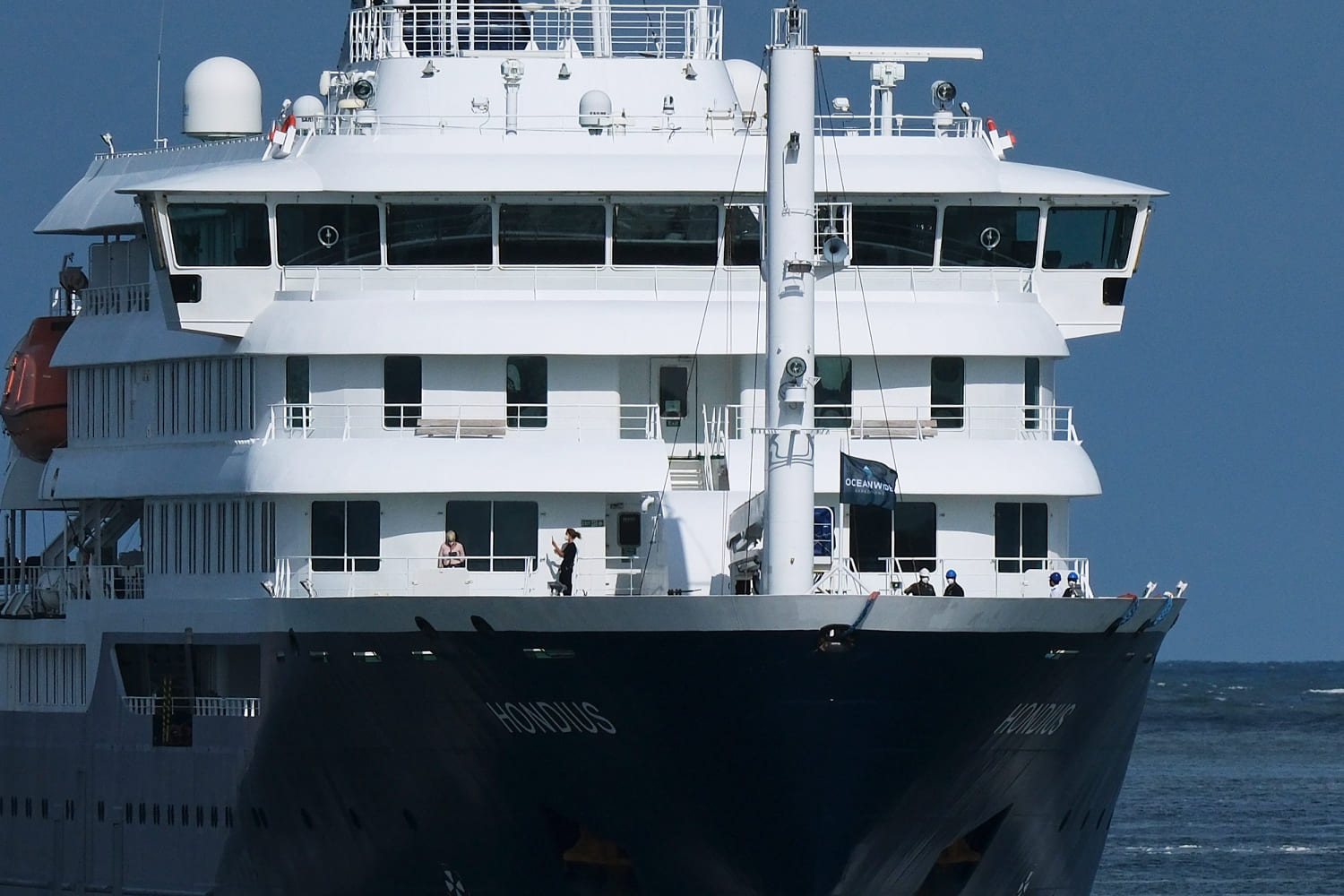
The North Sea does not welcome visitors in the late spring. It tolerates them. Under a bruised, grey sky, the water churns with a heavy, leaden rhythm, throwing salt spray against the hull of a vessel that should have been a floating paradise. Instead, it became a tomb.
When the luxury cruise liner finally crept toward the docks of Rotterdam, there were no cheering crowds. No confetti. The usual steel drums and welcoming banners of a Dutch port were replaced by the flashing amber lights of biohazard vehicles and rows of unmarked white vans. Men and women in thick, pressurized Tyvek suits stood waiting on the concrete pier, looking less like customs officials and more like astronauts stranded on a hostile planet.
For three weeks, this ship was an island of quiet horror.
A standard news wire would tell you the clinical facts. It would state that a cruise ship, carrying hundreds of passengers, arrived in the Netherlands after a deadly outbreak of Hantavirus. It would list the casualty count as a sterile statistic. It might briefly mention the origin of the voyage or the protocol of the Dutch health authorities.
But statistics do not scream in the middle of the night. They do not watch the person they love gasp for air while trapped in a twelve-by-twelve-foot cabin, thousands of miles from land, knowing the very air they share might be a delivery system for a agonizing death.
To understand what happened aboard that ship, you have to look past the official press releases. You have to look at the dust.
The Invisible Intruder
Every vacation begins with an escape. You leave behind the spreadsheets, the unpaid bills, the mundane anxieties of landlocked life. You step onto a vessel designed entirely for comfort, where every surface is polished to a mirror shine.
But luxury is a thin veneer.
Imagine a passenger. Let us call her Elena. She is sixty-two, a retired schoolteacher who saved for four years to afford this itinerary. She sits on her private balcony, watching the coastline recede, feeling a profound sense of safety. The ship is a fortress. It is a self-contained ecosystem of fine dining, crisp linens, and nightly theater.
What Elena does not see—what none of them saw—was the stowaway.
Hantavirus is not like the seasonal flu. It does not wander through a crowd via a casual cough in a crowded buffet line. It is an ancient, patient killer, typically carried in the saliva, urine, and droppings of rodents. In the deep, forgotten underbelly of the ship—perhaps in a cargo hold that sat dormant during a long winter drydock, or within the hidden utility channels behind the pristine drywall of the lower decks—a few field mice had nested weeks before.
The mice leave behind microscopic particles. When a crew member opens an old storage crate, or when the ship’s massive ventilation system shifts its airflow to compensate for a sudden change in climate, that dry, infected dust becomes airborne.
It is invisible. It has no smell.
Elena breathes it in while walking down a dimly lit residential corridor. It takes only a single, deep breath. The viral particles settle into the delicate tissue of her lungs. For the first few days, nothing happens. The incubation period is a cruel trick of nature; it allows the victims to enjoy their dinners, to take excursions in picturesque ports, and to toast to the sunset, completely unaware that a biological countdown has begun inside their chests.
The Shifting Tide
The first sign of trouble was dismissed as sea sickness.
It started with a low, throbbing ache in the joints. Then came the chills. By the fifth night, the ship’s medical bay—a modest clinic designed to handle sprained ankles, sunburns, and the occasional cardiac scare—was overwhelmed.
The transition from a vacation to a crisis happens slowly, then all at once.
The ship's doctor, a seasoned maritime physician used to dispensing motion-sickness patches and antibiotics, realized too late that he was dealing with something catastrophic. Patients weren't just fatigued; they were suffocating. Hantavirus Pulmonary Syndrome attacks the respiratory system with terrifying speed. The capillaries in the lungs begin to leak fluid, effectively drowning the patient from the inside out.
Panic is a heavy fluid. It pours through the corridors of a ship, filling the tight spaces until the air itself feels thick.
The captain made the only call he could: he turned the ship around, heading for the nearest major port with advanced isolation facilities. But a cruise ship at sea cannot simply pull over. It is bound by international maritime law, by weather patterns, and by the terrifying reality that no country wants a plague ship to dock on its shores.
As the vessel steamed toward the Netherlands, ports along the way turned them away. One by one, radio dispatches brought the same cold response: Maintain your course. Do not enter our waters.
Inside the cabins, the atmosphere turned feral. Room service was discontinued. Passengers were ordered to isolate in their quarters. The cheerful announcements from the bridge were replaced by flat, trembling updates from a captain who sounded older by the hour. The sound of the engines became a monotonous, mocking heartbeat.
Consider what happens next: the air conditioning is turned off to prevent the virus from circulating through the central ducts. In the late spring warmth, the cabins become stagnant boxes. The luxury liner is suddenly a floating prison, drifting across a grey sea, carrying a payload of fear.
The Anatomy of the Air We Breathe
We take the mechanics of respiration for granted. We inhale, our diaphragms drop, and oxygen diffuses into our bloodstream. It is an automatic, effortless miracle.
When Hantavirus takes hold, that miracle unravels. The virus targets the endothelial cells that line the blood vessels in the lungs. Instead of a tight, secure barrier that keeps fluids where they belong, the vessels become porous, like cheesecloth.
The medical term is non-cardiogenic pulmonary edema. The human reality is far more brutal. The victim’s chest feels as though it is being compressed by a hydraulic press. Every gasping attempt to pull air into the body only draws more fluid into the air sacs.
Onboard, the medical bay ran out of ventilators within forty-eight hours.
The staff had to make choices that will haunt them for the rest of their lives. They had to decide who received the remaining oxygen tanks and who would be left in their cabins with nothing but a hand-held pulse oximeter and the comfort of a terrified spouse.
The bodies were moved under the cover of darkness. The ship’s cold storage, usually reserved for the vast quantities of meat and produce required to feed thousands of vacationers, was cleared out to make room for a different kind of cargo. The contrast was grotesque: rows of stainless-steel shelves that had held premium cuts of beef just days prior were now occupied by zipped canvas bags.
The Cold Welcome
When the anchor finally dropped in the deep-water port of Rotterdam, the silence aboard the ship was absolute.
The engines died, and with them, the last illusion of momentum. They were no longer traveling anywhere. They had arrived, but there was no sense of arrival. There was only the stark, clinical reality of containment.
The Dutch authorities did not rush aboard with open arms. They approached with the methodical, agonizing slowness of a bomb squad. Every protocol had to be verified. Every airlock had to be tested.
From her cabin window, Elena looked out at the pier. She had survived the infection, though her lungs felt scarred, heavy, and permanently altered. She watched a team of workers erect a temporary plastic tunnel from the ship’s gangway to a fleet of waiting ambulances. It looked like a visual representation of the barrier that now existed between the passengers and the rest of humanity. They were clean, but they were tainted.
The tragedy of the modern world is our belief that we have conquered nature. We build massive steel structures that defy the ocean. We install HEPA filters and satellite navigation systems. We convince ourselves that a ticket bought with a credit card guarantees safe passage through a world we have tamed.
But nature does not recognize our itineraries. It exists in the dark corners, in the dust of a forgotten cargo hold, waiting for the right moment to remind us of our fragility.
The survivors who stepped off that ship onto the cold Dutch concrete did not look like people who had just finished a vacation. They walked with the halting, stunned steps of refugees fleeing a war zone. They looked at the sky, at the solid earth beneath their feet, and at each other, realizing that the longest journeys are not measured in nautical miles, but in the distance between life and death.
The ship sits there still, tied to the pier, a mountain of white steel reflecting the grey sky. The authorities will scrub it. They will spray chemicals through the vents, tear up the carpets, and declare it safe once more. Another crowd of smiling passengers will eventually board, carrying their luggage and their dreams of escape.
But for those who were onboard during those dark weeks on the North Sea, the ship will always be a ghost, haunted by the memory of a breath they took without thinking, and the friends who never got to breathe out.