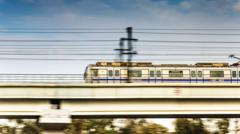
The air inside the coach is unnervingly still. It smells of fresh plastic, industrial-grade floor cleaner, and expensive air conditioning. Outside the window, a sea of rusted corrugated metal roofs and tangled black electrical wires blurs past as the train accelerates. Below, on the jagged arteries of the city’s main road, a thousand motorcycles are locked in a screaming, soot-choked stalemate. From this height, the commuters on the ground look like frantic ants. Up here, in the stainless steel belly of the three-billion-dollar elevated rail, there are only six people.
One is a security guard staring at his own reflection. Two are college students taking selfies. The others are just shadows in a cavernous space designed to hold hundreds.
India is currently gripped by a fever for the future. Over the last decade, the nation has embarked on one of the most ambitious infrastructure projects in human history: building a massive network of urban metro systems across nearly 30 cities. The numbers are staggering. We are talking about an investment that has already crossed the $100 billion mark. Yet, in city after city—from the tech hubs of Hyderabad to the industrial sprawls of Kanpur—the result is often the same. Gleaming stations. High-tech turnstiles. Empty platforms.
It is a paradox that defies logic. India’s cities are the most congested on the planet. Our lungs are filled with the grey grit of construction dust and exhaust. We spend years of our lives trapped in the "first gear" existence of urban traffic. Why, then, are we refusing to board the very thing meant to save us?
The Last Mile Heartbreak
Consider a hypothetical commuter named Arjun. He lives in a modest apartment in the suburbs of a Tier-2 city like Kochi or Jaipur. Arjun works in a glass-and-steel office tower eight miles away. On paper, the new Metro is a miracle for him. It cuts a forty-minute crawl through humid chaos down to a twelve-minute breeze.
But the Metro doesn't start at Arjun’s front door.
To reach the station, Arjun must navigate a half-mile stretch of road that has no sidewalk. He has to dodge open drains and aggressive street dogs while sweating through his professional attire. When he finally reaches the station, he climbs three flights of stairs because the escalator is undergoing "maintenance." After his smooth, twelve-minute ride, he exits at the other end, only to find he is still two miles from his office. There are no rickshaws available. The "feeder buses" promised by the government are nowhere to be seen.
Arjun realizes that while the train is fast, the journey is exhausting. He goes back to his scooter. It’s hot, it’s dangerous, and the fuel is expensive, but it offers something the billion-dollar rail cannot: door-to-door dignity.
This is the "last-mile" problem, and it is the silent killer of Indian mass transit. We have built the spine of a giant but forgotten the feet. In the rush to lay tracks and inaugurate shiny terminals, planners overlooked the gritty reality of how an Indian pedestrian actually moves. Without safe walkways, cycling paths, and reliable shuttle services, a metro station is just an island of efficiency in a sea of dysfunction.
The Mathematics of a Mid-Day Slump
The financial weight of these empty cars is starting to pull. Most of India’s metro systems are currently operating at less than 30% of their projected ridership. In some cities, that number drops to a haunting 5%.
Standard economic theory suggests that if you build it, they will come. But infrastructure isn't just about supply; it’s about the brutal calculus of the daily wage. For a significant portion of India’s working class, the Metro is a luxury. While a ticket might only cost thirty rupees, that is double or triple the price of a cramped, sweaty public bus. When you multiply that by twenty-six working days a month, the "future of transit" looks like a budget deficit for a family trying to keep the lights on.
We are witnessing a mismatch between engineering ambition and sociological reality. The planners looked at London, Singapore, and Paris. They saw sleek lines on a map. They didn't look at the guy selling tea on the corner or the woman carrying a heavy bag of produce to the market. They built a system for a middle class that is still largely tethered to their cars as status symbols, and they priced out the working class who actually need the mobility.
A Forest of Concrete
There is a psychological toll to this kind of growth. If you drive through cities like Nagpur or Lucknow, you see the massive concrete pillars of the Metro rising like the legs of a prehistoric beast. They dominate the skyline, casting long shadows over centuries-old neighborhoods.
To build these tracks, thousands of trees were felled. Local shops that stood for generations were demolished to make room for station entrances. The promise was that the sacrifice would be worth it—that the city would finally breathe. Instead, the pillars have become a permanent part of the landscape, while the congestion on the roads beneath them remains unchanged.
The silence on the platforms is the sound of a broken promise.
It’s not that the technology is flawed. The trains themselves are marvels of modern engineering. They are automated, energy-efficient, and impeccably clean. But a train is not a solution; it is a tool. And a tool is only useful if people can reach it, afford it, and rely on it to get where they are actually going.
The Illusion of Progress
We have fallen in love with the "ribbon-cutting" ceremony. Politicians love the Metro because it is visible. You can see it from miles away. You can put it on a poster. You can use it to claim that a city has become "world-class." It is much harder to campaign on the promise of "better-paved sidewalks" or "reorganized bus routes."
But true progress is often invisible. It’s the seamless transition from a bus to a train. It’s the ability for a woman to walk to a station at 9:00 PM and feel safe because the streetlights actually work. It’s the realization that a city's health isn't measured by how many billions it spends, but by how many people it moves.
Currently, the debt is mounting. Metro authorities are scrambling to find "non-fare box" revenue. This is a fancy way of saying they are turning stations into shopping malls and wedding venues because the commuters aren't paying the bills. When a transit system has to rely on selling advertising space for luxury watches to survive, it has lost its way.
The Ghost in the Machine
Late at night, the empty trains keep running. It’s a requirement of the system. They glide through the dark, their interior lights glowing, passing over the heads of the thousands of people sleeping on the sidewalks below.
The tragedy isn't just the wasted money. It’s the wasted opportunity. India has the chance to redefine how a developing nation moves. We have the digital infrastructure to create a perfectly integrated mesh of shared mobility. We have the sheer human density to make any transit system profitable.
But as long as we treat the Metro as a trophy rather than a utility, the cars will remain empty. We will continue to build these magnificent, silent monuments to a future that hasn't quite arrived, while the rest of the country remains stuck in second gear, looking up at the tracks and wondering when the next train is coming, and if it will ever be for them.
The ghost trains keep humming. The city keeps gasping for air. The gap between the two is a bridge that no amount of concrete can fix.