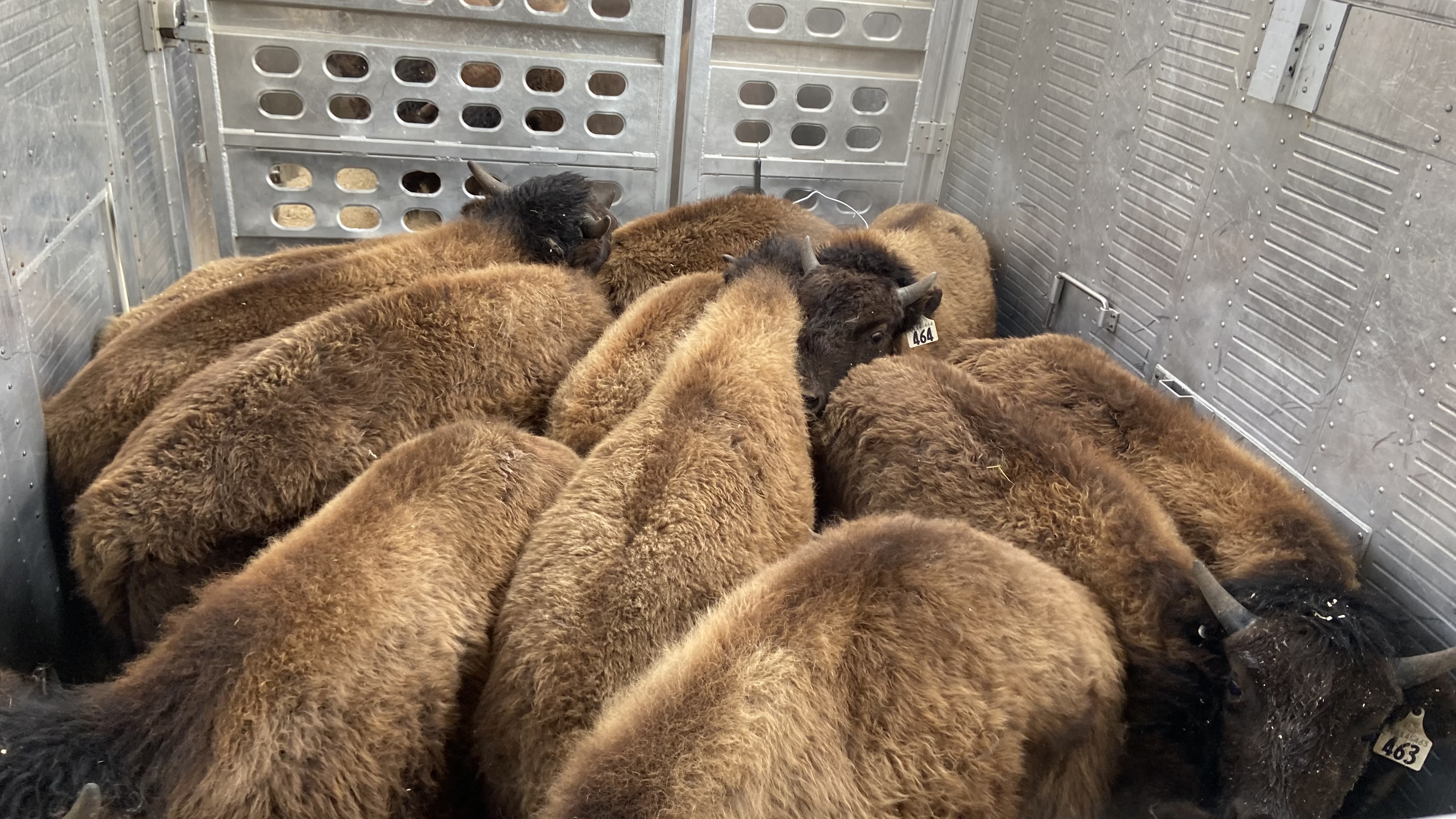
The air inside the steel crate is thick with the scent of dried grass and the heavy, humid heat of forty-four living prehistoric monuments. Outside, the Alberta wind bites at the edges of Elk Island National Park, but inside this pressurized vessel, the breath of the wood bison creates a microclimate of its own. These are not just animals. They are one thousand pounds of muscle, shaggy fur, and evolutionary stubbornness, descendants of a lineage that very nearly blinked out of existence.
Now, they are airborne.
Most travelers worry about their carry-on weight or the legroom in coach. But when your passengers are wood bison being deported for their own good, the logistics move from the mundane to the miraculous. These forty-four individuals are currently suspended thousands of feet above the earth, traveling from the rolling hills of central Alberta to the rugged expanse of Alaska’s Innoko River. It is a journey of 2,500 kilometers. It is also a journey across a century of near-extinction.
The Weight of a Ghost
To understand why we are flying cattle-shaped behemoths across international borders, you have to look at the silence they left behind. Imagine standing on the edge of the Alaskan interior a hundred years ago. The land looks right. The grass is there. The water flows. But the heartbeat is missing. For decades, the wood bison was a ghost in Alaska, a memory held only by Indigenous elders and the fossil record.
Overhunting and the creeping fingers of habitat loss did what the Ice Age couldn't: they cleared the field. By the early 20th century, the wood bison was functionally a myth. We almost lost them. If not for a tiny, remnant herd discovered in the deep pockets of the Canadian wild, the story would have ended with a taxidermy mount and a sad footnote in a biology textbook.
The recovery of the species is a slow-motion victory. It is measured not in months, but in decades. Elk Island National Park has acted as a biological vault, a high-security fortress where the genetics of the wood bison are kept pure and the population is nurtured. But a vault is no place for a giant. Bison are meant to move. They are meant to shape the earth with their hooves and graze the meadows into health.
The Metal Ark
Moving forty-four bison isn't as simple as herding them onto a ramp. It is a symphony of stress management and mechanical engineering. Each animal must be tested, quarantined, and monitored. You cannot explain to a two-year-old bull that he is part of a global conservation strategy. To him, the world has suddenly become a series of narrow chutes and the deafening roar of turboprop engines.
The "human element" here is often a tired veterinarian with coffee-stained clothes, or a park ranger who has spent three years watching these specific yearlings grow. There is a specific kind of quiet tension that hangs over the loading docks. If one animal panics, they all panic. If the temperature in the hold spikes, the mission fails.
Consider the cargo pilot. Usually, the job is crates of electronics or seasonal fruit. Today, the pilot feels the shift in the plane’s center of gravity every time a dozen bison decide to shift their weight simultaneously. It is a living, breathing, shifting cargo that demands a delicate hand on the yolk. This is not a delivery; it is a transplant. We are suturing a piece of the ecosystem back onto a wound that has been open for a century.
Why Alaska Matters
You might ask why we bother. Why not keep them in Alberta, where they are safe and fed?
The answer lies in the concept of "genetic hedging." If a catastrophic disease hits Elk Island, or if a massive fire sweeps through the park, the entire species faces a bottleneck. By spreading the population—sending forty-four here, fifty there—we are creating backups. We are installing "restore points" across the North American continent.
But more than that, Alaska needs them. The Innoko River region is a vast, shimmering landscape of sedge meadows. Without the bison, these meadows grow rank and stagnant. When the bison return, they act as ecological architects. They stomp down the snow, allowing the frost to penetrate deeper and keep the permafrost stable. They graze the old growth, making room for new, nutrient-dense shoots that feed the birds, the insects, and the smaller mammals.
They are the janitors, the gardeners, and the foundation stones of the north.
The Long Walk Home
When the plane finally touches down and the crates are moved to the barges that will take them the final leg of the journey, the atmosphere changes. The mechanical roar fades, replaced by the lapping water of the Alaskan interior.
The moment of release is never like the movies. There is no triumphant music. Usually, there is a long, hesitant pause. The door opens, and the bison stares out at a world that looks familiar but feels strange. They sniff the air—air that carries the scent of Alaskan willow and ancient silt.
Then, the first hoof hits the ground.
It is a heavy, muffled thud. It is the sound of a debt being paid. One by one, the forty-four move out into the green. They don’t look back at the rangers or the crates. They don't know about the international treaties or the decades of bureaucratic maneuvering it took to get them here. They only know the grass.
We spend so much of our time breaking things. We pave over the meadows and we silence the forests, often without even realizing what we’ve lost until the silence becomes deafening. This move—this expensive, complicated, exhausting transport of forty-four heavy hearts—is a rare moment where we are putting the pieces back together.
As the herd disappears into the brush, blending into the shadows of the trees, the landscape finally looks complete. The heartbeat has returned. The ghosts have taken on flesh and bone, and for the first time in a long time, the wilderness is no longer holding its breath.
The silence of the Innoko is finally broken by the low, guttural grunt of a bull claiming his new home.


