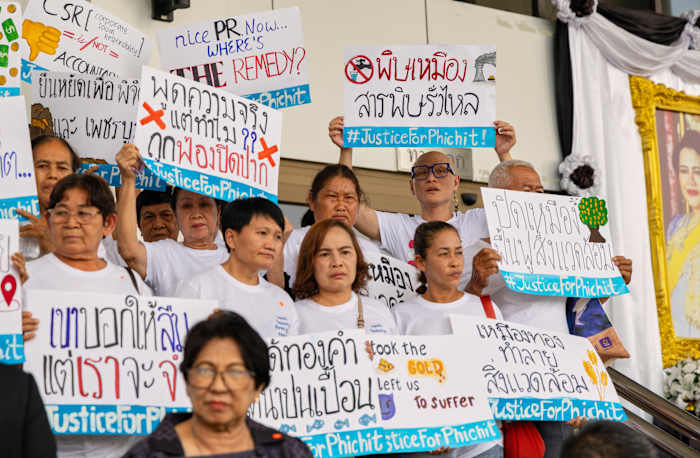
The headlines are predictable. A decade of litigation, a "historic" court victory for villagers, and a gold mining operator finally held liable for heavy metal contamination in Thailand. The public celebrates. Activists take a victory lap. The media paints it as a David vs. Goliath triumph where the legal system finally functioned.
They are all wrong.
What we just witnessed wasn't a win for the environment or the local community. It was a masterclass in how corporations use the legal system as a low-interest credit line for environmental destruction. When a court takes ten years to decide that poisoning a water table is "wrong," the resulting fine isn't a penalty. It is a late fee. And in the world of high-stakes extraction, late fees are just part of the cost of doing business—often cheaper than the cost of actually following the law in the first place.
The Decade-Long Discount Rate
Every day that a mining company spends in court fighting a liability claim is a day they aren't paying for remediation. In the financial world, we call this the time value of money.
Imagine a scenario where a mining operation causes $50 million in ecological damage today. If they spend $5 million on elite legal counsel to drag the case out for twelve years, and the court eventually orders them to pay $60 million, the company has actually won. Why? Because $50 million invested in almost any capital market over a decade will yield far more than the $10 million "penalty" added by the court.
By the time the gavel drops, the original NPV (Net Present Value) of that liability has shriveled. The "victory" for the villagers is paid out in currency that has lost 30% of its purchasing power to inflation, while the company has already extracted, processed, and sold the gold that caused the mess.
I have sat in boardrooms where environmental risk is quantified not as a moral obligation, but as a manageable line item. If the probability of a fine is 20% and the payout is ten years away, the "Expected Value" of that disaster is effectively zero on this year’s balance sheet. This isn't a failure of the mining company; it is a feature of a legal system that values procedural exhaustion over immediate restitution.
The Toxic Runoff Fallacy
The "lazy consensus" in environmental reporting suggests that "toxic runoff" is an accidental byproduct of mining. It isn't. It is an engineering choice.
In modern gold mining, specifically cyanide heap leaching or open-pit operations, managing tailings is the single most expensive recurring cost. To truly isolate heavy metals like cadmium, arsenic, and manganese from the local water table requires a level of containment that eats into margins.
When a company "allows" runoff, they are essentially externalizing their production costs onto the local population. The villagers’ bloodstreams become the free storage facility for the mine's waste. When the court finally rules, it is merely asking the company to pay a fraction of the "rent" they owed for using those bodies as a landfill for the last decade.
Why "Liable" is a Cowardly Word
The Thai court held the operator "liable." In the jargon of corporate law, liability is a sterile, bloodless term. It suggests a balance sheet correction.
What we should be talking about is Environmental Tort Stripping. This is the process where a parent company creates a localized subsidiary to hold the mining license. If the environmental damage becomes too great, the subsidiary declares bankruptcy, leaving the "liability" with a shell company that has no assets. The parent company, meanwhile, has already moved the gold bars to a vault in Perth or Zurich.
Unless a court pierces the corporate veil and holds the individual directors personally and criminally responsible, "liability" is just a ghost haunting an empty office.
The Myth of "Restoration"
The court orders usually include a mandate to "restore the environment to its original state." This is a scientific impossibility, and everyone in the industry knows it.
Once heavy metals enter a karst groundwater system—common in Southeast Asia—there is no "reset" button. You cannot un-ring the bell of a poisoned aquifer.
- Heavy Metal Persistence: Arsenic and cadmium don't biodegrade. They bioaccumulate.
- Soil Chemistry: The pH shifts caused by acid mine drainage can alter soil fertility for centuries, not years.
- Human Health: You cannot "restore" a child’s neurological development once it has been stunted by lead or manganese exposure.
By framing the remedy as "restoration," the legal system gives the company an out. They can spend a few million on "remediation" projects—planting some trees, building a concrete cap—that look good in an annual CSR (Corporate Social Responsibility) report but do nothing to fix the underlying chemical catastrophe.
The Investor’s Blind Spot
If you think this is just an "overseas" problem or a "developing nation" issue, you haven't looked at your own 401(k). Western institutional investors pour billions into these operators because they provide high yields. Those yields are high specifically because the "cost of risk" is being suppressed by a slow-moving legal apparatus.
The "ESG" (Environmental, Social, and Governance) scores that many funds brag about are often based on self-reported data. A company can have a "Gold Standard" ESG rating right up until the day their tailing dam collapses. Why? Because the metrics focus on "policies" rather than "outcomes." Having a "Waste Management Policy" earns you points; actually keeping the waste out of the river is apparently optional until a judge says otherwise ten years later.
Stop Suing, Start Seizing
If we actually wanted to stop toxic runoff, the legal strategy would look entirely different. The current "sue and wait" model is a gift to the polluter.
Instead of decades of litigation, the standard should be Immediate Asset Freezes. The moment heavy metal contamination is verified by a third-party lab, the mine’s revenue should be diverted into an escrow account. Not in ten years. Not after the third appeal. Now.
If the company wants their revenue back, the burden of proof should be on them to show the water is clean. Flip the script. Currently, the villagers—who have the least resources—carry the "burden of proof" to show they were poisoned. They have to pay for the blood tests, the soil samples, and the high-priced lawyers to argue against a phalanx of corporate scientists.
The Harsh Reality of "Winning"
The villagers in this Thai case will get a payout. It will be a life-changing amount of money for some, and a drop in the bucket for others. But they will still be living on poisoned land. They will still be drinking bottled water because their wells are silent killers.
The company will write a check. Their stock price might dip for a day, then recover as the "uncertainty" of the court case is finally removed. The "liability" is settled. The "toxic runoff" is now a closed file.
This isn't justice. It’s a liquidation sale on the environment.
The industry insider knows the truth: as long as the fine is less than the profit, the runoff will continue. The only way to change the behavior is to make the cost of the "accident" higher than the value of the mine. Until we start seizing the gold itself, we are just haggling over the price of the poison.
Stop celebrating "liable" verdicts. Start demanding the keys to the vault.


