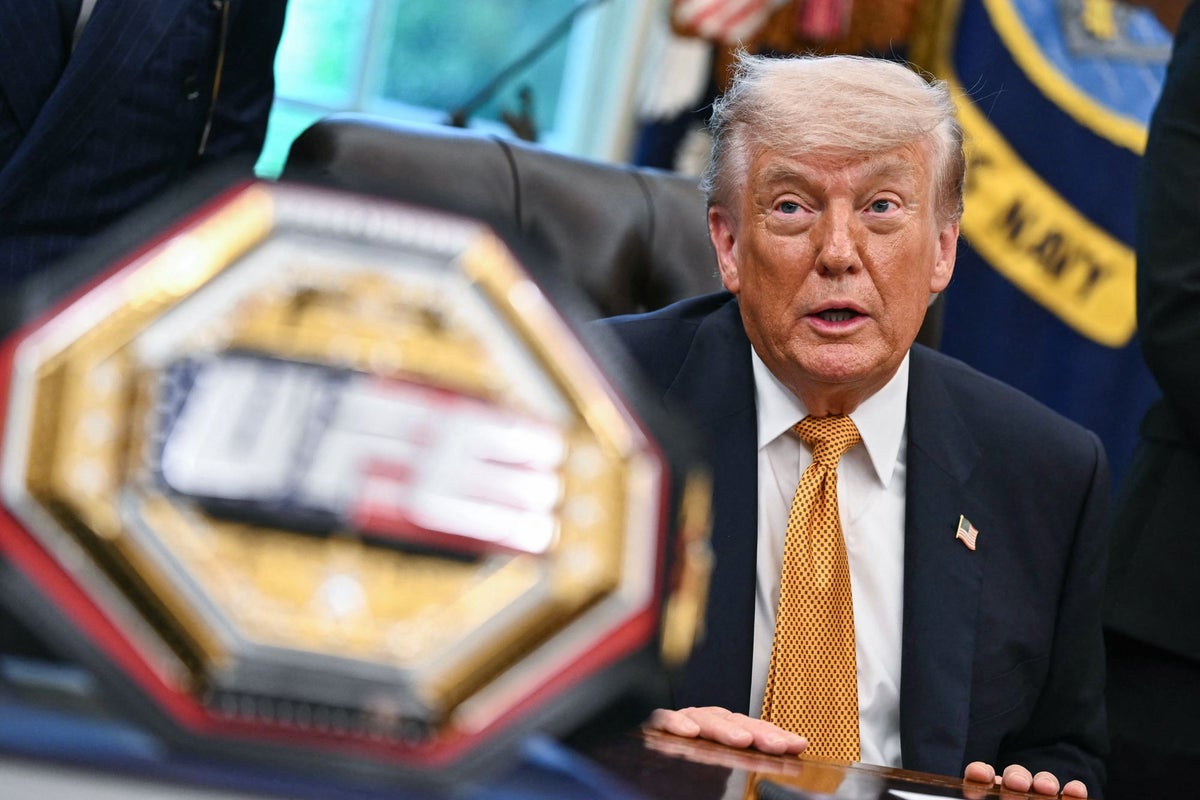
The air inside the arena doesn't smell like politics. It smells of expensive cologne, salt-crusted canvas, and the sharp, metallic tang of adrenaline. Under the bright lights of the UFC Octagon, two athletes are preparing to dismantle one another for the entertainment of the masses. But if you shift your gaze away from the sweat and the sprawling grapplers, toward the front-row seats where the light hits the floor, you see a different kind of combat.
This is the VIP section of a Trump-era sporting event, a place where the barrier to entry isn't just who you know, but exactly how many zeros sit behind your name in a wire transfer.
Recent reports have pulled back the curtain on a staggering reality: the price of admission for a seat at the White House-adjacent UFC fights has reached the million-dollar mark. This isn't just a ticket. It’s a buy-in. It is the physical manifestation of a new era where the worlds of bone-crunching sports and high-stakes governance don't just collide—they merge into a single, high-octane gala.
The Price of the Inner Circle
Consider a hypothetical donor named Arthur. Arthur owns a mid-sized logistics firm and has spent years writing $5,000 checks to local candidates. He gets the occasional thank-you note. Maybe a signed photo. But Arthur wants more. He wants to breathe the same air as the people who move the needles of global trade. He wants to be in the room where the "real" talk happens, away from the sterile hallways of D.G. or the stiff formalities of a rubber-chicken dinner.
To get that access, Arthur is told the price is $1 million.
For that price, Arthur isn't just watching a flyweight title defense. He is purchasing a package that reportedly includes prime seating, high-level hospitality, and—most importantly—proximity to the President’s inner circle. It is a fundraising strategy that treats a political movement like a premium lifestyle brand.
The logic is simple. Brutal. Effective.
Why spend six months chasing a thousand donors for $1,000 each when you can find one person willing to drop seven figures for a night of blood and glory? The UFC, under the leadership of Dana White, has become the preferred staging ground for this brand of populist-elitist fusion. White and Donald Trump share a history that stretches back to the early 2000s when Trump hosted UFC events at his Atlantic City properties when no one else would touch the "human cockfighting" labels the sport then carried.
That loyalty has blossomed into a political goldmine.
The Invisible Stakes of a Floor Seat
When you see a donor sitting three feet away from the cage, you aren't looking at a sports fan. You are looking at a walking investment.
The money flowing into these events—specifically through PACs and joint fundraising committees—serves a dual purpose. On the surface, it funds the gargantuan machinery of a presidential campaign: the TV ads in Pennsylvania, the ground game in Arizona, the digital blitz. But beneath the surface, it buys something far more valuable than advertising. It buys the "huddle."
In the traditional political world, access is often hidden. It happens in smoky backrooms or on private jets. But the UFC model brings it into the neon light. It turns the act of political contribution into a status symbol. When a donor drops $1 million for a fight night, they aren't just supporting a candidate; they are announcing to every other titan in the room that they have arrived.
It is the ultimate "flex" in a culture that prizes strength and wealth above all else.
However, this creates a strange friction. The UFC prides itself on being the sport of the everyman—the blue-collar worker who appreciates the grit of a fighter who came from nothing. Yet, the seats closest to that grit are now reserved for the ultra-wealthy. The guy in the nosebleeds paid $200 to see his hero. The guy at cageside paid $1,000,000 to be seen by the leader of the free world.
The irony is thick enough to choke on.
Why the Million-Dollar Ticket Works
We often wonder why people pay these sums. Is a conversation with a politician truly worth the price of a suburban mansion?
To understand the motivation, you have to look at the psychology of the "High Roller." In business, a million dollars is often seen as an acquisition cost. If Arthur, our hypothetical logistics mogul, spends that million to sit next to a key policy advisor or a sympathetic Senator, he isn't "donating." He is investing in a future where his business interests might find a more favorable ear.
It is a shortcut. A way to bypass the bureaucracy of the American system and go straight to the source.
- Proximity equals influence.
- Visibility equals relevance.
- Participation equals power.
The UFC environment provides the perfect cover for this. It’s loud. It’s chaotic. It’s masculine. It’s an atmosphere where formal rules feel like they belong to a different planet. In the middle of a roaring crowd, a five-minute conversation about trade tariffs or tax breaks doesn't feel like lobbying. It feels like two guys talking shop at a sporting event.
That’s the genius of the play. It de-sanitizes politics and replaces it with something raw.
The Cultural Shift
This isn't just about one man or one party. It represents a fundamental shift in how power is brokered in the United States. We are moving away from the era of the "Policy Paper" and into the era of the "Spectacle."
In the past, a million-dollar donor might expect a private dinner at a historic estate. Today, they want to be part of the show. They want the lights, the cameras, and the association with the "warrior spirit" that the UFC embodies. It allows the donor to feel like a fighter, even if the only thing they’ve ever wrestled with is a balance sheet.
But what does this mean for the person watching at home?
It creates a sense that the government is an exclusive club with a very high membership fee. When the price of "entry" is a million dollars, the average voter begins to feel like a spectator in their own democracy. They are watching the fight from the couch, while the future of their country is being discussed by people who paid more for a seat than the spectator will earn in a decade.
The stakes are invisible, but they are heavy.
Every time a donor shakes a hand at cageside, a connection is forged. Those connections turn into phone calls. Those phone calls turn into meetings. Those meetings turn into the laws that govern the rest of us.
The million-dollar ticket isn't just about the fight in the cage. It’s about the fight for the soul of how we access our leaders.
The Final Round
As the main event concludes and the crowd pours out into the night, the donors retreat to their waiting SUVs. The fighters are covered in bruises, their purses already being calculated by their managers. The fans are heading to the exits, checking their bank accounts to see if they can afford a souvenir t-shirt.
But the million-dollar donors? They leave with something else.
They leave with the memory of a whisper in an ear. They leave with a selfie that will sit on an office desk, signaling to every client and competitor that they are "in." They leave with the quiet satisfaction of knowing that while thousands of people watched the fight, only a handful of them were actually playing the game.
The cage is cleared. The lights go down. The canvas is scrubbed clean of the blood. But the deals made in the shadow of the Octagon remain, hardening into the reality of a world where the best seat in the house is the one that most of us can't even dream of buying.
The sport is real. The fighters are real. But the most important struggle isn't happening between the two people in gloves. It’s happening in the seats, where the currency is access and the price is everything you’ve got.