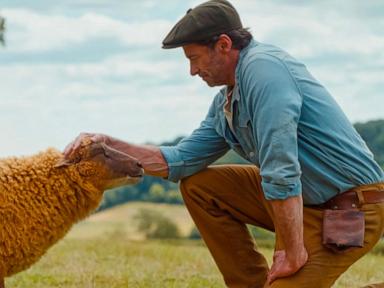
The rain in the English countryside doesn’t just fall; it possesses a certain weight, a damp persistence that seeps into the bones of the locals and the coats of their livestock. Somewhere in the rolling, verdant hills of a fictional village, a flock of sheep is staring at a crime scene. They aren't just witnesses. They are the detectives.
It sounds like the fever dream of a children's book author or perhaps a desperate pitch in a high-stakes Hollywood boardroom. But The Sheep Detectives is something far more potent. It is a cinematic reminder that we have spent the last decade drowning in a sea of gritty reboots, nihilistic anti-heroes, and "prestige" dramas that leave us feeling emotionally hollowed out. We have forgotten how to be delighted. Recently making headlines lately: Why The Jackson Poetry Prize Judges Are Wrong About AI And The Human Soul.
Consider the typical modern viewer: tired, scrolling through a digital library of a thousand titles, most of them featuring explosions or detectives with tragic backstories and a penchant for expensive scotch. We are over-stimulated and under-nourished. Then comes a story about ruminants with a keen eye for justice.
The View from the Pasture
At the center of this narrative is not a grizzled police captain, but a collective consciousness. Imagine, if you will, a border collie named Hamish. In the eyes of the human world, Hamish is a loyal worker, a tool of the trade. But in the secret, internal world of this film, Hamish is a weary mediator, the only bridge between the chaotic whims of "Two-Legs" and the surprisingly sharp intellect of the flock. Additional insights on this are detailed by Deadline.
The sheep do not think like we do. They do not care about motives or inheritance taxes. They care about the rhythm of the day, the scent of the approaching storm, and the sudden, jarring absence of the shepherd. When the village's beloved, if eccentric, caretaker is found dead, the authorities see an accident. The sheep see a shadow that didn't belong.
This is where the human element takes hold. We often look at nature—and the animals within it—as a background texture to our own dramas. We assume we are the only ones paying attention. The Sheep Detectives flips the lens. It suggests that while we are busy looking at our phones or nursing our petty grievances, the world around us is watching, judging, and waiting for us to catch up.
A Cast of Unlikely Savants
The film succeeds because it treats its starry cast not as mere voice actors, but as souls inhabiting a different frequency. When you hear the gravelly, seasoned tones of a veteran A-lister coming out of a weathered ewe, it shouldn't work. It should be a gimmick. Instead, it creates a jarring, beautiful empathy.
There is a specific kind of magic in seeing a high-stakes "whodunnit" play out through the eyes of the overlooked. It mirrors our own lives. How many times have you sat in a meeting or a family dinner, seeing exactly what was wrong, but lacking the "voice" to change the outcome? The sheep are us. They are the observers who see the truth but are ignored by the people in charge.
The Mechanics of the Mystery
The plot doesn't cheat. It follows the classic beats of a locked-room mystery, but the clues are sensory.
- A specific brand of tobacco lingering on a gate.
- The metallic tang of a tool that shouldn't be out in the rain.
- The vibration of a car engine that doesn't match the local postman's.
These aren't the high-tech forensic breakthroughs of a CSI episode. They are the primal, basic observations of creatures tuned into their environment. The film challenges the audience to sharpen their own senses. It asks us to look at our own "pastures" and notice what is out of place.
Why We Crave the Gentle Mystery
There is a reason the "cozy mystery" genre is experiencing a massive resurgence. Life is currently loud. It is unpredictable. The stakes in our real-world news cycles are often existential. When we sit down to watch a movie, we don't always want to be reminded of the crumbling of institutions or the heat death of the universe.
Sometimes, we need the stakes to be contained. We need to believe that even in a small village, justice matters. We need to know that if someone is kind to animals, that kindness leaves a mark.
The "family-friendly" label is often used as a polite way of saying "shallow." This is a mistake. Truly family-friendly content is the hardest to create because it must be honest enough for adults and wonder-filled enough for children. It requires a balance of light and shadow. The Sheep Detectives understands that children are aware of death and loss; they just need a way to process it that doesn't involve cynicism.
The Invisible Stakes
Beneath the humor and the woolly hijinks, there is a subtext about the disappearance of the rural way of life. The village is under pressure. Developers are circling. The old ways are being mocked by a younger, faster generation that doesn't understand why you would spend forty years talking to sheep.
The death of the shepherd is the death of a connection to the land. If the sheep can’t solve the mystery, they won’t just lose a friend; they will lose their home. They will be "liquidated," a clinical term for a brutal reality. Suddenly, the goofy detective story has teeth. The stakes are a heart beating against a cold, corporate future.
The Texture of the Story
The cinematography avoids the bright, saturated colors of most modern comedies. Instead, it leans into the mossy greens, the slate greys, and the warm, golden light of a kitchen window at night. You can almost smell the wet wool and the woodsmoke. This sensory immersion is vital. It grounds the absurdity of the premise in a reality that feels tactile and true.
The pacing is deliberate. It doesn't rush to the next explosion. It allows the characters to breathe, to chew on the scenery (sometimes literally), and to let the mystery settle. In a world of three-second TikTok clips, there is something rebellious about a movie that asks you to sit and watch a flock of sheep think.
The Final Reveal
In the climax, there is no high-speed chase. There are no guns. There is only a quiet, devastating confrontation that relies on the killer’s own arrogance. They assume the sheep are just "meat and wool." They speak their secrets aloud because they believe no one is listening.
The moment the truth comes out is not a shout, but a silence. It is the silence of a village realizing that they have been looking in the wrong direction all along.
We go to the movies to see ourselves. Usually, we want to see ourselves as the hero, the lover, or the adventurer. But there is a profound relief in seeing ourselves as the sheep—part of a community, observant, resilient, and capable of extraordinary things when we simply pay attention to one another.
The film leaves you with a singular, lingering thought. Tomorrow morning, when you walk out your door, you might look at the birds on the wire or the dog across the street with a slight, knowing smile. You might wonder what they’ve seen. You might even start paying attention to the shadows yourself.
The sheep are watching. And they’ve already figured it out.