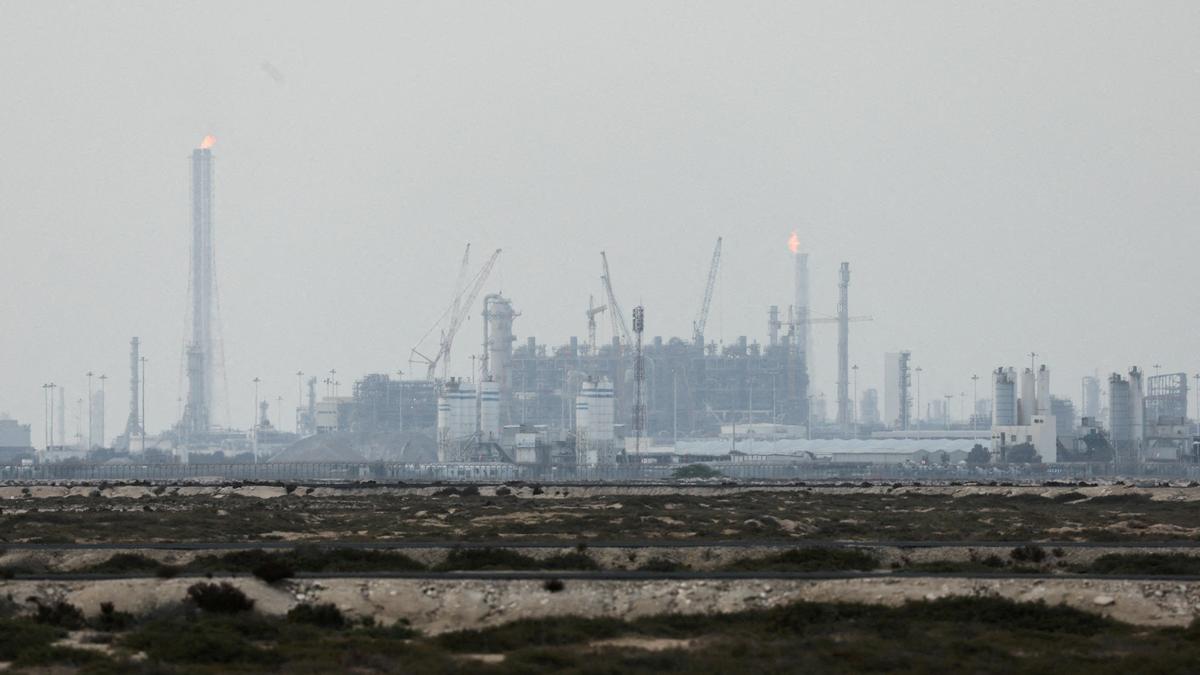
The global energy market is currently reacting to a series of sophisticated strikes on critical infrastructure in the Persian Gulf. Crude prices spiked immediately following reports of damage to processing plants and storage units, but the numbers on the ticker tell only half the story. While initial reports focus on the immediate $3 to $5 jump in Brent crude, the underlying reality is far more concerning for the global economy. This isn't just a temporary supply hiccup. It is a calculated demonstration of how easily the world’s most vital energy arteries can be constricted by low-cost, high-impact asymmetric warfare.
Traders are scrambling to price in a "risk premium" that had largely gone dormant over the last eighteen months. However, the standard market reaction—buying the news and waiting for a correction—ignores the technical vulnerability of these specific sites. When a refinery or a stabilization plant is hit, you don't just flip a switch to bring it back online. We are looking at a potential deficit of several million barrels per day that cannot be easily offset by American shale or strategic reserves.
The Fragility of the Stabilization Loop
Most casual observers see a "facility" and imagine a simple warehouse for oil. The reality is a labyrinth of stabilization towers and gas-oil separation plants (GOSPs). These are the crown jewels of the Gulf's energy infrastructure. Their job is to remove hydrogen sulfide and reduce the vapor pressure of "sour" crude to make it safe for tanker transport.
If these towers are damaged, the oil effectively stays in the ground. You cannot put raw, unstable crude onto a VLCC (Very Large Crude Carrier) without risking a catastrophic explosion at sea. The specialized alloys and custom-engineered components required to repair these stabilization units have lead times that stretch into months, not days. This creates a physical bottleneck that no amount of paper trading or "emergency releases" from the IEA can solve. We are currently witnessing a collision between high-frequency financial markets and the slow, grinding reality of industrial engineering.
Why Strategic Reserves Are a False Safety Net
Governments often point to Strategic Petroleum Reserves (SPR) as a shield against this kind of volatility. It sounds comforting. The problem is that the SPR is a tool for managing a brief interruption, not a sustained shift in the geopolitical security environment.
- Logistical Friction: Moving oil from salt caverns to refineries takes time. The infrastructure to move these reserves is often operating at near-capacity already.
- Grade Mismatch: The crude held in many reserves doesn't always match the specific "diet" of the refineries that need it most.
- Depletion Risk: Using the reserve now leaves a nation exposed if a second, more severe escalation occurs.
Reliance on these reserves often masks the deeper issue of underinvestment in spare global production capacity. Outside of a few key players in the Middle East, there is very little "tap" left to turn. If those specific taps are the ones being targeted by drones and missiles, the global economy is flying without a net.
The Drone Paradigm Shift
The nature of the attacks themselves reveals a terrifying cost-to-damage ratio. For decades, the primary threat to Gulf energy was a conventional naval blockade or a full-scale ground war. Today, the threat comes from $20,000 loitering munitions that can bypass billion-dollar air defense systems.
Air defense systems like the Patriot or the S-400 were designed to intercept high-altitude jets and ballistic missiles. They struggle with low-flying, slow-moving drones made of carbon fiber that have a minimal radar signature. When a swarm of twenty drones targets a specific valve manifold or a power substation, the defense cost is lopsided. Spending $2 million on an interceptor missile to stop a drone made of lawnmower parts is a losing mathematical equation.
This asymmetry means that even "limited" attacks can have a disproportionate effect on market psychology. Insurance companies are already re-evaluating "war risk" premiums for tankers entering the Strait of Hormuz. Those costs are passed directly to the consumer at the pump, acting as a hidden tax on global trade.
The Hidden Impact on Natural Gas
While the headlines scream about oil, the collateral damage to Natural Gas (NG) and Liquefied Natural Gas (LNG) production is often the silent killer for industrial economies. Many of the targeted facilities are "integrated," meaning they process both liquids and gases simultaneously.
When an oil processing unit goes down, the associated gas—which is used to power local desalination plants and electricity grids—often has to be flared. This isn't just an environmental disaster; it’s an energy vacuum. If a country in the Gulf has to divert its remaining gas to keep its own lights on and its water running, it will cut back on LNG exports to Europe and Asia.
Europe is particularly vulnerable here. Having spent the last few years pivoting away from pipeline gas, the continent is now hyper-dependent on the global LNG spot market. A disruption in the Gulf doesn't just mean more expensive gasoline in California; it means shuttered chemical plants in Germany and record-high heating bills in Tokyo.
De-risking the Un-riskable
Financial analysts are currently obsessed with the "re-shoring" of energy. There is a loud contingent arguing that more drilling in the Permian Basin or the North Sea is the only answer. That perspective misses the interconnected nature of global pricing.
Oil is a fungible global commodity. Even if a country produces every drop it consumes, its domestic price is still pegged to the global benchmark. If the Gulf goes dark, the price of a barrel in Midland, Texas, still hits triple digits. There is no such thing as energy independence in an interdependent world.
The only real "fix" is a radical diversification of energy sources and a massive investment in hardened, decentralized infrastructure. However, that transition takes decades. In the short term, the world remains tethered to a handful of high-risk geographic chokepoints.
The Shell Game of Global Supply
Watch the shipping manifests in the coming weeks. You will see a frantic reshuffling of cargoes. Tankers originally destined for Singapore will be diverted to Marseille. Cargoes from West Africa will be bid up by Indian refiners desperate to replace lost Gulf barrels.
This "musical chairs" of energy supply creates massive inefficiencies. Longer routes mean higher freight rates and more "oil on water"—barrels that are stuck in transit for 40 days instead of 10. This effectively reduces the total available supply in the market even if the physical production hasn't dropped to zero.
The market isn't just reacting to the missing barrels; it is reacting to the realization that the old security guarantees are dead. For thirty years, the "Petrodollar" arrangement implied that the West would provide an umbrella of total security for the Gulf’s energy fields. These latest attacks prove that the umbrella has holes.
Immediate Pressure Points to Monitor
- Repair Timelines: If we don't see heavy machinery and specialized contractors arriving at the sites within 72 hours, the outage is structural, not superficial.
- Insurance Rates: Watch the "Hull and Machinery" premiums. If they jump 200%, the shipping lanes are effectively closed to all but the most desperate players.
- Satellite Imagery: Low-resolution thermal data will reveal if flaring is increasing, which indicates that processing capacity is still offline.
The spike in prices we see today is a warning shot. It is a signal that the era of cheap, guaranteed energy security is over. We are entering a period where the "geopolitical discount" has been replaced by a permanent "instability tax."
Check your exposure to midstream energy companies that hold the contracts for these repairs, as they are the only ones positioned to profit from this specific brand of chaos.