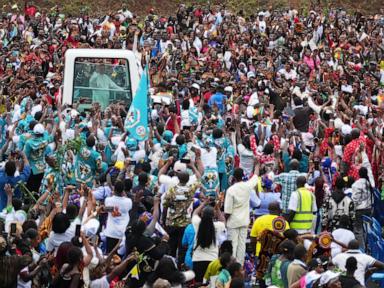
The streets of Yaoundé aren't just crowded right now. They’re vibrating. If you've ever seen a city prepare for a world-class sporting event, double that energy and add a layer of deep, spiritual intensity. That's what happens when more than 500,000 people decide to show up for a single Mass. Pope Leo XIV’s visit to Cameroon isn't just a local church event. It’s a massive logistical feat and a geopolitical statement that most of the Western world is completely ignoring.
The sheer scale of this gathering tells you everything you need to know about where the heart of the Catholic Church beats today. It’s not in Europe. It’s in Africa. When half a million people—roughly 20% of the city’s population—converge on the capital, the infrastructure screams. But the people? They don't care about the heat or the narrow roads. They’re there for a glimpse of the man they see as a bridge between their daily struggles and a higher hope.
The Massive Logistics Behind the Yaoundé Gathering
You can’t just host 500,000 people on a whim. The Cameroonian government and the local archdiocese have been working on this for months. They’ve transformed open spaces into outdoor cathedrals. Security is tight. We’re talking about thousands of police officers, soldiers, and volunteers creating a human grid to keep the peace.
People are traveling from the far north, from the coastal regions, and even crossing borders from neighboring Gabon and Equatorial Guinea. They aren't staying in five-star hotels. They’re sleeping on church floors, in makeshift camps, or with relatives in packed apartments. It’s a messy, beautiful, chaotic display of faith. If you think your morning commute is bad, try navigating Yaoundé when every second person is trying to reach the same altar at the same time.
The economic impact is staggering too. Small vendors are lining the routes, selling everything from commemorative cloths to bottled water. For many local families, this isn't just a spiritual high point. It’s the biggest business opportunity they’ve seen in a decade.
Why Africa is the New Center of the Catholic World
Let’s be real. The Vatican knows the numbers in the West are dipping. But in Africa, the numbers are exploding. Pope Leo XIV isn't visiting Cameroon by accident. He’s going where the growth is. This visit validates the African Church’s influence on global policy and doctrine.
In many parts of Cameroon, the Church provides what the state sometimes can’t. We're talking about schools, hospitals, and social safety nets. When the Pope speaks here, he’s not just talking to "the faithful." He’s talking to the people who run the backbone of the country’s social infrastructure. This Mass is a "thank you" and a "keep going" wrapped into one massive liturgy.
- Growth Rates: Catholic populations in Africa have grown by over 200% in the last few decades.
- Youth Engagement: Unlike the aging congregations in the US or France, the crowd in Yaoundé is overwhelmingly young.
- Political Weight: The Pope’s presence forces local leaders to address issues like corruption and peace in a way that’s hard to ignore when the whole world is watching.
Security Challenges and the Peace Message
Cameroon has had its share of internal friction. Between the tensions in the English-speaking regions and the threats in the north, security isn't a joke. The government is using this visit to show they can maintain order. It’s a PR win if it goes smoothly.
But for the people, the Pope’s message of peace isn't some abstract theological concept. It’s a survival requirement. When Leo XIV talks about reconciliation, he’s talking to families who have been displaced or divided by conflict. That’s why they’re standing in the sun for eight hours. They want to hear that their suffering is seen. They want a moral authority to tell the world that Cameroon matters.
What This Mass Means for the Future of the Papacy
This isn't your grandfather's Vatican. Pope Leo XIV has shown a consistent preference for "the peripheries." By choosing Cameroon for such a massive event, he’s signaling that the future of the faith will be shaped by the global south. Expect to see more African cardinals in the next consistory. Expect the issues facing this continent—climate change, debt relief, and migration—to move to the front of the Vatican’s agenda.
The sheer volume of people expected at this Mass should be a wake-up call. It proves that despite the secularization of the North, religious fervor is a primary mover of people and politics in the rest of the world.
If you’re watching from afar, don't just look at the photos of the crowd. Look at the faces. Look at the logistical coordination required to keep a half-million people safe and fed in a developing city. It’s a miracle of human will.
Pay attention to the local news broadcasts and the radio updates coming out of Yaoundé over the next 48 hours. The official statements will be polished, but the real story is in the neighborhoods. Look for the grassroots organizations managing the crowds and the local priests who have been awake for three days straight. That’s where the real impact lives. If you want to understand the modern world, stop looking at Brussels and start looking at the 500,000 people standing in a field in Cameroon.