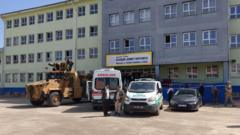
The morning in Erzurum should have smelled like woodsmoke and the sharp, clean bite of Anatolian winter air. Instead, it smelled of copper and adrenaline. At the Mustafa Kemal Atatürk Vocational and Technical High School, the transition from the mundane to the horrific happened in the span of a single heartbeat. One moment, there was the rhythmic scraping of chairs against linoleum. The next, there was the sound that no classroom is built to contain.
We often treat school shootings as data points. We count the wounded, we map the trajectory of the bullets, and we file the event away under the sterile label of "societal trends." But for the sixteen teenagers who felt the heat of lead tearing through the air—or through their own skin—the event isn't a statistic. It is a permanent fracture in the timeline of their lives.
The Shadow at the Door
He was nineteen. Old enough to be gone, yet young enough to be remembered by the hallways he haunted. A former student doesn't return to his old school by accident. He returns because he has unfinished business with the ghosts of his own past. When he stepped onto the campus, he wasn't a stranger; he was a familiar face twisted into a mask of intent.
In many ways, the "ex-student" is the most dangerous kind of intruder. He knows where the blind spots are. He knows which doors don't quite latch and which stairwells offer the clearest line of sight. He isn't breaking in; he is reclaiming a space where he likely felt powerless, now wielding the ultimate, terrible tool of "power."
Consider the classroom. It is meant to be a sanctuary of logic. You study the laws of physics, the structure of a sentence, the predictable outcomes of a chemical reaction. Then, a human variable enters the room with a firearm, and every law of the universe feels suddenly, violently suspended.
The Anatomy of the Panic
Sixteen people.
Think about that number. It’s a starting lineup for a football team with substitutes. It’s a large family gathering. It’s half a classroom. Each one of those sixteen individuals is now a map of trauma. Some bear the physical marks—the jagged entry points, the shattered bone, the long road of surgeries and physical therapy in a Turkish hospital bed. Others carry the invisible kind of shrapnel: the sound of the first shot that will play on a loop every time a car backfires or a locker slams too hard.
The chaos of those minutes is impossible to describe through a "dry" news lens. There is the frantic scramble for cover, the smell of ozone, and the sudden, heavy silence that follows a scream. In Erzurum, a city known for its resilience and its rugged highland spirit, the shock didn't just vibrate through the school walls; it paralyzed the entire community.
Why did he do it? The investigation will look for "triggers." They will look at his grades, his social media, his disciplinary record. They will try to find a neat, tidy reason to put in a folder. But the truth is often messier. It is a slow-motion collapse of mental health, a cocktail of isolation and easy access to a weapon. To the nineteen-year-old, the gun was likely the only voice he felt the world would finally listen to.
The Illusion of "Normal"
We have a habit of looking at these tragedies and asking what went wrong with the security. We talk about metal detectors, higher fences, and more guards. We want to turn our schools into fortresses because it’s easier than turning our culture into a community.
But a school cannot be a fortress and a place of learning simultaneously. One requires openness; the other demands a seal. When we see sixteen students bleeding in a Turkish high school, the failure isn't just in the lock on the front door. The failure is in the gap between "leaving" a school and "belonging" to the world.
Imagine a student who drifts. He finishes his time at the vocational school, or perhaps he is asked to leave. He enters a world that feels increasingly indifferent to his existence. The school remains a fixed point in his mind—the place where his grievances were formed or where his potential was stifled. It becomes a target because it is the only place that still feels significant to him.
The physical wounds of the sixteen will eventually scar over. Turkish doctors are skilled, and the human body is remarkably stubborn in its will to survive. But the psyche is more fragile. How do you go back to a desk where you once crouched in fear of your life? How does a teacher, whose primary job is to nurture, ever look at the doorway again without a flick of apprehension?
The Weight of the Aftermath
This wasn't a movie. There was no slow-motion heroics, no swelling soundtrack. There was only the terrifyingly fast reality of a young man with a gun and the dozens of lives he decided to gamble with.
As the sirens faded and the crime scene tape was stretched across the entrance, the city of Erzurum began the agonizing process of counting its blessings while mourning its peace. Sixteen injured is a miracle in the dark sense of the word—it means sixteen families didn't have to plan a funeral this week. But "injured" is not "okay."
The "injured" are currently navigating a world of white sheets, the beeping of monitors, and the overwhelming presence of "what if." What if I had sat one row to the left? What if I had stayed in the hallway five seconds longer? What if he hadn't run out of ammunition?
These questions don't have answers. They only have echoes.
The nineteen-year-old is now in custody. The legal system will take its course. There will be headlines for a few days, a week perhaps. Then the world will move on to the next crisis, the next political upheaval, the next tragedy. But in sixteen homes in Turkey, the world has stopped.
The Lingering Note
There is a specific kind of silence that falls over a school after an event like this. It’s a heavy, expectant silence, as if the building itself is waiting for the other shoe to drop. The blood is scrubbed from the floors. The bullet holes are patched and painted over. To a stranger walking through the halls a month from now, everything will look "normal."
But the students will know. They will walk a little faster past certain doors. They will look at the ex-students they see in the street with a new, involuntary shiver of suspicion. The ghost of the nineteen-year-old and his weapon will linger in the rafters long after he is behind bars.
We tell ourselves these are isolated incidents. We tell ourselves that Erzurum is far away, or that our own schools are different. We rely on the distance to keep the fear at bay. Yet, every time a former student walks back onto a campus with a grudge and a barrel, the distance shrinks.
The bell will ring again tomorrow morning. The students will file in. They will open their books. But they will also keep one eye on the door, listening for a sound that doesn't belong in a place of learning, praying that the shadow in the hallway is just a friend, and not a ghost seeking revenge.