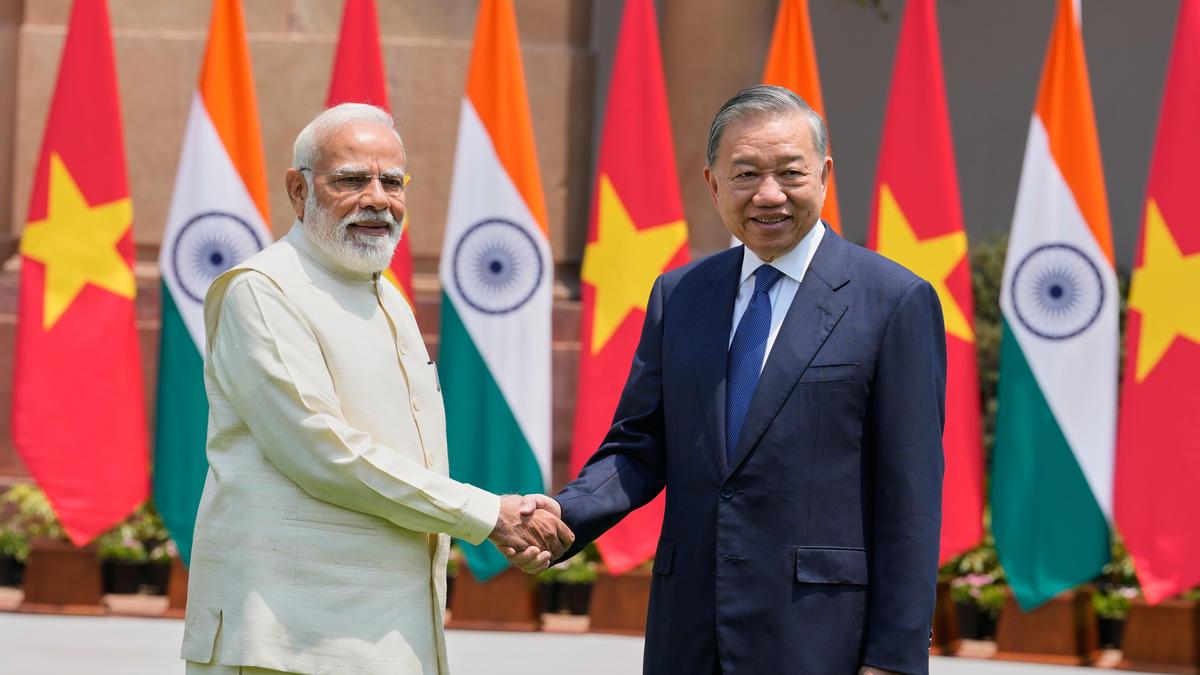
Diplomatic pageantry is a highly predictable theater. The red carpet at the forecourt of Rashtrapati Bhavan, the children in traditional attire waving tiny flags, the carefully choreographed handshakes between Prime Minister Narendra Modi and Vietnamese President To Lam.
The media immediately falls in line, churning out breathless copy about a "new era" of defense cooperation, a "decade-old strategic partnership," and the "deep civilizational ties" that supposedly bind New Delhi and Hanoi.
It is a comfortable narrative. It is also entirely divorced from geopolitical reality.
I have spent years watching defense analysts and trade experts draw up grand maps of a counter-hegemonic arc stretching from the Indian Ocean to the South China Sea. They point to the symbolic purchase of Indian BrahMos missiles, the S-400 air defense systems, and the shared anxiety over a rising superpower to the north. But behind the closed doors of defense ministries and corporate boardrooms, the "Comprehensive Strategic Partnership" is largely a paper tiger.
India and Vietnam are not building an alliance. They are running parallel, self-interested foreign policies that occasionally intersect for a photo opportunity. Believing this relationship will fundamentally reshape the security architecture of the Indo-Pacific is not just optimistic—it is a dangerous miscalculation.
The Myth of the Joint Security Front
The most pervasive misconception surrounding President To Lam’s visit to New Delhi is that India and Vietnam are preparing to form a functional military counterweight in Southeast Asia.
They are not.
Vietnam’s defense policy is governed by its strict "Four Noes" doctrine, first articulated in its 2019 National Defense White Paper:
- No military alliances.
- No aligning with one country against another.
- No foreign military bases on Vietnamese territory.
- No using force or threatening to use force in international relations.
Vietnam will never sign a mutual defense pact with India. It will never allow the Indian Navy to establish a permanent operational presence in Cam Ranh Bay. Hanoi understands that its survival depends on a delicate, hyper-pragmatic hedging strategy.
To Lam is the General Secretary of the Communist Party of Vietnam and the country's President. His primary objective is regime survival and domestic economic stability, not acting as a geopolitical proxy for India’s regional ambitions. Hanoi knows that a single misstep in the South China Sea could disrupt its massive export machine. It will use India to buy hardware and signal resolve, but the moment a crisis occurs, Vietnam will stand alone—by choice.
                  [ The Strategic Friction ]

     INDIA                                    VIETNAM
  (Act East, Maritime                        (Four Noes Doctrine,
  Power Projection)                         Extreme Pragmatism)
          \                                     /
           \                                   /
            v                                 v
      [ Rhetorical Alignment but Operational Divergence ]
The Harsh Math of Bilateral Trade
While diplomats brag about bilateral trade hitting historical highs of approximately $16.5 billion, they conveniently ignore the scale of the broader global market.
To put $16.5 billion into perspective, Vietnam’s total trade volume exceeds $700 billion annually. Its trade with China is near $200 billion. Its trade with the United States hovers around $110 billion.
India is a rounding error in Vietnam’s economic ledger.
2025 Trade Volume Comparison (USD)
============================================================
Vietnam-China Trade:   |||||||||||||||||||||||||||||| $200B
Vietnam-US Trade:      |||||||||||||||| $110B
Vietnam-India Trade:   || $16.5B
============================================================
The underlying structural realities of both economies prevent any real, deep-seated integration.
- Direct Competitors: India and Vietnam are not complementary economies; they are direct rivals for the same manufacturing capital fleeing China. Both are pitching themselves as the ultimate "China plus one" destination. Whether it is electronics, textiles, or footwear, a factory built in Hai Phong is a factory lost to Tamil Nadu or Gujarat.
- Protectionist Undercurrents: While To Lam talks trade at the National Stock Exchange in Mumbai, back home, Indian manufacturers lobby the government to protect domestic industries from cheap ASEAN imports.
- Infrastructure Deficits: The shipping lanes between India and Vietnam remain slow and expensive compared to the highly optimized, short-haul supply chains connecting Vietnam to Southern China and Taiwan.
We are told that cultural links and Buddhist diplomacy—exemplified by To Lam’s pilgrimage to the Mahabodhi Temple in Bodh Gaya—will bridge this economic chasm. But in the cold calculus of global supply chains, shared spiritual heritage does not lower tariff barriers or speed up container ships.
Pushing Back Against the Standard Narrative
The standard media framing of this visit suggests that India and Vietnam are natural partners destined to lock arms. Let us dismantle the most common assertions:
The Premise: "India's Act East policy finds its natural anchor in Vietnam."
The Reality: India's maritime focus is primarily western and central Indian Ocean, where its primary sea lines of communication lie. The South China Sea is a secondary theater for the Indian Navy. Conversely, Vietnam is purely focused on its immediate maritime boundary. Expecting India to project credible power into the Western Pacific to assist Vietnam is logistically and politically implausible.
The Premise: "Shared reliance on Russian military hardware creates perfect defense synergy."
The Reality: Both nations are desperately trying to diversify away from Moscow due to sanctions and supply-chain bottlenecks. Rather than cooperating, they are competing for the attention of Western defense contractors and trying to build up domestic defense industries. They are rivals in the arms-acquisition market, not partners.
The Real Value of the Visit
If the grand strategic narrative is a mirage, why is To Lam in New Delhi?
The answer lies in tactical leverage. Both nations use these bilateral summits to send signals to third parties.
For India, hosting the Vietnamese President is a low-cost way to show Beijing that New Delhi can play in China’s backyard. It is a rhetorical counter-pressure tactic.
For Vietnam, keeping India close acts as an insurance policy. It signals to Beijing that Hanoi has alternative partners, even if those partners are thousands of miles away and unlikely to send troops to the Paracel or Spratly Islands.
This is not a strategic partnership built for the long haul. It is a transactional arrangement based on temporary mutual convenience. Treat the grand proclamations coming out of Hyderabad House with deep skepticism. The real action in Asia is not happening on the red carpets of New Delhi; it is happening in the factories, the shipping lanes, and the quiet, high-stakes trade negotiations where India and Vietnam remain fierce competitors.