The morning air in Sunan is thin and tastes of kerosene. It is a cold, clinical scent that clings to the back of the throat, a reminder that the stillness of the North Korean dawn is purely artificial. On the tarmac, the Hwasong-17 sits like a jagged monument to a singular family’s obsession. It is a skyscraper of fuel and physics, designed for a journey it will never finish—a violent arc intended to prove that the world can be touched, or burned, at will.
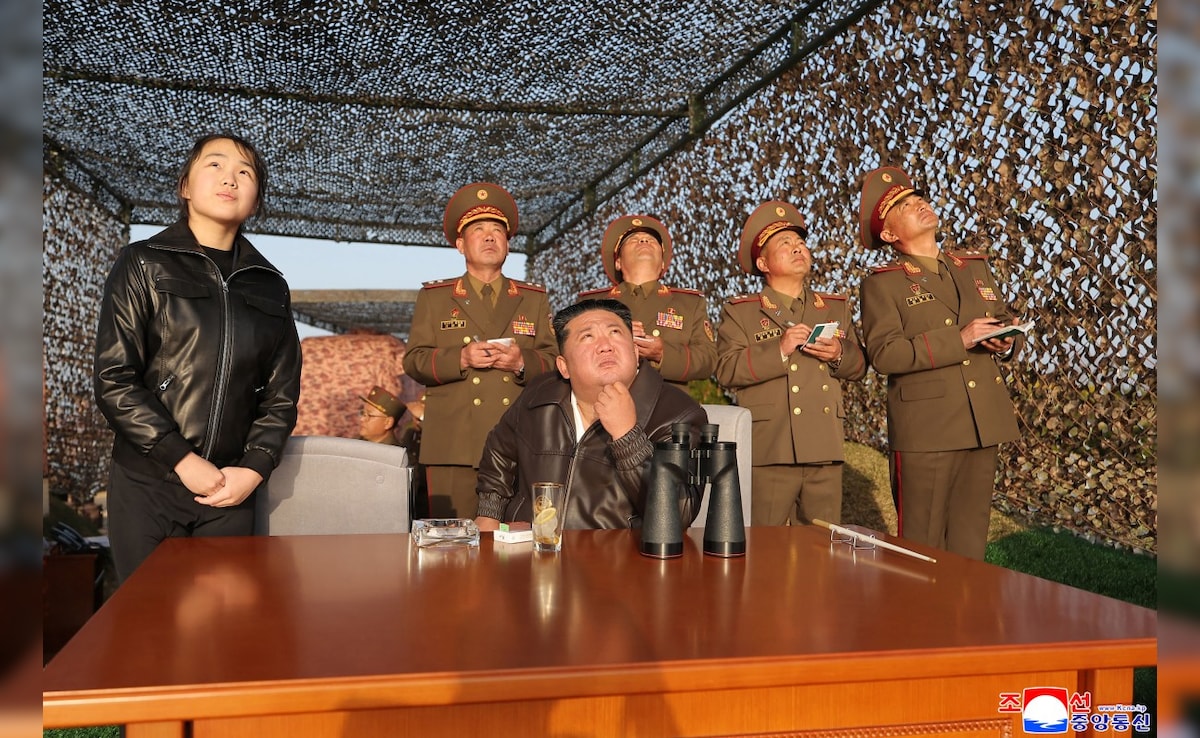
Standing beside it is a man whose silhouette is known to every intelligence agency on the planet. But he is not alone. Clinging to his hand is a girl in a white puffer jacket, her hair pulled back, her eyes reflecting the massive, matte-black fuselage of the intercontinental ballistic missile. She looks like any child on a field trip, save for the fact that her classroom is a launchpad and her lesson plan is the mechanics of global catastrophe.
This is not a military briefing. It is a family portrait.
The Weight of a Father’s Hand
We often view geopolitical maneuvers through the lens of cold data—throw weights, range capabilities, reentry heat shields. We talk about the 15,000-kilometer reach of the Hwasong-17 and how it puts the entire continental United States within a theoretical bullseye. We analyze the solid-fuel engines and the mobile launchers.
But the data misses the heartbeat.
Kim Jong Un is not merely showing the world a weapon; he is showing his daughter her inheritance. Imagine, for a moment, being that child. While other children of global elites are being groomed for boardrooms or political dynasties built on soft power, she is being taught the language of the button. To her, the thunder of a rocket engine isn't a terrifying anomaly. It is the soundtrack of her father’s love. It is the family business.
The optics are deliberate. By bringing Kim Ju Ae—believed to be his second child—into the scorched-earth reality of the missile program, Kim is signaling a permanence that transcends his own lifespan. This is the third generation of the "Paektu Bloodline" handing the torch to the fourth. The torch, in this case, is a nuclear-capable ICBM.
The Invisible Stakes of a Playground Launch
Consider the hypothetical life of a technician working under the shadow of that missile. They are a ghost in this narrative, one of thousands who have poured their lives into making sure these engines ignite. To them, the presence of the girl is a terrifying variable. If the missile fails while the "Respected Daughter" is watching, the consequences are not merely professional. They are existential.
The pressure inside that launch facility is thick enough to choke. Every weld, every line of code, every ounce of liquid propellant must be perfect. The world watches for the technical failure—the mid-air tumble or the fizzle on the pad. But the regime watches for the symbolic failure. In a system where the leader is infallible, a faulty rocket is more than a setback; it is a crack in the divine narrative.
When the countdown reaches zero, the earth doesn't just shake. It screams. The Hwasong-17 rose on a pillar of orange flame, a terrifyingly beautiful sight if you can divorce it from its purpose. As the missile clawed into the sky, the cameras didn't just stay on the fire. They turned to the father and daughter. They captured the clapping, the shared smiles, the pride.
It was a celebration of a successful delivery system. But what, exactly, was being delivered?
The Architecture of Fear
The technology behind these launches has evolved with a speed that has caught Western analysts off guard. We used to mock the "bottle rockets" of the early 2000s. We don't laugh anymore.
North Korea has moved beyond simple replicas of Soviet-era Scuds. They are now working with complex, indigenous designs. The Hwasong-17 is a "monster missile," one of the largest road-mobile ICBMs ever built. Its size allows it to carry multiple warheads—decoys, perhaps, or several nuclear devices intended to overwhelm defense systems like the Midcourse Defense (GMD) in Alaska.
This is the technical reality. But the emotional reality is that this hardware is built on the backs of a population that remains in the dark. While the daughter in the white jacket watches a multi-million dollar firework, miles away, the power grids flicker and the food rations thin. The missile is fed first. It is the most expensive member of the family.
Why the World Got the Story Wrong
For years, the international community treated these launches as cries for attention. We thought if we offered enough aid, or applied enough sanctions, the hunger for the "nuclear sword" would fade. We treated Kim Jong Un like a rational actor in a Western economic model.
He isn't. He is an actor in a dynastic epic.
By involving his daughter, Kim has effectively ended the debate about denuclearization. You don't bring your child to a temporary project. You bring them to the foundation of your house. He is telling the world that these weapons are now a permanent feature of the Korean landscape, as immovable as the mountains.
The "human element" here is often mistaken for a PR stunt. It’s far more chilling. It is the normalization of the unthinkable. When a child sees a weapon of mass destruction as a backdrop for a family outing, the moral weight of that weapon evaporates. It becomes a tool, like a plow or a tractor, simply part of the machinery required to keep the family safe.
The Long Shadow on the Tarmac
The missile eventually hit its peak altitude—some 6,000 kilometers in a lofted trajectory—before splashing down in the waters off Japan. In a standard news report, that’s the end of the story. The flight time was 69 minutes. The distance was 1,000 kilometers. The threat was "assessed."
But look closer at the photos released by the state media. Look at the way Kim Jong Un leans down to speak to the girl. He isn't pointing at the stars. He’s pointing at the horizon.
There is a profound loneliness in those images. A father and a daughter, isolated from the world by a ring of steel and a wall of propaganda, standing on a patch of concrete that represents the only security they trust. It is a security built on the promise of mutual destruction.
We are witnessing the birth of a new kind of leader—one who has never known a world where her family didn't hold the power to end cities. The transition from the father's grip to the daughter's future is the real story. The missile is just the vehicle.
As the smoke cleared from the Sunan launchpad, the two walked away, hand-in-hand. The missile was gone, hidden back in its silo or its mountain hangar, waiting for its next call to the stage. The girl will grow up. She will learn the mathematics of payloads and the politics of brinkmanship. She will remember the day the ground shook and her father smiled, and she will believe, with every fiber of her being, that the fire in the sky is the only thing keeping her alive.
The world sees a threat. She sees a legacy.
And that is the most dangerous development of all.