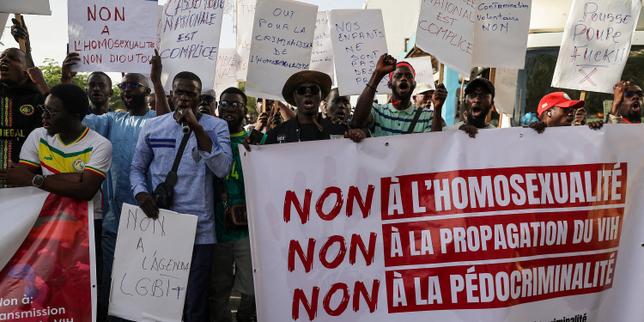
French political maneuvers and NGO campaigns aimed at altering Senegal’s anti-homosexuality laws are backfiring, driving LGBTQ+ individuals into deeper danger while straining Paris-Dakar diplomatic relations. French activists and politicians view their intervention as a moral obligation to protect human rights. The reality on the ground in Dakar is entirely different. This well-intentioned pressure is triggering a fierce nationalistic backlash in Senegal, where local politicians exploit Western interference to passing even stricter penalties. By treating a deeply rooted social and religious issue as a geopolitical lever, French actors are achieving the exact opposite of their stated goals.
The Friction of Western Pressure
Senegal represents one of West Africa's most stable democracies, yet its legal framework remains unyielding on traditional social norms. Under Article 419 b of the Senegalese Penal Code, acts against nature with an individual of the same sex are punishable by up to five years in prison. For decades, a delicate, unspoken social compromise existed. Discretion was the currency of survival.
French municipal councils, specific members of the National Assembly, and Paris-based human rights organizations recently shifted tactics. They chose to publicize the issue, demanding that French aid and diplomatic partnerships be contingent on human rights reforms in Dakar.
This strategy ignores the domestic political realities of Senegal. When a former colonial power demands legal changes, it does not foster progress. It triggers a defense mechanism. Local religious leaders and political coalitions quickly frame LGBTQ+ advocacy not as a matter of human rights, but as a modern form of cultural imperialism.
The Mechanism of Backlash
To understand why this approach fails, look at the legislative reaction in Dakar. Every time a French politician delivers a speech or Paris pledges funds to an underground Senegalese activist network, conservative groups in Senegal mobilize.
[French Public Pressure]
       │
       ▼
[Senegalese Nationalist Reaction]
       │
       ▼
[Demands for Stricter Local Laws]
       │
       ▼
[Increased Risk for Local LGBTQ+ Community]
This cycle directly inspired a legislative push by the collective And Samm Djikko Yi (To Preserve Our Values), which sought to double the maximum prison sentence for same-sex acts to ten years. While the bureau of the National Assembly rejected the draft law on technical grounds, the political appetite for criminalization has only grown. French interference gave local populists the perfect foil. They weaponized the defense of traditional values to win votes, leaving the local vulnerable population caught in the crossfire.
The Funding Dilemma and Grassroots Reality
Money flowing from European donors into West African civil society often complicates survival on the ground. French organizations frequently channel financial support to local initiatives with explicit conditions regarding visibility and reporting.
This creates a structural disconnect. Western NGOs require measurable metrics, public reports, and media presence to justify their budgets to donors. But for a gay man or a lesbian woman living in a suburb of Dakar, visibility can be a death sentence.
The Vulnerability of High Profiles
When a local group accepts high-profile foreign backing, they become targets. Neighbors notice the sudden influx of resources. Local media outlets, eager for sensational headlines, expose the organizations. This exposure leads to arbitrary arrests, evictions, and mob violence.
The most effective support networks in Senegal have historically been completely informal. They operate out of quiet apartments, offering shelter, medical care, and legal defense without a single billboard or press release. Western funding structures are inherently unsuited for this level of deep secrecy. By demanding transparency and Western-style advocacy, foreign benefactors inadvertently dismantle the covert safety nets that actually keep people alive.
The Geopolitical Shift
Paris no longer holds the monopoly on influence in West Africa. The diplomatic landscape has shifted fundamentally over the last decade. As France intensifies its moral demands, Senegal has viable alternatives.
Dakar is rapidly diversifying its international alliances. China, Turkey, and various Gulf States offer massive infrastructure investments and financial partnerships completely free of social conditions.
┌──────────────────┐     ┌──────────────────┐
│   Western Aid    │     │ Non-Western Aid  │
├──────────────────┤     ├──────────────────┤
│ • Financial Capital│    │ • Financial Capital│
│ • Moral Mandates │     │ • No Social Strings│
│ • Legal Demands  │     │ • Infrastructure │
└──────────────────┘     └──────────────────┘
When French diplomats hint at restricting bilateral aid over human rights concerns, they lose their seat at the table. Senegal simply turns to partners who do not comment on its internal judicial system. This loss of French leverage means that when egregious human rights abuses occur, Paris has fewer quiet diplomatic channels available to negotiate releases or protect individuals. The aggressive public stance neutralizes the quiet, behind-the-scenes diplomacy that yields actual results.
Reimagining the Strategy
If the goal is genuine protection rather than political posturing in Paris, the framework must change completely. Western nations must step back from the microphone.
True protection looks like asylum, not public preaching. Instead of funding high-profile advocacy campaigns that spark local outrage, French authorities could streamline the humanitarian visa process for individuals facing imminent physical danger. This is a concrete action within French jurisdiction. It does not violate Senegalese sovereignty or spark a nationalistic media frenzy in Dakar.
Shifting Focus to Practical Asylum
- De-escalate Public Rhetoric: Cease making aid conditional on social reforms in public forums.
- Fund Medical and Legal Desks: Divert budgets from public awareness campaigns to quiet emergency funds for legal defense and healthcare.
- Streamline Visa Access: Create discrete pathways for activists under direct threat to relocate without public fanfare.
The current trajectory is unsustainable. French politicians will continue to win points with domestic constituencies by championing human rights abroad, while Senegalese politicians will continue to secure conservative votes by defying Western pressure. Between these two political machines sit real people whose daily survival becomes more precarious with every speech delivered in Paris. True solidarity requires the humility to understand when your voice is making the problem worse.