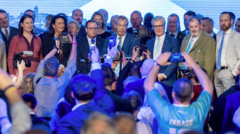
The rapid ascent of Reform UK in Scotland hit a significant wall this week. Within twenty-four hours of a high-profile launch meant to signal a new era for the party north of the border, Nigel Farage was forced to suspend Stuart Niven, the candidate for Dundee City West. The official reason cited is a prior disqualification as a company director involving the diversion of tens of thousands of pounds in Covid-era grants into a personal account. While the party frames this as a swift correction, it actually exposes a structural failure in vetting that threatens to undermine their entire 2026 Holyrood campaign.
This is not an isolated incident of "one bad apple" as the party leadership suggests. It is a recurring pattern of a startup political organization moving faster than its internal infrastructure can handle. By failing to catch a publicly documented directorship strike-off, Reform UK has handed its opponents a powerful narrative of incompetence just as it tries to position itself as the serious alternative to a struggling SNP and a cautious Scottish Labour.
The Vetting Vacuum
Nigel Farage previously admitted that the party's candidate screening in the past had been "piss poor." He promised a professional overhaul for the 2026 Scottish Parliament elections, yet the Niven case suggests the "professional" upgrade is more aesthetic than functional. A simple check of the Companies House disqualified directors register—a task that takes approximately ninety seconds—would have flagged the financial misconduct.
The failure to perform this basic due diligence is catastrophic for a party that campaigns on the platform of being more efficient and fiscally responsible than the "establishment." If you cannot vet a single candidate's business history, how can you be trusted with the Scottish budget? The suspension came only after local journalists at the Herald did the work the party’s own compliance team apparently skipped.
Beyond Financial Misconduct
The crisis extends past Niven’s bank accounts. The launch has been plagued by a series of disclosures regarding the social media activity of several other Scottish candidates. These range from Linda Holt in Fife North East, who directed personal insults at former First Minister Humza Yousaf, to Senga Beresford in Galloway and West Dumfries, who has been linked to endorsements of far-right content.
The party’s defense, led by Scottish leader Malcolm Offord, is that these candidates are "real people" with "real lives" who said things before entering politics. This is a strategic pivot designed to appeal to a base that is weary of "cancel culture," but it ignores the fundamental requirement of political suitability. There is a distinction between being an outspoken "real person" and lacking the basic judgment required for public office.
The Economic Mirage
While the candidate controversy dominated the headlines, a more systemic issue emerged regarding the party’s Scottish manifesto. The Institute for Fiscal Studies (IFS) recently scrutinized Reform's claims that they could fund a £2.3 billion tax cut by trimming "wasteful" Holyrood spending. The verdict was scathing.
David Phillips, the IFS's devolved finance specialist, noted that the party’s figures were "not fiscally credible." They appeared to confuse day-to-day operational spending with long-term capital investment. In many ways, the financial allegations against individual candidates are a microcosm of the party’s broader struggle with fiscal reality. They are selling a vision of a lean, efficient government while their own internal processes are proving to be anything but.
A Leadership Under Pressure
The timing of this collapse is particularly damaging for Malcolm Offord. Having recently defected from the Conservatives to lead Reform’s charge in Scotland, he is now being characterized by Scottish Labour leader Anas Sarwar as "spineless" for his refusal to drop other controversial candidates. Offord’s position is difficult. If he purges every candidate with a problematic digital footprint, he risks having no slate at all. If he keeps them, he taints the brand before the first vote is even cast.
The Scottish electorate has historically been resistant to the specific brand of populism offered by Reform and its predecessor, the Brexit Party. To break through, they needed to present a disciplined, professional front. Instead, the first forty-eight hours of their campaign have been spent in damage control.
The Real Cost of Growth
The "why" behind this failure is simple: Reform is a private company, not a traditional political party. It lack the local branch structures and long-term vetting pipelines that the SNP or Labour have built over decades. They are recruiting in a hurry to fill 73 seats, and in that rush, the bar for entry has been lowered to the floor.
When a party prioritizes volume over value, incidents like the Niven suspension are inevitable. This isn't just about a candidate in Dundee; it's about whether Reform UK is a serious political movement or merely a vehicle for high-profile defections and headline-grabbing rallies.
A Dangerous Precedent
If the party continues to defend candidates who have shared extremist content or have questionable financial backgrounds, they will remain a fringe element in Scottish politics. The "silent majority" they claim to represent generally prefers stability over chaos. By allowing the Scottish launch to devolve into a debate over Islamophobia and Covid-grant fraud, they have effectively marginalized themselves before the campaign has even truly begun.
The next few weeks will be telling. If Reform does not immediately implement a more rigorous, transparent vetting process, they will continue to be picked apart by the Scottish press and opposition researchers. The voters are watching, and in a country where trust in the political class is already at a low ebb, "at least we're not the other guys" is no longer a sufficient platform.
Would you like me to analyze the specific vetting protocols used by other UK political parties to see where Reform is falling short?