The steam rising from a plastic tray in a primary school hall carries a scent we all recognize. It is the smell of gravy, damp coats, and the low hum of a hundred children finding their seats. For most parents, that smell is a comfort. It represents a safety net, a hot meal guaranteed by the state, a moment of nourishment in a busy day. But if you follow the trail of that steam back through the kitchen doors, past the industrial ovens, and across the shipping lanes of the Pacific Ocean, the comfort begins to dissolve into a cold, hard mathematical equation.
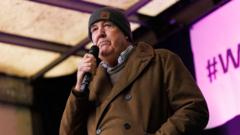
Jeremy Clarkson sat in a room recently and stared at that equation. He wasn't looking at a menu; he was looking at a ledger. What he found "staggered" him, not because of a lack of quality, but because of a triumph of logistics over logic. A chicken breast raised, slaughtered, processed, and frozen in China—half a world away—arrives in a British school kitchen cheaper than a bird raised in a field three miles down the road.
This is not a story about farming. It is a story about the ghost in our cupboards.
The Three-Mile Journey vs. The Ten-Thousand-Mile Leap
Consider a farmer in the Cotswolds. Let’s call him David. David wakes up at 5:00 AM. He checks his sheds. He pays for high-quality feed that meets stringent UK welfare standards. He pays his staff a living wage. He navigates a thicket of environmental regulations designed to ensure that the nitrogen from his farm doesn't choke the local river. When David sends his poultry to market, he has a price point. He has to. If he drops below it, the farm—which might have been in his family for three generations—simply ceases to exist.
Now, consider the journey of the alternative.
A chicken in a massive industrial complex in East Asia is processed into nuggets or strips. It is packed into a refrigerated shipping container. It travels through the South China Sea, across the Indian Ocean, up through the Suez Canal, across the Mediterranean, and around the coast of Iberia before docking at a British port. Even with the cost of the fuel, the massive carbon footprint of the voyage, the insurance, the port fees, and the inland haulage, that chicken is still cheaper than David’s.
How?
The answer isn't efficiency. It's a fundamental disconnect in what we value. When we look at a school dinner, we see a meal. When the system looks at a school dinner, it sees a "unit cost."
The Hidden Subsidy of Distance
We are often told that global trade is a "win-win." We get cheap goods; developing nations get economic growth. But this narrative ignores the "invisible stakes." The reason that imported chicken is cheaper isn't because the Chinese are magically better at raising birds. It’s because they are playing by a different set of rules.
When a British farmer follows welfare rules, those rules have a cost. We, as a society, decided we don't want battery cages. We decided we want traceability. We decided we want birds that aren't pumped full of certain antibiotics. These are moral choices translated into legislation. But when the procurement department of a large catering firm looks at their budget, those moral choices look like a deficit.
By buying the cheaper, imported meat, the system is essentially "outsourcing" its conscience. We get to keep our high standards for our own farmers—effectively pricing them out of the market—while feeding our children meat produced under standards we would never legally allow on our own soil.
It is a paradox. We have made it too expensive to be virtuous at home, so we buy our calories from places where the rules are quieter.
The Boy at the End of the Table
Let’s look at a hypothetical student. We’ll call him Leo. Leo is seven. He doesn't know about trade deficits or the price of grain in Ukraine. He just knows he is hungry and he wants his lunch.
For many children, school is the only place they get a warm meal with protein in it. If we can't afford to feed them at all, what is the point of a high-welfare farm?
This is the central dilemma. The local council, facing budget cuts, has a finite pot of money. If they buy from David, they can only afford to feed half the children. If they buy from the shipping container, they can feed everyone. It’s a mathematical trap that looks like a moral choice, but isn't one. The "choice" has already been made by the market, which doesn't care about the boy at the end of the table or the farmer in the Cotswolds.
But consider what happens next: David’s farm goes under. The field becomes a housing estate. The knowledge of how to raise animals, the infrastructure, the very ability to feed ourselves—it all disappears. Once that capacity is gone, it is gone for good. We become entirely dependent on that ten-thousand-mile leap. If a pandemic closes a port or a conflict blocks a canal, Leo’s lunch doesn't just get more expensive; it disappears.
The True Price of the Cheap
When Jeremy Clarkson says he is "staggered," he is reacting to the absurdity of it. We live in a world where a bird from the other side of the planet costs less than a bird from our own garden. This is a "race to the bottom" where the winners are the logistics companies and the losers are our farmers, our environment, and our future resilience.
We are living on a credit card of global stability. We are banking on the fact that the shipping lanes will always be open, that fuel will always be affordable, and that someone, somewhere, will always be willing to work for less than we are.
It is a fragile, beautiful, and terrifying system.
But there is a different way to look at it. What if we didn't see the school dinner as a cost to be minimized? What if we saw it as an investment?
If we spent those extra few pennies to buy from David, we wouldn't just be buying a chicken breast. We would be buying the health of our rural economy. We would be buying the preservation of our landscape. We would be buying a shorter supply chain that doesn't burn a lake of diesel to get to the plate. We would be buying the certainty that we can feed our own children tomorrow, regardless of what happens in the Suez Canal.
The real problem lies elsewhere, far from the canteen. It’s in our collective refusal to acknowledge that the "cheapest" option often has a hidden invoice attached. We pay it in the loss of our high-street shops, in the decline of our villages, and in the quiet, creeping anxiety of a nation that can no longer sustain itself.
The Final Tray
Leo finishes his lunch. He scrapes the tray and heads back to class. He doesn't know that his meal is a masterpiece of global engineering. He doesn't know that it arrived here because of a glitch in the world's economy that makes a long journey cheaper than a short one.
But we know.
The next time we walk past a field and see a flock of birds, we should remember that they are more than just scenery. They are a buffer against a world that is becoming increasingly unpredictable. They are a choice we haven't quite made yet—a choice between a ledger that balances today and a future that actually works.
The steam has cleared from the hall now. The tables are being folded away. The silence that follows is the sound of a system that is efficient, cold, and utterly indifferent to the hands that grow its food. It is the sound of a story that is being written for us, one cheap tray at a time.
Imagine the day the ships stop coming.
Would you like me to analyze the current UK agricultural subsidies to see how they might bridge this price gap?