The Captain of the Maersk Hangzhou does not think in terms of geopolitical chess or barrel-per-day quotas. He thinks about the vibration of the deck beneath his boots and the salt-crust forming on the bridge windows. He thinks about the three hundred million dollars of cargo—electronics, grain, toys, medicine—stacked in steel boxes behind him. But mostly, he thinks about the Bab el-Mandeb.
It is a narrow strip of water, just eighteen miles wide at its tightest squeeze. To the west lies Djibouti; to the east, Yemen. In Arabic, its name means "The Gate of Tears." It was named for the ancient dangers of navigation, but today, the tears are economic. If the Strait of Hormuz is the world's jugular vein for oil, the Bab el-Mandeb is its central nervous system for everything else. In similar news, read about: The Myth of the Healthy Successor Why Mojtaba Khamenei’s Fitness is a Geopolitical Distraction.
When tensions between the United States and Iran escalate, the world looks at Hormuz. We worry about the price of gas at the corner station. We worry about the strategic petroleum reserve. Yet, there is a second, more fragile link in the chain that remains largely invisible until the moment it snaps.
The Dominoes in the Dark
Consider a mid-sized electronics retailer in Manchester or a construction firm in New Jersey. They operate on the assumption of a "just-in-time" world. Parts arrive exactly when the assembly line needs them. Products hit the shelves just as the previous stock vanishes. This efficiency is a miracle of modern logistics, but it is built on a foundation of absolute stability. The New York Times has also covered this fascinating issue in great detail.
When a conflict flares up in the Red Sea, that stability evaporates.
A container ship diverted from the Suez Canal doesn’t just "take a detour." It commits to a grueling, ten-day journey around the Cape of Good Hope at the southern tip of Africa. This adds roughly 3,500 nautical miles to the trip. It burns thousands of tons of extra fuel. It incurs massive labor costs.
But the real damage isn't the fuel bill. It's the clock.
In a globalized economy, time is more than money. Time is the ghost in the machine. A ten-day delay means a factory in Germany halts production because a specific semi-conductor is stuck off the coast of South Africa. It means the seasonal inventory for a clothing brand arrives after the season has ended. The cost of shipping a single forty-foot container can quadruple overnight. These costs are not absorbed by the shipping giants. They are passed down, cent by cent, until they land on your grocery bill.
The Shadow of the Drone
Modern warfare has undergone a terrifying democratization. We used to think of naval blockades as massive fleets of destroyers and aircraft carriers—billions of dollars of hardware clashing on the high seas. That era is over.
Today, a prolonged conflict between regional powers involves "asymmetric" tools. Imagine a drone, built for the cost of a used sedan, launched from a mobile platform in the Yemeni desert. It doesn't need to sink a massive cargo ship to win. It only needs to make the insurance on that ship unaffordable.
When a missile or a loitering munition strikes a commercial vessel, the London insurance markets react with cold, mathematical precision. The "war risk premium" spikes. For many companies, the cost of insuring a transit through the Red Sea becomes higher than the profit margin of the cargo itself.
The gate closes. Not with a physical barrier, but with a spreadsheet.
The Strait of Hormuz carries roughly 20% of the world’s liquid petroleum, but the Red Sea and the Suez Canal handle 12% of total global trade and nearly 30% of all container traffic. If a conflict with Iran spills over into these waters through proxy forces or direct engagement, we aren't just talking about a spike in oil prices. We are talking about the potential seizure of the global supply chain.
A Tale of Two Straits
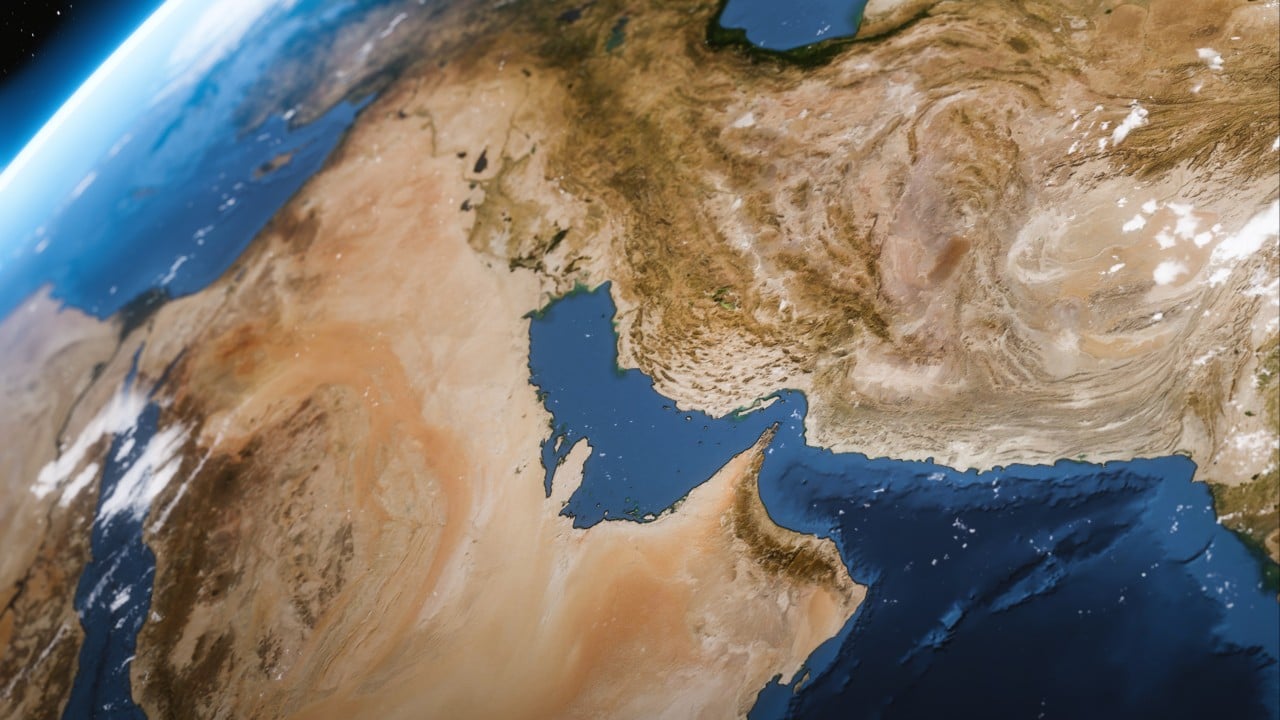
The geography of the Middle East creates a dual-threat scenario that military planners call a "double-ended chokepoint."
To understand the stakes, we have to look at the math of energy versus the math of goods. If the Strait of Hormuz is restricted, the world loses a significant portion of its daily oil supply. The result is an immediate, sharp pain: higher prices at the pump, increased heating costs, and a slowdown in transportation.
$$Price_{Total} = Price_{Commodity} + Cost_{Logistics} + Risk_{Premium}$$
However, if the Bab el-Mandeb—the southern entrance to the Red Sea—is compromised, the impact is more insidious. It is a slow-motion car crash for the global economy. Grain shipments from Europe to Asia are delayed, threatening food security in developing nations. Components for renewable energy projects—solar panels and wind turbine parts—sit idle on the water. The transition to green energy, which relies heavily on these global trade routes, stutters.
The invisible link is the trust we place in the horizon. We trust that the horizon will always bring the next ship.
The Human Toll of a Logistics War
Beyond the macroeconomic data points, there is a human cost that rarely makes the headlines.
There are the sailors—roughly 1.9 million of them worldwide—who find themselves in the crosshairs. These are often men and women from the Philippines, India, and Eastern Europe, working long contracts to send money home. When a "prolonged conflict" occurs, they become the unwilling front line. They sleep in life jackets. They keep 24-hour watches for the glint of a drone or the wake of a fast-attack boat. The psychological trauma of navigating a "hot" zone changes the industry. People quit. Recruiting becomes harder. The backbone of global trade begins to fray.
Then there is the consumer.
We often talk about inflation as a monetary policy failure, but it is frequently a logistical failure. If a conflict between the U.S. and Iran drags on, the "vital link" of the Red Sea becomes a bottleneck that squeezes the middle class. It isn't just about the price of a gallon of gas. It's about the price of a crib, the availability of a specific antibiotic, and the cost of the steel used to build new homes.
The world is smaller than we think. A skirmish in a body of water most people couldn't find on a map can dictate whether a family in Ohio can afford their Christmas presents or if a farmer in Kenya can afford fertilizer.
The Fragility of the "New Normal"
We have lived through a golden age of maritime security. For decades, the assumption was that the oceans were a "global commons," protected by international law and the overwhelming presence of the U.S. Navy. We built our entire civilization on the idea that the sea was a highway, not a battlefield.
But that assumption is being tested.
A prolonged conflict doesn't need to be a "total war" to be devastating. It only needs to be persistent. If the threat of disruption becomes the new normal, the very structure of our world changes. We move away from global cooperation and toward "near-shoring" and "friend-shoring." We build walls—economic and physical.
The cost of that transition is trillions of dollars. It is a reversal of decades of poverty reduction and economic integration.
The "vital link" isn't just a geographical coordinate. It is a psychological one. It is the belief that the world is open, that trade is a bridge, and that the "Gate of Tears" can remain just a name from a forgotten past.
The Captain on the bridge of the Maersk Hangzhou adjusts his course. He watches the radar. He knows that the water ahead is deep, but the margin for error has never been thinner. The world is waiting on the other side of the strait, unaware that its entire way of life is currently bobbing on the swell, held together by a prayer and a fragile, invisible thread.
A single spark in the dark can burn a bridge. But in the Red Sea, a single spark can turn the world's most important highway into a dead end.


