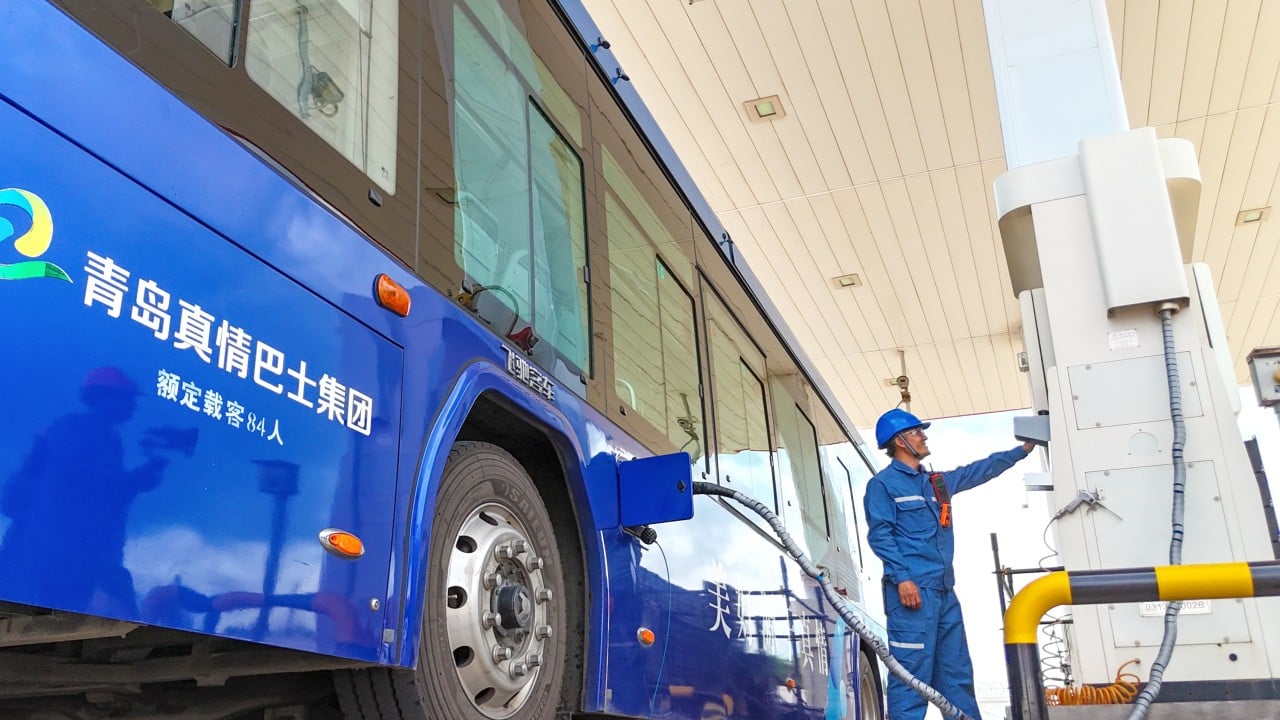
Li Wei wakes before the sun. In the cold, gray pre-dawn of a Hebei winter, his neighborhood smells of coal dust and damp earth. It has smelled this way for thirty years. But when he walks into the sprawling industrial facility where he serves as a lead technician, the air feels different. It is quieter. The heavy, sulfurous tang that used to cling to the back of his throat is thinning.
He stands before a row of massive, humming electrolyzers. They look like giant steel lungs. Inside them, electricity is ripping water molecules apart with a silent, relentless violence. Oxygen drifts away. What remains is a ghost gas. Hydrogen.
For decades, we have been told that this gas is the future. For just as long, it has been an expensive, elusive phantom—something that worked in a laboratory but withered when asked to power the massive, grinding gears of a nation. But the air in this facility has shifted. The state is no longer just funding research papers; they are building the veins of an entirely new anatomy. China is moving from the phase of cautious experimentation into the sheer, crushing weight of industrial scale.
The statistics are dry, but the implications are scorching. China is currently the world’s largest producer of hydrogen, yet most of it has historically come from coal—an ironic, dirty solution to a clean-energy ambition. That is ending. The mandate now is to switch the source, pulling hydrogen from renewables, turning wind and sun into fuel. It is an engineering challenge of biblical proportions.
Consider a hypothetical engineer named Sarah. She works in a coastal facility, thousands of miles from Li Wei. Her job is to manage the intermittency of the wind. When the gusts die down, the electrolyzers stutter. When the turbines spin at a frenzy, the grid chokes on excess energy. Hydrogen acts as the battery that saves her from failure. It is the bridge between the chaotic fury of nature and the steady, demanding hunger of the steel mills.
To understand why this matters, you must understand the weight of the steel.
Steel, cement, and shipping. These are the "hard-to-abate" sectors. You cannot run a blast furnace on a lithium-ion battery. You cannot put a container ship across the Pacific on a solar panel. When the world talks about decarbonization, it is usually whispering about light bulbs and passenger cars. This, however, is the roar of the real engine. It is the heavy machinery of civilization. Hydrogen is the only substance light enough to be portable and energy-dense enough to replace the hydrocarbons that built the modern world.
There is a deep, unsettling uncertainty here. We are betting everything on a fuel that is notoriously difficult to contain. Hydrogen atoms are tiny, mischievous, and prone to slipping through the smallest cracks in any container. We are essentially trying to build a pipeline for ghosts.
I remember watching a demonstration years ago, a prototype fuel cell unit that flickered and died because of a faulty valve. It felt like watching a candle trying to light a forest fire. At the time, it seemed foolish. We were spending billions to solve a problem that physics seemed to want to prevent. My colleagues and I debated whether the cost would ever drop low enough to make the transition anything more than a subsidized hobby.
But scale changes everything.
When you build ten units, you are a tinkerer. When you build ten thousand, you are an industrialist. China is moving to that latter stage, and the ripple effects will be felt on every continent. They are pouring money into the supply chain, manufacturing the membranes, the catalysts, and the storage tanks with a speed that borders on the frantic.
The strategy is not merely to clean the air. It is to capture the next century of industrial dominance.
If you own the technology that turns wind into steel, you own the market. Europe and the United States are watching this transition with a mix of jealousy and anxiety. They have their own roadmaps, their own subsidies, and their own grand promises. But there is a difference between writing a policy document and pouring concrete.
The human element is often lost in these high-level discussions. We talk about energy transitions as if they are abstract shifts in accounting ledgers. They are not. They are shifts in how people live, how they work, and what they breathe.
Li Wei does not care about the geopolitical implications of the hydrogen transition. He cares about the reliability of the system. He cares that the plant stays running without a catastrophic pressure failure. He cares that the company is hiring more people to manage the new units arriving on flatbed trucks from the coast.
His life is becoming a microcosm of the national goal. He is learning to service systems that didn't exist three years ago. He is a pioneer, whether he wants to be or not. And he is not alone. Millions of workers are being retrained to handle this volatile, invisible energy source.
But what if it fails?
The fear is not just economic; it is structural. If the infrastructure for hydrogen doesn't materialize with the speed the state demands, we will be left with stranded assets—billions of dollars of idle electrolyzers rusting in the sun. We are living through a period of immense, high-stakes trial. We are essentially betting the stability of our energy future on the hope that we can out-engineer the laws of thermodynamics.
Every day, the electrolyzers in the facility hum louder. The production targets are aggressive, climbing steadily toward the stated national goals for 2030 and beyond. It is a race against time, against the rising heat of the climate, and against the sheer momentum of a world addicted to carbon.
The wind turbines spin on the horizon, unseen and unheard by the policymakers in their distant offices. But for Li Wei, they are the heartbeat. Each rotation generates the current that splits the water, creating the fuel that will eventually fire the furnaces of a greener industry.
He checks his gauges one final time before his shift ends. The numbers are climbing. The hydrogen is flowing. He walks out into the night, the air still thick with the legacy of the old ways, but in his mind, he is already breathing the future.
The fire is lit. It is silent. It is invisible. And it is going to consume everything we thought we knew about power.