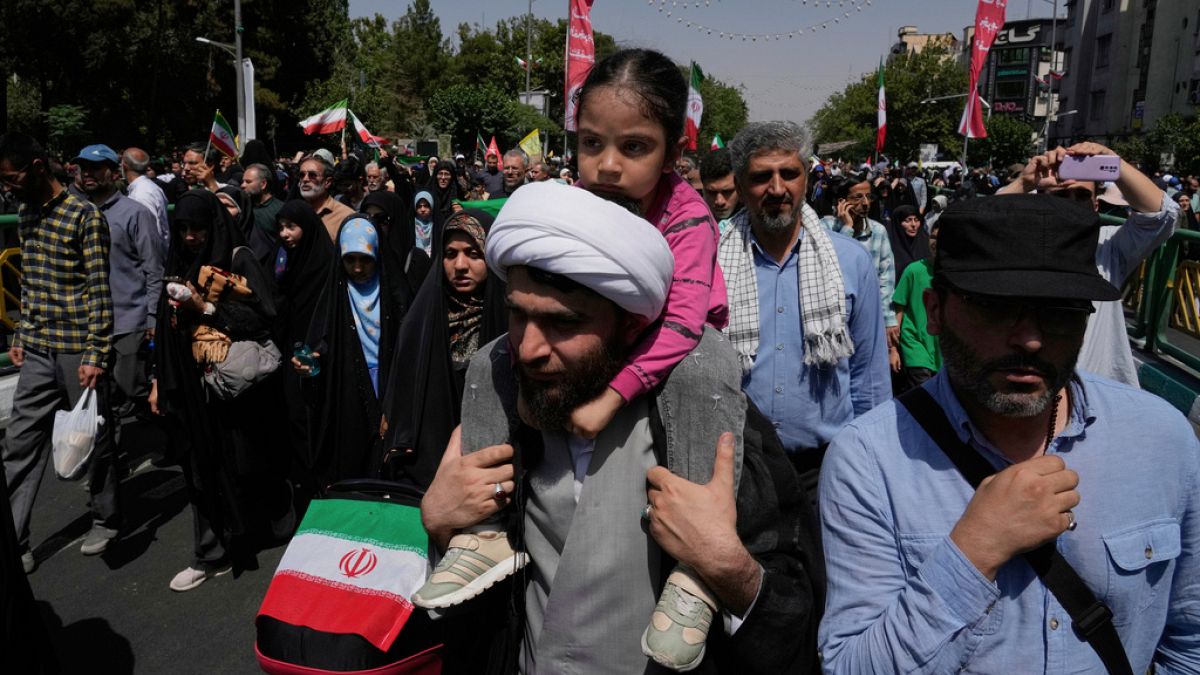
Western observers often assume that when the missiles start flying, a population naturally huddles behind its leadership. It's the "rally 'round the flag" effect. But in Tehran, that logic is currently hitting a brick wall. Iranians aren't just staying home and hoping for the best; they’re flooding the streets even as the threat of regional escalation looms larger than it has in decades.
If you're wondering why someone would risk a baton charge or worse while their country is essentially at war, you have to look past the headlines about geopolitics. For the average person in Tehran, the "war" isn't just something happening on a distant border or in a digital simulation of drone strikes. It’s a daily, grinding reality reflected in the price of bread and the vanishing value of the rial.
The immediate answer to why protests are happening now is simple. The economy didn't just stumble; it fell off a cliff. By late December 2025, the Iranian rial hit a staggering low of 1.4 million per U.S. dollar. Imagine trying to run a small shop in the Grand Bazaar when your inventory costs double every few weeks. That’s where this latest wave started—with the merchants. When the Bazaar strikes, the regime listens, because that’s the traditional heartbeat of Iranian commerce and conservative stability.
The Economic Breaking Point
Most people outside Iran don't realize how much the internal "war" against inflation has prepared the ground for the actual physical conflict. Food price inflation has hovered above 70%, and basic utilities like water and electricity have become luxuries. In 2025, the shortages were so bad that President Masoud Pezeshkian even floated the idea of moving the capital away from Tehran entirely because the city’s infrastructure was literally drying up.
When the U.S. and Israel launched joint strikes under "Operation Epic Fury" in February 2026, the government expected a surge of nationalistic fervor. Instead, they got a population that asked: "How can we fight a war when we can't buy eggs?"
The disconnect is massive. The state spends billions on its "Axis of Resistance" and regional proxies, yet can't keep the lights on in its own capital. For a huge segment of the population, specifically Gen Z and the struggling middle class, the street is the only place left to voice that frustration. They aren't necessarily rooting for an invading force, but they're definitely done with the status quo.
A Crisis of Legitimacy and Succession
It isn't just about money. We're witnessing a historic vacuum in leadership. The death of Supreme Leader Ali Khamenei in early 2026 didn't just create a headline; it triggered a frantic, messy scramble for power within the Assembly of Experts.
The Vacuum at the Top
When the "center" of a revolutionary state dies during a military crisis, the cracks in the facade become impossible to hide. Protesters aren't just asking for lower prices anymore. They’re calling for an end to the Islamic Republic system itself. You see graffiti in the Punak neighborhood or near Tehran University that doesn't just complain about the war—it demands a transition to something entirely new.
The Role of the Opposition
There’s a lot of talk about Reza Pahlavi and the monarchist movement. While he has a following, especially among those who remember a more secular Iran, the movement on the ground is way more fragmented. You have students, ethnic minorities like the Kurds, and bazaar merchants all protesting for different reasons. They haven't formed a "unified front" yet, which is exactly why the regime has managed to stay in power despite the chaos. The state uses this lack of unity to frame the protesters as "terrorists" or "foreign agents," but that narrative is losing its grip.
State Violence and the Digital Blackout
The crackdown in January 2026 was the deadliest in decades. Amnesty International and other monitors reported that the death toll likely reached into the thousands. The government’s response followed a familiar, brutal script.
- Internet Shutdowns: On January 8, the state pulled the plug. They know that without the internet, it’s much harder to organize and even harder for the world to see what’s happening in places like Kahrizak.
- Paramilitary Presence: The IRGC and Basij units aren't just on the street corners; they're on the rooftops.
- Legal Threats: The judiciary has moved toward "fast-track" trials with charges that carry the death penalty.
Despite this, people still go out. Why? Because for many, the risk of the street is no longer greater than the risk of staying home and slowly starving or living under a regime they no longer believe in. honestly, it’s a level of bravery that’s hard to wrap your head around from a distance.
What This Means for the Near Future
The "shadow war" between Israel and Iran has finally stepped into the light. But the real battle is happening inside Tehran’s city limits. The regime is betting that they can use the war as an excuse to tighten their grip and eliminate dissent. They’re calling the protesters "rioters" and "Zionist tools."
But the math doesn't add up. You can't run a war and a domestic crackdown simultaneously forever, especially when your currency is worthless and your regional allies are being systematically weakened. The closure of the Strait of Hormuz might spike global oil prices to $110 a barrel, but that doesn't put money back into the pockets of a shopkeeper in Tehran. It just makes the world more eager to see the regime fail.
If you’re looking for what happens next, watch the Bazaar and the universities. If the strikes continue and the students keep showing up despite the internet blackouts, the regime's "martyrdom" ideology will be tested like never before. They are fighting an external war they can't win and an internal war they've already lost in the hearts of the youth.
Keep an eye on the official casualty counts versus the reports coming out from human rights groups. The gap between those two numbers is the most honest metric of the state's fear. The next step is watching whether the security forces—the rank and file of the police and the army—begin to question their orders as they see their own families struggling under the same economic weight as the protesters they’re told to suppress.


