The air in the control room is stale, smelling faintly of coffee and recycled oxygen. Outside, the night is absolute. You are peering into a radar screen, watching tiny, bioluminescent blips navigate the narrowest neck of the Persian Gulf. This is the Strait of Hormuz. Twenty-one miles wide at its narrowest point. A sliver of water holding the pulse of the global economy hostage.
To a commuter in London or a farmer in Punjab, this place is a ghost story told in geopolitics. To the captain of a Very Large Crude Carrier (VLCC), it is the most stressful gauntlet on the planet.
Consider the reality of Captain Elias, a man who has spent thirty years chasing horizons. He stands on the bridge of a quarter-million-ton tanker, watching the deep, dark water. Beneath his keel lies the lifeblood of nations. Every gallon of oil, every bit of jet fuel, every precursor to the plastic in your phone must pass through this funnel.
Elias knows the math. He knows that nearly a third of the world’s seaborne oil passes through these waves. He also knows the geography of his predicament. The shipping lanes are squeezed between the Iranian coast and the Omani peninsula. It is a choke point. An immovable physical reality that makes the entire world dependent on the whims of a few coastal powers.
Recently, the nature of this passage changed. The rhythm of trade has been interrupted by a new, unspoken tax.
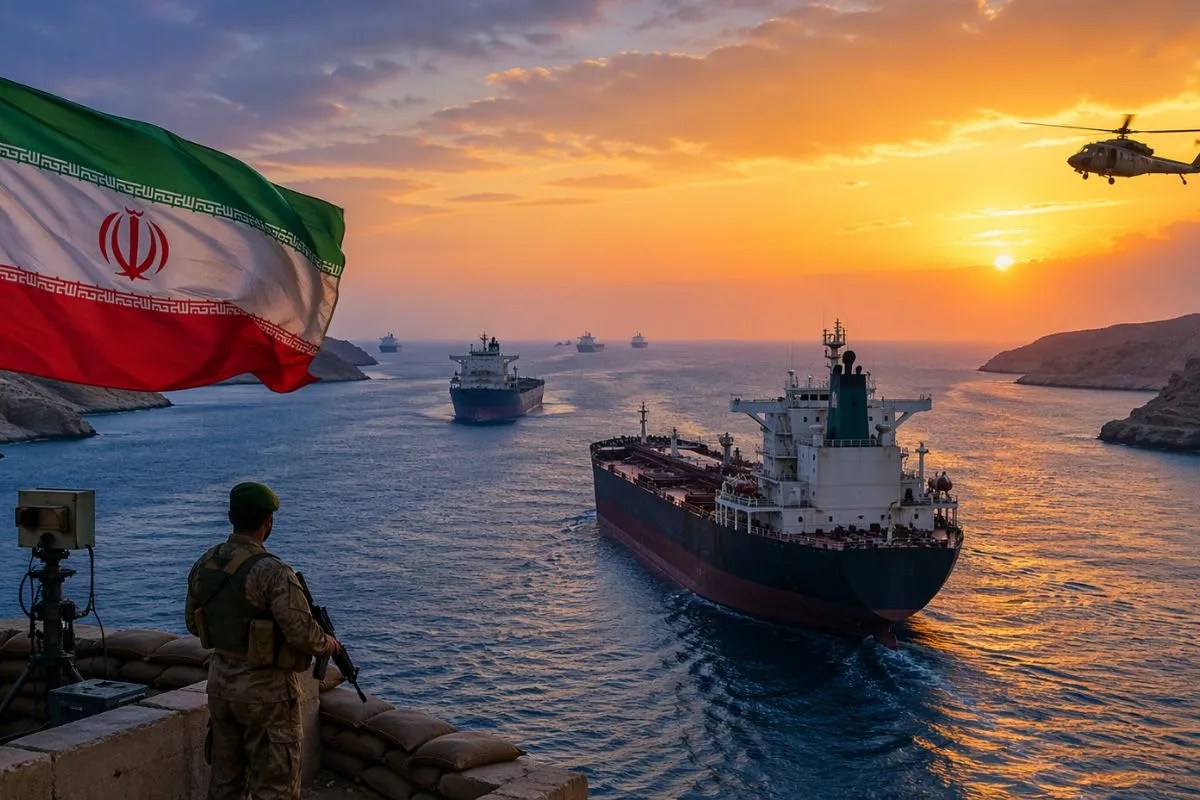
It isn't a bill sent in the mail. It is a shift in the way power is exercised on the water. Iran, watching from the jagged northern cliffs, has moved beyond traditional military posturing. They have transformed the Strait into a toll booth. By detaining vessels, shadowing tankers, and creating an atmosphere of unpredictable friction, they have essentially levied a tax on the movement of global energy.
Insurance premiums for ships traversing these waters have spiked. The cost of fuel reflects the risk of the journey. When a tanker is held, questioned, or harassed, the global market flinches. Prices rise in gas stations thousands of miles away. You feel it in your wallet, even if you never knew the name of the waterway.
This is the invisible cost of the Strait.
It is easy to view this as a dry, political spat between states. That is the mistake of the distant observer. To understand what is happening here, think of the Strait not as a highway, but as a bridge guarded by a toll collector who decides, on a whim, that the bridge is closed. Or perhaps, that the crossing will cost double today.
The geopolitical weight of this strip of water is immense. Iran understands that by controlling the flow, they control the narrative. When they exercise authority over a foreign-flagged ship, they are not just stopping a vessel; they are signaling to Washington, to Riyadh, to the world, that the keys to the kingdom are in their pocket.
Some analysts call this strategy of coercion "gray zone" warfare. It is a clinical term for a messy reality. It means actions that fall just short of open, declared war. It is the harassment of merchant mariners, the seizure of cargo, and the calculated disruption of supply chains. It is designed to be just disruptive enough to cause pain, but not quite enough to trigger a full-scale kinetic response.
I have seen the nervousness in the eyes of sailors as they approach the median line. They check their radar. They watch for the fast-attack craft that dart out from the shadows of the Iranian coast. These boats are small, agile, and carry the weight of a regional superpower. They are the enforcers of this new, informal toll.
The reality is that we are trapped in a fragile architecture. The world’s dependency on oil from the Gulf is a dependency on the stability of this specific, narrow channel. We have built a modern civilization that runs on liquid energy, yet we allow the supply lines of that energy to remain vulnerable to a handful of regional actors who have discovered that geography is destiny.
When a ship is delayed in the Strait, the global supply chain doesn't just stop; it ripples. A delay of one day at Hormuz can mean a shortage in a refinery in Singapore, which means a price hike for consumers in Tokyo, which ripples through the stock exchange in New York. The system is so hyper-connected that the throat of the world is, quite literally, twenty-one miles wide.
What happens next is not a matter of treaties or high-level summits. It is a matter of tension. Every time a tanker enters the Strait, it is an act of high-stakes gambling. The owners are betting that the toll will not be too high today. They are betting that the political winds will not shift in the next six hours. They are betting that their cargo, and their crew, will reach the open ocean.
There is no simple solution to this. You cannot dredge the Strait wider. You cannot move the geography of the Middle East. We are left with a cold, hard truth: the flow of our collective prosperity is guarded by a gate, and the person holding the key has learned exactly how much to turn it to ensure the world feels the squeeze.
Look at the horizon from the bridge of a tanker. The sun is setting, casting a long, blood-orange glow across the surface of the Persian Gulf. The water is calm, deceptively peaceful. But the radar is blinking. The radio is crackling with the voices of ships being challenged, identified, and ordered to hold their course.
The toll collector is watching. And in the silent, dark heart of the water, the world keeps paying the price.