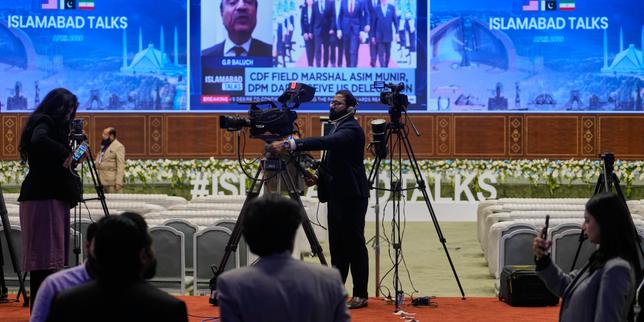
State media wants you to believe that a meeting between the Iranian delegation and the Pakistani Prime Minister is a tectonic shift in Middle Eastern diplomacy. It is not. It is theater. While the cameras flash and the diplomatic cables hum with standard platitudes about "regional stability" and "brotherly ties," the reality on the ground remains a volatile mix of mutual suspicion and strategic paralysis.
Stop looking at the handshake. Start looking at the map.
The mainstream press loves a "de-escalation" narrative. They see two neighbors talking and assume a bridge is being built. In reality, these meetings are often nothing more than damage control for a relationship that has been structurally broken for decades. You are watching a high-stakes performance designed to mask a fundamental lack of alignment.
The Myth of the Islamic Bloc
The most pervasive lie in regional reporting is the idea of a cohesive "Islamic front" against external pressures. This is a fairy tale for the gullible. Pakistan and Iran are trapped in a classic security dilemma, exacerbated by their wildly different global alignments.
Pakistan is a nuclear-armed state that has spent half a century tethered to American military aid and Saudi Arabian financial lifelines. Iran is a revolutionary theocracy that has spent the same period defining itself in direct opposition to those very powers. To suggest they are moving toward a unified strategic posture because of a brief sit-down in Islamabad is to ignore the cold, hard logic of the petrodollar and the nuclear umbrella.
I have tracked these "historic" meetings for years. They follow a predictable script:
- Border security "cooperation" is pledged.
- Trade volume targets are announced (and never met).
- A vague statement on Palestine or regional peace is issued.
- Both sides return home and continue to fund or ignore proxy groups that irritate the other.
Border Brutality and the Proxy Problem
If you want to understand the true state of Iran-Pakistan relations, don't read the state-sanctioned press releases. Look at the Sistan-Baluchestan border.
Earlier this year, both nations traded missile strikes. Let that sink in. These aren't "minor skirmishes" between rivals; these were direct violations of sovereignty between two countries that claim to be partners. Iran accuses Pakistan of harboring Jaish al-Adl militants. Pakistan points the finger at Iran for providing a haven for Baloch separatists.
A meeting between a delegation and a Prime Minister does not solve the ethnic and sectarian friction points that define this 900-kilometer stretch of wasteland. The "security cooperation" promised in these meetings is a logistical nightmare. Neither side truly trusts the other's intelligence services. Expecting the ISI and the IRGC to share actionable data is like expecting two wolves to share a single kill. It looks good on paper; it fails in the dirt.
The Energy Pipe Dream
The media will inevitably bring up the Iran-Pakistan (IP) gas pipeline. It is the "zombie project" of international diplomacy. It’s been "just around the corner" since the 1990s.
Every time a delegation visits, the pipeline is dusted off and presented as a symbol of economic integration. Here is the brutal truth: that pipeline will never carry significant volume as long as US sanctions remain in place. Pakistan is in a perpetual state of economic collapse, surviving on IMF bailouts and Saudi handouts. It cannot afford the multi-billion dollar fines or the secondary sanctions that would follow a deep energy partnership with Tehran.
The "deal" isn't a deal. It’s a talking point used by Islamabad to signal to Washington that it has other options, and by Tehran to show its domestic audience that it isn't isolated. It is a bluff that everyone at the table knows is a bluff.
Why the "Middle East War" Angle is a Distraction
The competitor's headline links this meeting directly to the broader war in the Middle East. This is a lazy attempt to frame every diplomatic movement as a part of a monolithic conflict.
While the war in Gaza and the potential for a wider conflagration between Israel and Iran are real, Pakistan is not a primary player in that theater. Pakistan’s military is inward-looking and obsessed with its eastern border. It has zero appetite for being dragged into a kinetic conflict in the Levant.
The Iranian delegation isn't in Islamabad to build a war council. They are there to ensure that Pakistan stays out of the way. They want a neutral neighbor, not a partner. If Iran can keep its eastern flank quiet while it manages the "Axis of Resistance" to its west, it considers that a win.
The China Factor
If there is any real weight to this meeting, it’s written in Mandarin.
Both nations are increasingly beholden to Beijing. The China-Pakistan Economic Corridor (CPEC) is the only thing keeping the lights on in Islamabad. Iran, meanwhile, signed a 25-year strategic partnership with China to bypass Western isolation.
China wants a stable, integrated region to secure its trade routes. These meetings are often nudged by Beijing to ensure that their two volatile "partners" don't blow up the neighborhood and ruin the investment. This isn't an Iranian-Pakistani rapprochement; it’s a regional management strategy dictated by a third party.
Dismantling the "People Also Ask" Nonsense
Is Pakistan siding with Iran against Israel?
No. Pakistan does not recognize Israel, but it is also deeply dependent on the very Western powers that support Israel. It will offer rhetorical support to the Palestinian cause because it has to for domestic political survival, but it will not provide military or strategic assets to Iran's "Forward Defense" strategy.
Does this meeting signal a shift away from the West?
Hardly. Pakistan's elite send their children to British schools and keep their money in London and New York. They aren't pivoting to a revolutionary Iranian model. They are playing a game of survival. They will take a meeting with anyone who might offer a temporary reprieve from their mounting debts.
Can Iran and Pakistan solve their border issues?
Not without addressing the Balochi nationalist movement, which neither state is willing to do through anything other than force. As long as both states use the border regions as a dumping ground for their security problems, the friction will remain.
The Dangerous Illusion of Progress
The danger in believing the "diplomatic breakthrough" narrative is that it breeds complacency. It ignores the fact that these two states are fundamentally competitors for regional influence. They are two powers sharing a fence, both of whom have reasons to want the other to remain preoccupied with internal strife.
When you read that the Iranian delegation "discussed bilateral cooperation," translate that as "they argued about the border and disagreed on the pipeline again."
Stop falling for the optics of the handshake. The real story is the silence between the words. The real story is the missile batteries still pointed at the horizon.
Diplomacy is often just the art of managing an inevitable divorce. Don't mistake the civil conversation for a reconciliation. In the brutal world of South Asian and Middle Eastern geopolitics, a smile is just a way to hide the teeth.
Go back and look at the photos of this meeting. Look at the body language. Look at the hollow eyes of the bureaucrats who know they are repeating the same failed promises they made five years ago.
The status quo isn't being disrupted. It's being managed. And management is just another word for stagnation.
Burn the press release. Watch the border.