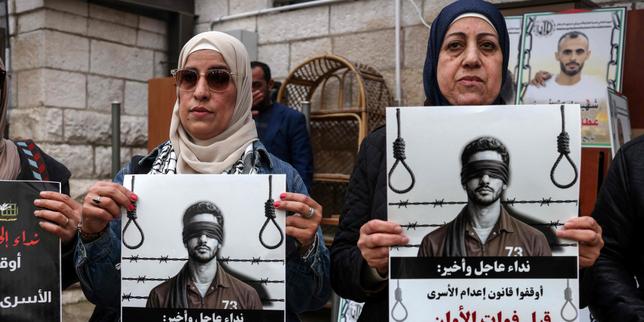
The air in Ramallah and Gaza isn't just heavy with the usual tension. It’s thick with a specific kind of dread. Israel’s push to formalize the death penalty for "terrorists"—a term that, in the current legal climate, almost exclusively targets Palestinians—isn't just another security measure. It’s a seismic shift in the legal and moral landscape of the conflict. You can feel the anger bubbling over in the streets. This isn't theoretical for the families of the thousands of Palestinians currently in Israeli jails. It's a terrifyingly real prospect that changes the rules of survival.
Palestinians view this legislation as a "legalized execution" tool designed to break the spirit of resistance. When you look at the numbers, the scale of detention is staggering. Thousands are held without trial under administrative detention. Now, the threat of the noose hangs over a legal system that many international observers already describe as deeply flawed. This isn't just about law; it's about the psychological weight of an entire population living under the shadow of a state-sanctioned kill switch.
The legal machinery of the death penalty
The bill passed its preliminary reading in the Knesset with a clear message. It targets those who kill Israeli citizens with "nationalist" or "racist" motives. In practice, that’s a direct line to Palestinian militants or even protesters involved in fatal clashes. Under current Israeli military law in the West Bank, the death penalty actually exists. But there’s a catch. It requires a unanimous decision from a three-judge panel. This new law? It wants to lower that bar to a simple majority.
Think about that for a second. Two out of three judges could decide if a person lives or dies. This shift isn't accidental. It’s a deliberate attempt to make the death penalty a functional, frequent part of the judicial toolkit rather than a dormant relic. Human rights groups like B'Tselem and Adalah have been screaming into the void about this for months. They argue that the Israeli military courts already lack the basic standards of a fair trial. Adding the gallows to that mix is a recipe for irreversible tragedy.
Many legal experts point out that Israel hasn't used the death penalty since the 1962 execution of Adolf Eichmann. Comparing a Nazi war criminal to Palestinian political prisoners is a leap that many in the international community aren't willing to take. The move signaled a hard-right pivot that cares less about international law and more about satisfying a domestic base that's hungry for "deterrence."
Why deterrence is a hollow argument
The main talking point for the law's supporters is deterrence. They say if you know you’ll hang, you won't pull the trigger. But ask anyone who’s spent time in the West Bank or Gaza if they think this will work. It won't. If anything, it’ll do the opposite.
History shows that in high-intensity conflicts, state-sanctioned executions usually create martyrs. They don't create peace. For a young man in Jenin or Nablus who already feels he has no future, the threat of death isn't a deterrent. It’s a badge of honor. I’ve seen how funerals for those killed in raids become massive recruitment events. Now imagine a televised, legal execution. The backlash wouldn't just be a few protests; it’d be a generational hardening of hearts.
Even the Shin Bet, Israel's own internal security agency, has expressed deep reservations about this. They know the ground reality. They understand that executing prisoners could lead to a wave of kidnappings as militant groups try to grab hostages to use as bargaining chips. It’s a cycle of violence that’s easy to start and nearly impossible to stop.
A broken system for the accused
The Palestinian experience in the Israeli military court system is a nightmare of bureaucracy and basalt walls. We're talking about a conviction rate that hovers around 99%. That’s not a typo. When you’re operating in a system where the odds are that stacked against you, the introduction of the death penalty feels like a foregone conclusion rather than a judicial process.
- Administrative Detention: Hundreds are held for years without knowing the charges against them.
- Military vs. Civil Law: Israeli settlers in the West Bank are tried under civil law, while Palestinians a few yards away face military tribunals.
- Interrogation Tactics: Reports of physical and psychological pressure to extract confessions are common.
If you’re a Palestinian mother, you don't see this law as "justice." You see it as a way for the state to take your son and never give him back, not even in a coffin. There's also the issue of the "security of the state" being used to hide evidence from defense lawyers. How do you defend someone against the death penalty when you aren't allowed to see the "secret file" the prosecution is using?
The international fallout and the silence
The world is watching, but the response has been tepid. The European Union typically opposes the death penalty in all circumstances, and they've voiced their disapproval. But disapproval doesn't change policy on the ground in Jerusalem. The United States finds itself in a tight spot, trying to balance its support for Israel with its stated commitment to human rights.
Palestinians feel abandoned by the international legal order. They see a double standard where some lives are protected by international conventions and others are subject to the whims of a right-wing coalition. This sense of isolation feeds the anger you see in the streets of Hebron and East Jerusalem. When people feel the law is just a weapon used against them, they stop believing in the law entirely.
What happens when the first sentence is carried out
The real fear isn't just the law itself. It’s the moment it’s actually used. If a Palestinian prisoner is sent to the gallows, the repercussions will be felt far beyond the prison walls. It would likely trigger a general strike across the Palestinian territories, and the risk of a full-scale uprising would skyrocket.
You also have to consider the impact on the Palestinian Authority (PA). They’re already viewed by many Palestinians as nothing more than a security subcontractor for Israel. If they can't prevent the execution of their own people, their remaining legitimacy will evaporate. This creates a power vacuum that more radical groups are only too happy to fill.
It’s a grim outlook. The law isn't just about punishment; it’s a political statement of dominance. For the families waiting for news of their loved ones in Megiddo or Ofer prison, the news cycles are a constant source of anxiety. They aren't just worried about prison conditions anymore. They're worried about a finality that can't be undone.
Taking a stand against the gallows
If you want to understand the gravity of this situation, don't look at the legal jargon. Look at the faces of the protesters. Look at the data from human rights organizations like Addameer, which tracks the treatment of Palestinian prisoners. They provide the most granular look at what’s actually happening inside the cells.
Stay informed by following local journalists who are on the ground in the West Bank. They see the raids and the arrests that never make the evening news in the West. Support organizations that provide legal aid to detainees. These lawyers are often the only line of defense between a prisoner and a system that has already decided their guilt.
This isn't a time for neutral observation. The implementation of a death penalty in a colonial context is a human rights catastrophe in the making. Demand transparency. Pressure your representatives to speak out against the expansion of military court powers. The only way to stop a law like this is to make the political cost of keeping it higher than the benefit of passing it. Don't let this become the new normal.