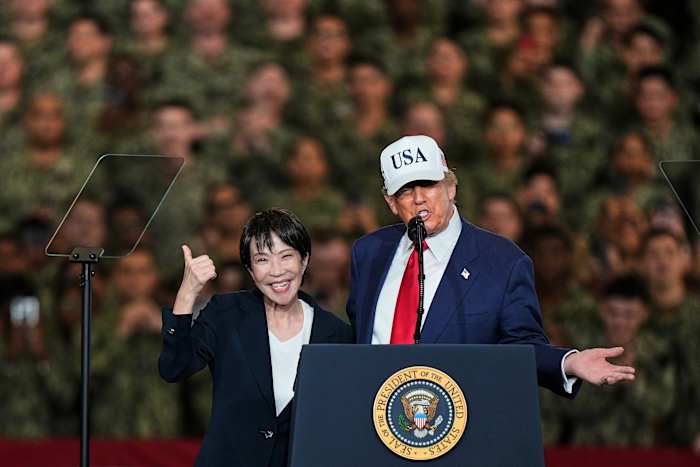
Prime Minister Sanae Takaichi is not waiting for the dust to settle in Washington. In a high-stakes gamble that signals a departure from decades of cautious Japanese diplomacy, Takaichi has moved to secure a personal and strategic commitment from Donald Trump regarding the Strait of Hormuz. This is about more than just ships. Japan imports roughly 90% of its crude oil from the Middle East, and the vast majority of that volume must pass through the narrow, volatile chokepoint between Oman and Iran. For Takaichi, the calculation is simple. If the Strait closes, the Japanese economy stops.
The meeting underscores a cold reality that Tokyo has finally accepted. The old multilateral frameworks for maritime security are fraying. By engaging directly with Trump, Takaichi is bypasssing traditional bureaucratic channels to ensure that the "America First" doctrine includes the defense of Japanese energy interests. She is effectively pitching Japan not as a dependent ward, but as a proactive partner willing to shoulder more of the burden in the Indo-Pacific in exchange for a hard guarantee on Middle Eastern stability. For a different look, check out: this related article.
The Hormuz Trap and the Takaichi Doctrine
For years, Japan operated under the "Peace Constitution" as a shield, letting the U.S. Navy handle the heavy lifting in the Persian Gulf. Those days are over. Takaichi’s administration recognizes that the U.S. appetite for policing global commons is at an all-time low. Iran’s increasing use of "gray zone" tactics—seizing tankers, deploying sea mines, and utilizing drone swarms—has made the Strait of Hormuz a graveyard for predictable shipping costs.
Takaichi is pushing for a reimagined security architecture. She wants a firm U.S. commitment to maintain a carrier strike group presence near the Gulf, but she is offering a significant quid pro quo. Tokyo is prepared to increase its "host nation support" for U.S. troops in Japan and expand the operational reach of the Japan Maritime Self-Defense Force (JMSDF). This is a massive shift. It moves Japan from a defensive posture to one of regional power projection. Related analysis on this trend has been published by Al Jazeera.
The risk is obvious. By tying Japan’s energy security so closely to a Trump administration, Takaichi is betting that personal chemistry can override shifting political winds in the U.S. Congress. It is a personality-driven foreign policy that many in the Japanese Diet find terrifying. Yet, the alternative—relying on a distracted or isolationist America—is seen by the Prime Minister's office as a guaranteed path to economic strangulation.
Why the Middle East Matters More Than Ever
Despite the global push for green energy, Japan’s immediate survival remains tethered to fossil fuels. The 2011 Fukushima disaster crippled the nation’s nuclear capacity, and while reactors are slowly coming back online, the gap is filled by oil and liquefied natural gas (LNG). The Strait of Hormuz is the literal jugular vein of the Japanese archipelago.
If Iran decides to block the Strait, oil prices wouldn't just rise; they would explode. We are talking about a jump to $150 or **$200 per barrel** within days. For a country like Japan, which lacks its own natural resources, such a spike would trigger an immediate industrial recession. Takaichi knows that her political longevity depends on the price at the pump and the stability of the yen. By securing Trump’s favor, she is buying insurance against a global supply shock that no amount of domestic policy could fix.
There is also the China factor. Beijing is watching these developments with intense interest. As China expands its own naval presence in the Indian Ocean, Japan feels the walls closing in. A U.S.-Japan alliance that extends its teeth all the way to the Middle East sends a clear message to the People's Liberation Army Navy. It says that the democratic axis is not retreating from the high seas.
The Cost of Protection
Trump is not known for giving anything away for free. The "help" Takaichi is seeking comes with a heavy price tag. Industry insiders expect that in exchange for maritime security guarantees, Japan will be pressured to increase its purchases of American military hardware and perhaps open its protected agricultural markets even further.
- Increased Defense Spending: Takaichi has already committed to doubling Japan’s defense budget to 2% of GDP.
- Energy Contracts: Expect Japan to sign more long-term contracts for American LNG, reducing its reliance on Russian and Middle Eastern sources.
- Technological Alignment: A tighter "tech curtain" where Japan aligns its semiconductor export controls even more strictly with U.S. policy.
This is not a traditional treaty negotiation. It is a transactional arrangement. Takaichi is speaking Trump’s language, framing the Strait of Hormuz not as a shared global responsibility, but as a business asset that requires a joint security venture.
The Strategic Failure of Multilateralism
The reason Takaichi is in Washington instead of Brussels or the UN is that the rules-based order has failed to protect shipping. The International Maritime Organization has no teeth. The UN Security Council is paralyzed by vetoes. When a Japanese-owned tanker is struck by a suicide drone in the Gulf of Oman, the "international community" issues a statement of concern. Takaichi wants more than a statement; she wants a destroyer.
Critics argue that this approach validates "strongman" politics and undermines the very alliances Japan has spent decades building. They aren't wrong. By cutting a side deal with the U.S., Japan may alienate European partners who also rely on the Strait. But from Takaichi’s perspective, Europe doesn't have the carrier groups necessary to keep the oil flowing. Only the U.S. does.
Domestic Resistance and the Constitutional Ceiling
Back in Tokyo, the opposition is sharpening its knives. Article 9 of the Japanese Constitution still technically forbids the use of force to settle international disputes. While previous administrations have "reinterpreted" this to allow for collective self-defense, sending the JMSDF into a potential combat zone in the Middle East remains a political third rail.
Takaichi is betting that the public's fear of an energy crisis will outweigh their traditional pacifism. She is framing the mission as "policing" rather than "warfare." It is a delicate linguistic dance. If a Japanese sailor is killed in an exchange with the Iranian Revolutionary Guard, the Takaichi government could collapse overnight. This is why the U.S. umbrella is so critical. Japan wants to be present, but they want the Americans to provide the heavy kinetic cover.
The Iranian Variable
Tehran is not a passive observer in this drama. Iran has long used the threat of closing the Strait as its primary leverage against Western sanctions. If Japan aligns too closely with a "maximum pressure" U.S. stance, it loses its long-standing role as a neutral mediator in the Middle East. For decades, Tokyo maintained cordial ties with Tehran, often acting as a bridge between the West and the Islamic Republic.
Takaichi is effectively burning that bridge. By choosing a side, Japan is admitting that its "omni-directional diplomacy" is dead. The world has become too polarized for a major economy to stay friends with everyone. You either have the protection of the U.S. Navy, or you are at the mercy of those who wish to disrupt the status quo.
A New Blueprint for Pacific Powers
What Takaichi is doing will likely become the blueprint for other Asian nations. South Korea, Taiwan, and even India are watching. They all share the same vulnerability: an extreme dependence on sea-borne energy. If Japan successfully negotiates a specific security carve-out for its supply lines, expect Seoul to be next in line at Mar-a-Lago.
The era of the "global policeman" who protects everyone for the sake of world peace is over. We are entering the era of "security for hire" or, more accurately, security for strategic alignment. Takaichi is simply the first leader to realize that in this new world, you have to ask for what you need before the ship sinks.
The success of this mission won't be measured in a joint communique or a photo op. It will be measured in the insurance premiums for VLCCs (Very Large Crude Carriers) heading for Chiba and Nagoya. If those rates stay down, Takaichi wins. If they spike, no amount of American "help" will save the Japanese economy from the consequences of its geography.
The prime minister’s move is a cold-blooded recognition that in the current geopolitical climate, a personal guarantee from the man at the top is worth more than a thousand pages of international law. She has placed her bets. Now the tankers have to keep moving.
Check the current positioning of the JMSDF’s Murasame-class destroyers; their next port of call will tell you exactly how successful these talks were.