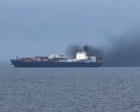
The headlines are screaming about US jet fighters circling Kharg Island like it’s 1987 all over again. The lazy consensus among defense analysts is that flattening Iran's primary oil terminal is the "red button" that collapses the regime and stabilizes the region. They talk about "strategic chokepoints" and "economic decapitation" as if modern energy markets are a game of Risk played on a cardboard map.
They are wrong.
Targeting Kharg Island isn't a masterstroke; it is an expensive, tactical redundancy that reveals how little the West understands about the decentralization of the Iranian shadow economy. If you think a few sorties of F-35s will end the threat, you’re looking at a world that ceased to exist a decade ago.
The Myth of the Centralized Hub
Kharg Island handles roughly 90% of Iran's crude exports. On paper, that makes it a juicy target. In reality, destroying it is the equivalent of trying to stop the internet by blowing up a single data center in Northern Virginia. It’s loud, it’s messy, and it’s ultimately futile.
Iran has spent the last five years perfecting the "ghost fleet" strategy. They don't need a pristine deep-water terminal to move product. Ship-to-ship (STS) transfers happen in the middle of the night in the Omani Basin and the Persian Gulf. They use aging VLCCs (Very Large Crude Carriers) that act as floating storage units, disconnected from the physical infrastructure of Kharg.
When you bomb a terminal, you destroy concrete and pipes. You do not destroy the millions of barrels already sitting in the hulls of a hundred different tankers flying flags of convenience. The "market shock" the media loves to predict ignores the fact that China—the primary customer—has already priced in the risk. Beijing isn't buying Iranian oil because it's easy; they buy it because it's a discounted, off-books hedge against US hegemony.
The Math of Escalation Failure
Let's look at the actual physics of the strike. To truly "neutralize" Kharg, you have to do more than pockmark the runways. You have to destroy the T-jetty and the Sea Island terminal.
$$Force = Mass \times Acceleration$$
In a kinetic environment, the math for the US is ugly. To keep Kharg offline, you need persistent air superiority in a highly contested A2/AD (Anti-Access/Area Denial) bubble. Iran’s S-300 batteries and domestic Bavar-373 systems aren't toys. Even if the kill ratio favors the US, the cost-to-benefit ratio is a disaster.
- Cost of one AGM-158 JASSM: Roughly $1 million.
- Cost of a Chinese-made Iranian drone: $20,000.
- Result: You spend millions to break a pier that they bypass using $50,000 worth of flexible pumping hoses and a rusted tanker.
I have seen military planners fall in love with "kinetic solutions" because they provide a clear visual of success on a satellite feed. It looks good in a briefing. It feels like "doing something." But it ignores the systemic resilience of a nation that has lived under the most grueling sanctions regime in human history. You cannot "starve" an economy that has already evolved to breathe underwater.
Why Oil Prices Won't Moon
The loudest argument against striking Kharg is that it will send Brent crude to $150 a barrel and wreck the global economy. This is the ultimate "lazy consensus" fear-mongering.
The world is currently drowning in spare capacity. Between the Permian Basin’s relentless output and Guyana’s emergence as a mid-tier power, the loss of 1.5 million barrels per day from Iran is a rounding error. If Kharg goes dark, OPEC+ (specifically Riyadh and Abu Dhabi) will simply turn the dials. They are itching for the market share.
The real danger isn't the lack of Iranian oil. The danger is the Iranian response to the insult of the strike. If you hit Kharg, they don't just sit there. They hit the desalination plants in the UAE. They hit the Abqaiq processing facility in Saudi Arabia.
You’re not trading Iranian oil for a peaceful Middle East. You’re trading a manageable regional cold war for a catastrophic breakdown of the water and power infrastructure of the entire Gulf. That isn't "securing interests." It’s arson.
The Silicon and Steel Misconception
We treat this like a 20th-century industrial conflict. We think in terms of "factories" and "depots." But Iran's power projection is now digital and asymmetric.
While US jets are burning JP-5 fuel to drop gravity bombs on a pile of rocks in the Gulf, Iran’s "Cyber Army" is mapped into the SCADA systems of Western utility grids. The asymmetry is staggering. A kinetic strike on Kharg provides the Iranian regime with the perfect "force majeure" excuse to trigger every sleeper cell and malware strain they've planted in the West over the last decade.
People Also Ask (And Why They're Wrong)
"Won't destroying Kharg Island bankrupt the IRGC?"
No. The IRGC’s wealth isn't sitting in a vault at the terminal. It’s tied up in a massive conglomerate of front companies, construction firms, and telecommunications interests across Iraq, Lebanon, and Syria. They dealt with "bankrupt" decades ago. They operate on a barter and black-market economy that doesn't require a functional pier at Kharg to survive.
"Can't the US just blockade the island instead?"
A blockade is an act of war that requires a massive, stationary naval presence. In the era of hypersonic anti-ship missiles and "swarm" drone tactics, parking a carrier strike group within range of the Iranian coast is tactical suicide. You’re risking a $13 billion Ford-class carrier to stop a $40 million oil shipment. The math doesn't work.
The Invisible Pipeline
The most glaring omission in the "Bomb Kharg" narrative is the Goureh-Jask pipeline. Iran spent billions to build a bypass that moves oil outside the Strait of Hormuz to the port of Jask.
While the media focuses on the "chokepoint" of Kharg, the Iranians have already built the back door. Targeting the island is striking a phantom. It’s an exercise in nostalgia for a time when geography was destiny. Today, geography is just a suggestion.
If the goal is to stop the Iranian nuclear program or curb regional influence, kinetic strikes on oil infrastructure are the equivalent of hitting a beehive with a yardstick because you don't like the way the bees are flying. You won't kill the bees; you’ll just ensure everyone nearby gets stung.
Stop looking at the map. Start looking at the ledger. You don't defeat a decentralized, sanctioned-hardened adversary by breaking their biggest window. You defeat them by making their existence irrelevant, and a few craters on Kharg Island won't do that. It will only make the rubble bounce while the oil keeps flowing through the dark.
Orders are simple: stop pretending that 1940s-style strategic bombing works against 21st-century asymmetric networks. You’re playing checkers against a ghost.
Would you like me to analyze the specific vulnerabilities of the Goureh-Jask bypass pipeline to see if it actually functions as a viable alternative?