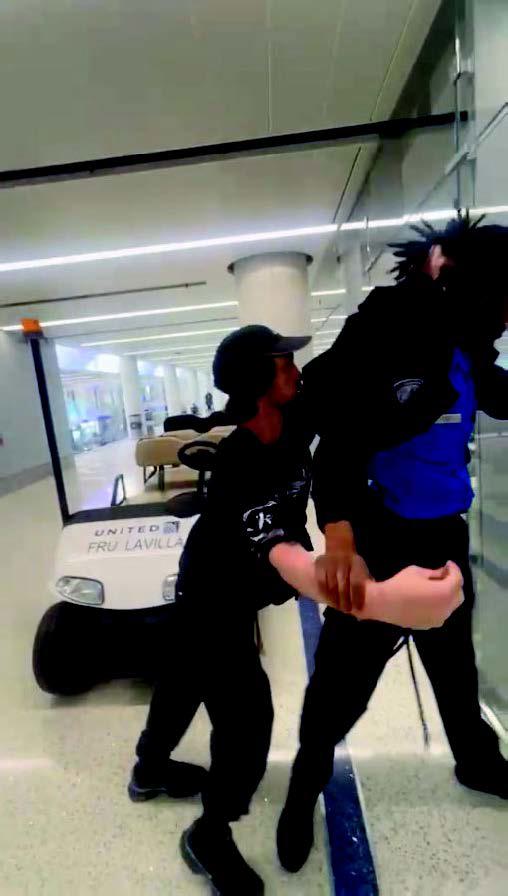
A 35-year-old Australian traveler, Thomas Jesse Bingham, now faces up to eight years in a United States federal prison after a violent confrontation with a Transportation Security Administration (TSA) officer at Los Angeles International Airport. The incident, which unfolded earlier this week, serves as a grim case study in the escalating volatility within American transit hubs. It wasn't a dispute over contraband or a missed connection that sparked the assault. It was a misplaced backpack.
According to federal prosecutors, the altercation began when Bingham approached an on-duty, uniformed TSA officer who was exiting a restroom in the connector between Terminals 6 and 7. Bingham allegedly accused the officer of stealing his passport and bag. When the officer denied the theft, the situation devolved into physical violence. Bingham is accused of grabbing the officer's uniform, ripping the identification lanyard from his neck, and yanking the officer's hair before shoving him into a glass partition.
The irony of the case was revealed shortly after the arrest. Los Angeles Airport Police located Bingham’s "stolen" belongings exactly where he had left them: at a restaurant in Terminal 7.
The Federal Price of Local Outrage
Assaulting a TSA officer is not a simple battery charge handled in local municipal court. Because TSA personnel are federal employees performing security duties, these cases fall under the jurisdiction of the Department of Justice. The charge of assault on a federal officer is a heavyweight offense. Bingham, a resident of Melbourne who was reportedly headed to Las Vegas before his arrest, found out the hard way that the American legal system treats airport security as a protected class.
Bingham was initially detained and released, but federal authorities moved quickly. He was re-arrested on Monday while attempting to board a flight to the United Kingdom, a clear indication that federal agents viewed him as a flight risk. This secondary arrest highlights a level of coordination between airport police and federal prosecutors that many travelers underestimate.
The victim in this case required medical evaluation for injuries to his hand and back. While the physical wounds may heal, the incident underscores a disturbing trend of "displaced aggression" where travelers vent their frustrations on the easiest available target.
Why Airport Security is a Powder Keg
The "why" behind these outbursts often points to a cocktail of environmental stressors. Travel remains a high-stakes, low-control environment. When a passenger loses something as vital as a passport, the body’s "fight or flight" response can override rational thought. In Bingham’s case, the choice was "fight."
However, industry analysts point to a deeper issue. TSA officers are often the face of bureaucracy, tasked with enforcing rules they didn't write. They are frequently understaffed and overworked. This incident occurred near a restroom—a "non-secure" moment for the officer—showing that the risks don't end at the x-ray machine.
The Statistics of Unruly Behavior
Recent data suggests that while the total number of travelers has rebounded to record highs, the percentage of "unruly" incidents remains stubbornly elevated compared to the pre-2020 era.
- Federal Prosecution: The DOJ has signaled a "zero tolerance" policy for airport assaults, shifting away from warnings toward formal indictments.
- Sentencing Guidelines: Under 18 U.S.C. § 111, the maximum penalty of eight years is reserved for assaults involving physical contact or the intent to commit a felony.
- The Travel Ban: Beyond prison, a conviction often results in being placed on the TSA’s No Fly List, effectively ending the individual's ability to travel within the United States indefinitely.
The International Fallout
For an Australian citizen, a federal conviction in the U.S. has life-long implications. It isn't just about the jail time. It’s about the permanent loss of the ESTA (Electronic System for Travel Authorization) privilege. A criminal record for assaulting a federal officer makes future entry into the U.S., and many other Western nations, nearly impossible.
This case isn't an isolated event. Just days prior, another traveler was arrested at Dallas Love Field for a similar violent outburst after his identity couldn't be verified. The pattern is clear: a segment of the traveling public now views physical confrontation as a viable method of dispute resolution.
The reality is that an airport is the worst place on earth to lose your temper. Every square inch is under surveillance. Every officer is backed by the full weight of the federal government. For Thomas Jesse Bingham, a moment of misplaced blame over a backpack left at a dinner table has likely altered the trajectory of his life.
Would you like me to look into the specific legal precedents for international travelers facing federal charges in the United States?