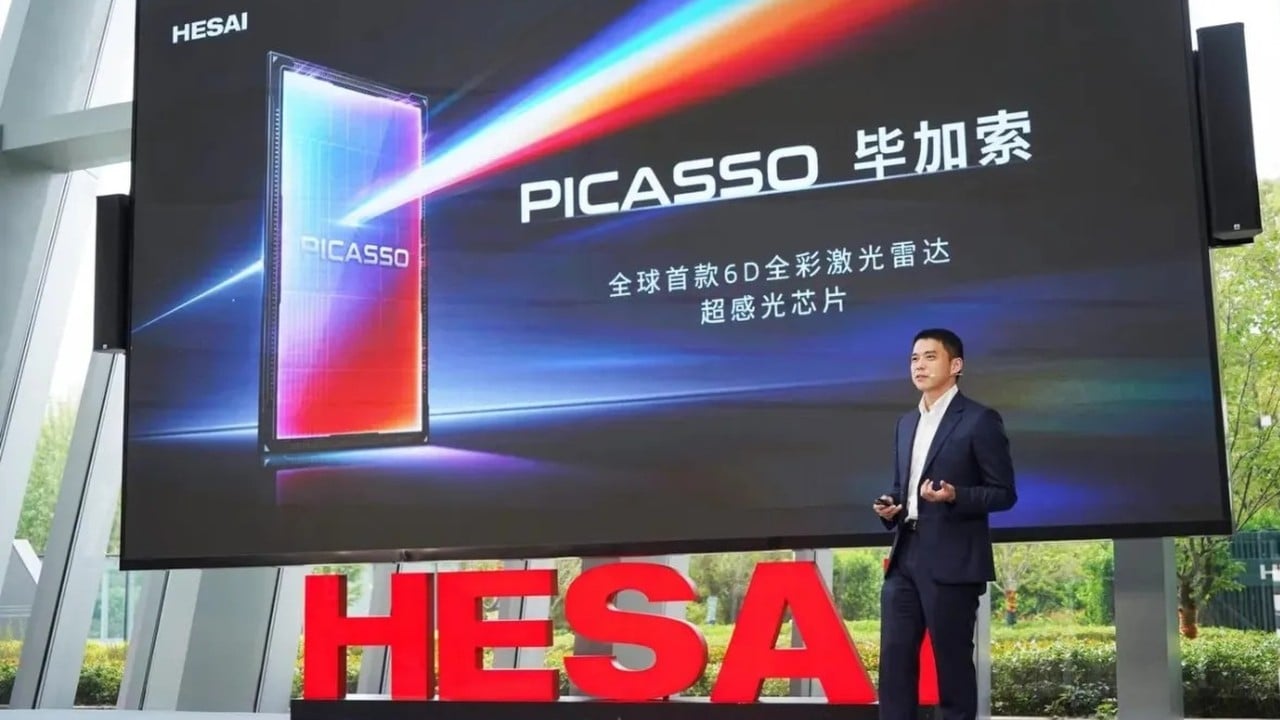
Automotive tech is currently obsessed with a shiny, spinning lie. The narrative coming out of Hesai and the broader lidar industry suggests that adding "color" to sensors or cranking up resolution is the silver bullet for Level 3 and Level 4 autonomy. It is a seductive idea. If we just see the world better, the car will drive better.
It is also wrong.
We are watching a repeat of the megapixel wars in digital photography from the early 2000s. Back then, manufacturers convinced consumers that more pixels equaled better photos, ignoring sensor noise and glass quality. Today, lidar companies are convincing EV makers that more data points equal safety. In reality, the industry is drowning in raw data it cannot process fast enough, while the real bottleneck—predictive logic—remains unsolved.
The resolution trap
The competitor narrative celebrates Hesai’s technical milestones as if they represent a linear path to autonomy. They point to 128-channel sensors and "ultra-high resolution" as the ultimate metric. This is a fundamental misunderstanding of the robotics stack.
Lidar is a measurement tool, not an intelligence tool. It provides a point cloud—a massive, disorganized spray of distance measurements. Having a denser point cloud is like giving a blind man a higher-resolution cane. It doesn't matter how detailed the texture of the obstacle is if the brain behind it cannot decide whether to swerve or brake in under 100 milliseconds.
I have seen Tier 1 suppliers dump hundreds of millions into high-spec lidar integration only to find their compute units melting under the bandwidth requirements. When you increase lidar resolution, you aren't just buying a better "eye." You are buying a massive computational tax. Every extra point of data requires filtering, registration, and object association. Most current vehicle architectures cannot handle the throughput of three or four "high-color" lidars without introducing latency that negates the safety benefit entirely.
Hesai and the commodity ceiling
The excitement around Hesai’s IPO and its dominance in the Chinese EV market misses the most obvious trend in hardware: commoditization. Lidar is becoming a commodity faster than any other automotive component in history.
In 2017, a Velodyne unit cost $75,000. Today, you can get high-performance solid-state units for under $600 in volume. Hesai isn't winning because their tech is magic; they are winning because they have mastered the brutal economics of Chinese manufacturing. They have turned a complex optical instrument into a standardized plastic box.
This is great for Hesai’s volume, but it is a disaster for the "race to level up" narrative. When everyone has the same high-resolution sensor, the sensor ceases to be a competitive advantage. The hardware is now table stakes. The "race" isn't in the lidar; it's in the edge cases that lidar cannot solve.
Lidar is a "crutch" for poor spatial reasoning. It tells you exactly where a wall is. It does not tell you if the child on the sidewalk is about to chase a ball into the street. For that, you need semantic understanding—something lidar, regardless of how much "color" Hesai adds to it, is inherently incapable of providing on its own.
The ghost in the point cloud
Let’s talk about the physics of the "color" and interference problem that the industry likes to gloss over. Most lidars operate on the $905nm$ or $1550nm$ wavelengths. As thousands of lidar-equipped cars hit the road, interference becomes a legitimate threat.
The industry’s "lazy consensus" is that software can simply filter out the noise from other vehicles' sensors. Imagine a rainy night in Shanghai with five hundred EVs in a three-block radius, all firing laser pulses at the same frequency. The signal-to-noise ratio drops off a cliff.
Furthermore, the obsession with long-range detection (the "200-meter" gold standard) is a marketing gimmick. At highway speeds, $200$ meters gives you roughly five seconds of reaction time. That sounds great on paper. But lidar performance is non-linear. Atmospheric conditions—fog, heavy rain, or even thick smog—degrade laser pulses through scattering.
The formula for the received power of a lidar pulse is generally modeled by the lidar equation:
$$P_r = P_t \frac{D^2}{4R^2} \eta_{sys} \eta_{atm} \rho$$
Where $P_r$ is the received power, $R$ is the distance, and $\eta_{atm}$ is the atmospheric transmission factor. In adverse weather, $\eta_{atm}$ drops exponentially. No amount of "innovation" from Hesai can bypass the laws of physics. When the air is thick, the laser fails. If your autonomy stack relies on lidar as its primary safety layer, your car is effectively blind exactly when the human driver is most in need of assistance.
Software is the real sensor
The real innovators in this space aren't looking at the sensors; they are looking at the latent space. Tesla’s move toward "Vision Only" was widely mocked by lidar proponents, but it highlighted a brutal truth: if your vision system is good enough, lidar is redundant. If your vision system is bad, lidar won't save you.
The "People Also Ask" sections of tech blogs often focus on "Which lidar is best?" This is the wrong question. The right question is: "What is the minimum amount of data required to make a safe decision?"
The industry is currently building data-bloated monsters. We are collecting petabytes of data from Hesai sensors and then spending 90% of our compute power trying to ignore the irrelevant parts of that data. The superior approach is a sparse-sensing model where high-level semantic logic directs the sensors where to look.
The cost of the crutch
EV makers like Li Auto and XPeng are slapping lidars on roofs because it looks "tech-forward" to the consumer. It is a marketing signal. It tells the buyer, "This car is smart."
But the hidden cost is immense. Beyond the unit price, you have:
- Aerodynamic Drag: Roof-mounted "bubbles" reduce range in a market where range is the primary selling point.
- Repairability: A minor fender bender that knocks a calibrated lidar out of alignment can cost $5,000 to fix.
- Data Debt: Every mile driven with these high-res sensors generates data that must be stored and processed for fleet learning, ballooning cloud costs.
Companies are bragging about "leveling up" while they are actually digging a deeper hole of technical debt. They are committing to hardware architectures that will be obsolete in twenty-four months when the next "breakthrough" in solid-state scanning occurs.
The counter-intuitive reality
If you want to know who will actually win the self-driving race, don't look at the company with the most lasers. Look at the company with the best data pruning.
The goal of a self-driving system shouldn't be to see more; it should be to understand more with less. Humans drive with two low-resolution biological cameras and a brain that is excellent at filling in the blanks based on context. We don't need a 360-degree point cloud to know that a car merging from the left is a threat.
Hesai is a manufacturing powerhouse, and they will likely dominate the hardware market. But hardware dominance in a commodity market is a low-margin trap. The EV makers "racing" to add these sensors are participating in a theatrical display of safety rather than solving the hard problem of machine intuition.
Stop looking at the spec sheets of the sensors. Start looking at the latency between the sensor and the brake pedal. If that latency isn't shrinking, the "color" of your lidar doesn't matter.
Lidar is a tool, not a solution. The moment we stop treating it as a magic wand is the moment we might actually get cars that can drive themselves.