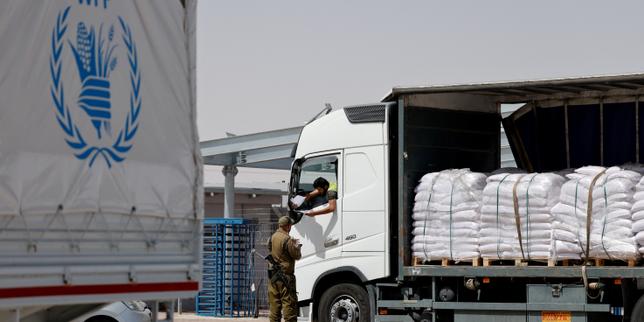
The headlines are predictable. They follow a script written in the 1990s. Israel suspends UNICEF aid. Egypt’s border remains a bottleneck. The UN issues a press release dripping with indignation. We are told the problem is a lack of "political will."
That is a lie.
The problem isn't just politics; it’s a fundamental misunderstanding of high-stakes logistics and the perverse incentives of the humanitarian industrial complex. If you think a few trucks across a border is the metric for success, you’re looking at the scoreboard while the stadium is on fire.
We need to stop treating aid like a Sunday school charity drive and start analyzing it like the volatile, high-risk supply chain operation it actually is.
The Myth of the Open Gate
Standard reporting suggests that if the Kerem Shalom or Rafah crossings were simply "open," the crisis would vanish. This assumes that logistics is a binary toggle—on or off.
It ignores the reality of Last Mile Friction.
In my years analyzing distressed supply chains, the hardest part isn't the first 500 miles; it’s the final 500 yards. When an organization like UNICEF sees a shipment "suspended," the media treats it as a singular act of malice. In reality, it is often a systemic failure of deconfliction.
A border crossing in a war zone is not a highway toll booth. It is a filter. When intelligence suggests that aid manifests are being used to smuggle dual-use materials—items that can be repurposed for military infrastructure—the filter tightens.
The "lazy consensus" says Israel is blocking aid to exert pressure. The nuance? Israel is managing a massive, unvetted "Just-in-Time" inventory system where the "customers" include hostile actors who hijack the delivery trucks the moment they clear the sensor array.
The UNICEF Incentive Structure
Why does UNICEF go to the press the moment a shipment is delayed? Because indignation is their primary marketing tool.
Donors don’t give money to efficient, quiet logistics. They give to "outrage."
If UNICEF successfully negotiated quiet, technical solutions for their Egyptian convoys, their fundraising visibility would plummet. There is a documented "conflict bias" in humanitarian NGOs. They are incentivized to highlight the blockage rather than solve the bypass.
Consider the cost-benefit analysis of these "suspended" shipments.
- Sunk Cost: The goods are already paid for by donors.
- Political Capital: A suspension provides a platform for a global PR campaign.
- Operational Cover: It excuses the internal failure to distribute aid already inside the enclave.
If a private sector logistics giant like DHL or Maersk saw their "entry suspended," they wouldn't just complain to the BBC. They would re-route, diversify their ports of entry, and harden their security protocols. UNICEF continues to rely on a single-thread supply chain because the failure of that thread is more valuable to their brand than the success of a secondary route.
The Egyptian Bottleneck No One Talks About
The media loves to point the finger at Jerusalem. They rarely look at Cairo.
Egypt views the Gaza border not as a humanitarian gateway, but as a national security liability. Every truck that sits on the Egyptian side of the border represents a massive "waiting cost" and a security risk for the Sisi administration.
When aid is "suspended," it’s often because the coordination between the Egyptian Red Crescent and Israeli COGAT (Coordination of Government Activities in the Territories) has broken down due to mutual distrust. Egypt doesn't want to be the permanent warehouse for Gaza, and Israel doesn't trust what's inside the warehouse.
The result? A massive, stagnant inventory of rotting food and expiring medicine that serves as a backdrop for news anchors.
Accountability is a One-Way Street
In any other industry, if you fail to deliver your product to the end user, you are fired. In the humanitarian world, if you fail to deliver, you get a bigger budget next year to "address the growing crisis."
We are witnessing a Moral Hazard of epic proportions.
- The UN avoids the hard work of vetting their local distributors to ensure aid isn't being seized by armed factions.
- Israel uses broad-brush security bans because granular vetting is slow and expensive.
- The Media prints the press releases without checking the warehouse manifests.
Imagine a scenario where aid delivery was handled by private military contractors with a mandate for "Protected Delivery." The trucks wouldn't stop for "security concerns" because they would provide their own security. The reason we don't do this? It would expose the fact that much of the "aid" is being diverted by the very groups the UN claims it isn't working with.
The Brutal Truth of Dual-Use Goods
"It’s just water pipes," the activists say.
"It’s just construction materials for a school," the NGO claims.
In a theater of war, there is no such thing as a "civilian" material that cannot be weaponized.
- Glucose: Used for making rocket fuel.
- Steel pipes: Used for rocket casings.
- Concrete: Used for tunnels.
When Israel suspends a UNICEF shipment, they aren't usually looking for guns. They are looking for the raw components of an underground city. The tragedy is that the "lazy" reporting ignores this technical reality in favor of a simpler "starvation as a weapon" narrative.
If you want to fix the flow of aid, you don't need more "dialogue." You need better X-ray tech and neutral, third-party vetting at the point of origin, not at the point of entry. But that would require the UN to admit that their current vetting process is a sieve.
Stop Asking for "Access" and Start Asking for "Distribution"
The focus on "entry" is a distraction. Even if 1,000 trucks entered tomorrow, the internal distribution network is shattered.
The trucks enter, they are swarmed, the goods are black-marketed, and the people who need them most get nothing. The suspension of aid entry is often a symptom of the fact that the internal "sink" is full—the warehouses inside Gaza are either inaccessible or controlled by the wrong people.
We are obsessed with the "input" because the "output" is too depressing to track.
I’ve seen this in South Sudan. I’ve seen it in Afghanistan. The "Access" narrative is the shield NGOs use to hide their "Distribution" failures.
The High Cost of Neutrality
UNICEF clings to the idea of "neutrality." In a conflict like this, neutrality is a fantasy. By refusing to take a side, they become a tool for whichever side has the most guns on the ground.
If they want their aid to move, they have to stop acting like a neutral observer and start acting like a stakeholder. That means:
- Publicly naming the groups hijacking aid. (They won't, it’s too dangerous for their staff).
- Accepting Israeli security monitors on every truck. (They won't, it violates their "sovereignty").
- Building a dedicated, hardened corridor. (They won't, it costs too much).
Instead, they choose the cheapest option: The Press Release.
The Path Forward (That No One Wants)
If we actually cared about the people in the enclave, we would stop treating the border as a political statement and start treating it as a port.
- Move the vetting to Cyprus or Greece. Inspect every ounce of aid there. Seal it in GPS-tracked, tamper-proof containers.
- Automated Crossings. Remove the human element of "suspension." Use automated scanners and conveyor systems to move vetted goods across the line.
- Direct-to-Community Delivery. Bypass the large warehouses that act as magnets for militants.
But none of this will happen. Why? Because the current system of "Crisis, Suspension, Outrage, Donation" is too profitable for the bureaucracy to dismantle.
The suspension of UNICEF aid isn't a failure of the system. It is the system functioning exactly as intended—to maintain a state of perpetual, fundable emergency.
Quit reading the headlines. Start reading the shipping manifests.
Stop mourning the "blocked" aid and start demanding to know where the "delivered" aid actually went.
Would you like me to analyze the specific logistics of the Cyprus maritime corridor to see if it actually solves these friction points?