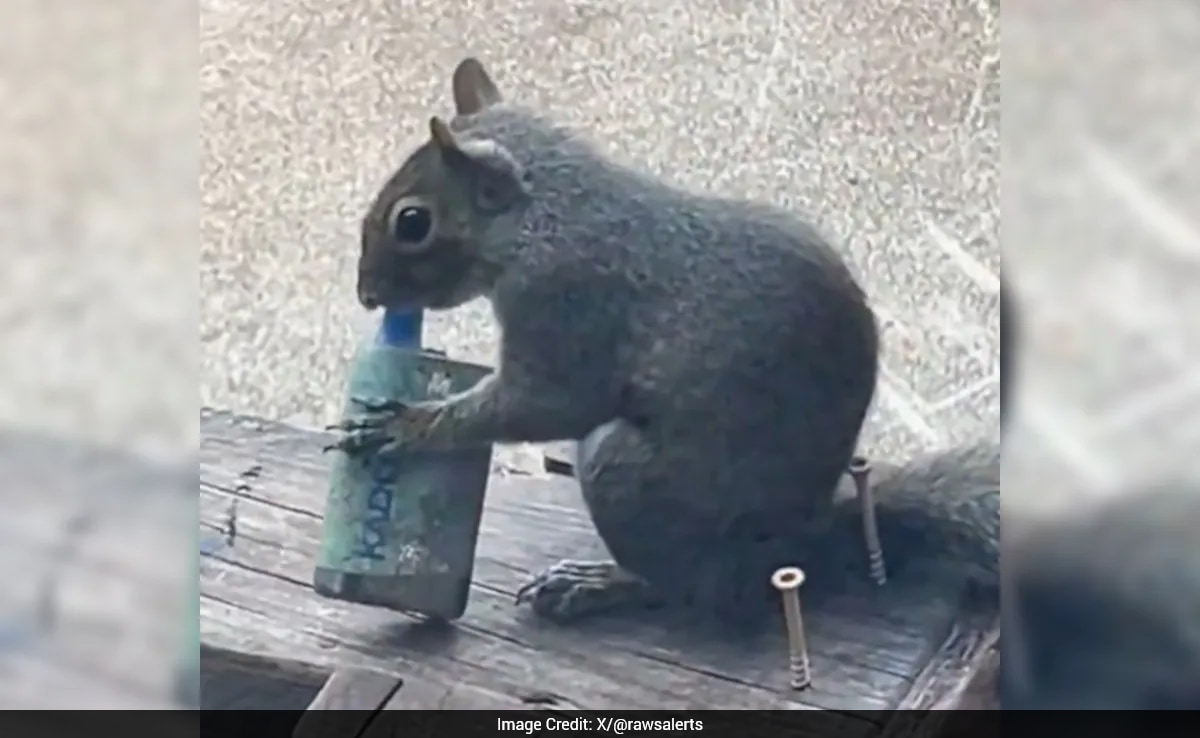
The streets of London are currently hosting a bizarre and unsettling ecological experiment. Viral footage of squirrels clutching discarded plastic vapes, gnawing on mouthpieces, and inhaling chemical residue is not a lighthearted internet moment. It is a symptom of a massive waste management failure. These urban rodents are attracted to the potent, synthetic fruit scents—strawberry, mango, and "blue razz"—which they mistake for high-calorie forage. Once they bite into the casing, they are exposed to concentrated nicotine salts and heavy metals, creating a new class of "vape-addicted" wildlife in the heart of the capital.
The Toxic Lure of Synthetic Fruit
Squirrels are opportunistic foragers with a sense of smell far more acute than a human's. In a natural setting, a sweet, fruity scent signals a vital energy source. In the concrete sprawl of Westminster or Camden, that scent now leads them to brightly colored lithium-ion batteries wrapped in plastic.
When a squirrel finds a discarded disposable vape, it isn't looking for a nicotine hit. It is hunting for sugar. However, the result is the same. The nicotine used in modern disposables is often in the form of protonated nicotine salts, which are absorbed much faster than the freebase nicotine found in older products. For a creature weighing less than a kilogram, the residue left in a "dead" vape is more than enough to cause significant neurological distress, tremors, and heart palpitations.
This is not just about the chemical buzz. The physical design of these devices is a death trap. To get to the "fruit," squirrels use their powerful incisors to rip through the outer shell. This frequently punctures the internal lithium battery. If the battery vents, the squirrel faces chemical burns or a small, intense fire in its mouth. Even if the battery remains intact, the animal is still ingesting a cocktail of vegetable glycerin, propylene glycol, and artificial flavorings that were never intended for the digestive system of a mammal.
A Disposable Disaster in the Parks
The surge in wildlife encounters with vapes tracks perfectly with the explosion of the disposable market. These devices are designed to be used and thrown away, yet London’s infrastructure is completely unprepared for the volume.
- 1.3 million disposable vapes are thrown away in the UK every single week.
- Most of these end up in standard litter bins or on the pavement, where they are easily accessible to scavengers.
- The lithium contained in these discarded devices annually is enough to power roughly 1,200 electric vehicle batteries.
The local councils are struggling. Most public bins are not fire-rated for lithium batteries, nor are they "squirrel-proof" in the way that bins in national parks are designed. In parks like St. James’s or Hyde Park, the proximity of heavy foot traffic to dense squirrel populations creates a high-density "vape-forage" zone. We are seeing a shift in behavior where squirrels are actively bypassing traditional nuts and seeds to investigate the colorful plastic cylinders left behind by commuters and tourists.
The Biological Cost of Nicotine Exposure
We have to look at what this does to the animal long-term. Nicotine is a potent insecticide; in fact, its original purpose in plants was to ward off herbivores. When a squirrel ingests it, the chemical hijacks their nervous system.
Veterinary experts note that nicotine toxicity in small mammals manifests as hyper-excitability followed by extreme lethargy. It disrupts their ability to hide from predators or navigate the high-wire act of London’s canopy. A "vaping" squirrel is a distracted squirrel, making it an easy target for foxes or a victim of a fall from a height.
Beyond the immediate buzz, there is the issue of bioaccumulation. These devices contain lead, nickel, and chromium. As squirrels gnaw on the components, these metals enter the local food chain. When a hawk or an owl eats a squirrel that has been "vaping" on discarded disposables, the toxins move up the ladder. This is an environmental poisoning event happening in slow motion, disguised as a viral video.
Why the Current Ban Might Fail the Environment
The UK government has moved to ban disposable vapes, citing both youth uptake and environmental damage. While this looks good on a press release, it ignores the massive "legacy waste" currently sitting in landfills and drainage systems.
A ban on future sales does not clean up the millions of devices already embedded in the urban environment. Furthermore, the ban is likely to trigger a black market of unregulated, even more dangerous products. These "gray market" vapes often have even less structural integrity, meaning they leak their toxic e-liquid even more easily when chewed by a curious animal.
The real issue is the circular economy failure. We have allowed a product to exist that combines a neurotoxin, a heavy metal, a lithium battery, and a plastic shell into a single, unrecyclable unit. Expecting a squirrel—or even a distracted human—to distinguish between a harmless piece of trash and a chemical hazard is a losing game.
The Myth of Biodegradable Alternatives
Some companies have attempted to market "eco-friendly" vapes made of cardboard or wood pulp. From a journalistic perspective, this is often little more than greenwashing. The internal battery and the nicotine reservoir remain essentially the same. For a squirrel, a cardboard-wrapped vape is even more attractive because it is easier to tear apart. The "green" version of the problem might actually be accelerating the rate at which wildlife can access the toxins inside.
The industry analyst’s view is clear: the problem isn't the material of the shell; it’s the existence of the category. You cannot have a "safe" disposable lithium product in an urban ecosystem.
The Public Health Mirror
What we see in the squirrels is a reflection of our own public spaces. If our parks are so saturated with chemical waste that the local fauna is being altered, we have lost control of our shared environment. The sight of a squirrel "vaping" should be treated with the same gravity as a seabird choked by a plastic ring. It is an indictment of a "convenience at any cost" culture that has prioritized a $5 nicotine hit over the basic cleanliness of our city.
The urban squirrel is a survivor. It has adapted to traffic, pigeons, and the scarcity of natural food. But it cannot adapt to the chemical engineering of the modern vape industry. We are forcing a prehistoric biology to contend with 21st-century chemical waste, and the results are predictable.
Infrastructure is the Only Fix
If we are to stop this, we need more than just bans. We need:
- Specialized Battery Disposal: High-visibility, fire-safe vape disposal points at the entrance of every major public park.
- Wildlife-Resistant Bins: Retrofitting London’s bin network to prevent scavengers from pulling out waste.
- Manufacturer Liability: Forcing the companies that profit from these devices to pay for the cleanup of the parks they have polluted.
The "vaping squirrel" isn't a funny mascot for a weird news cycle. It is a biological warning. It is a sign that our waste has become so chemically attractive and so physically pervasive that it is rewriting the behavior of the animals we live alongside.
The next time you walk through a London park and see a flash of red or gray fur by a bin, look closer at what they are carrying. It’s rarely an acorn anymore. We have turned our wildlife into the unwilling testers of a product they can't understand and shouldn't have access to. The solution isn't just to stop selling these things; it's to start taking responsibility for the mountain of plastic and nicotine we've already let pile up in the grass.
Stop treating the sight of a vaping animal as a curiosity. Start treating it as a hazardous material spill that is currently being eaten by the local population. Only then will the policy catch up to the reality of the crisis.