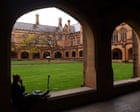
The sun in Queensland has a particular way of bleaching the world. On a typical Tuesday at the University of Queensland, the light bounces off the sandstone with a blinding, optimistic intensity. For most students, the heat is just a signal to find an air-conditioned library or a cold beer. But for those standing on the paved plazas with cardboard signs, that sun feels like a spotlight.
When you are twenty years old and far from home, a spotlight can be a terrifying thing.
We often talk about "pro-democracy protests" as if they are abstract political maneuvers, the kind of things that happen in textbooks or on the evening news. We use sterile language like diplomatic friction or consular assistance. But for a student we will call Chen—a composite of the very real, very frightened young people currently caught in a geopolitical pincer—the protest wasn't an abstract exercise. It was a moment of loud, sweaty, heart-pounding bravery in the Brisbane sun.
He held a sign. He shouted a few slogans about Hong Kong. He thought he was safe because he was standing on Australian soil.
He was wrong. The ground beneath his feet might have been Australian, but the digital sky above him was anything but.
The Invisible Witness
There is a specific kind of silence that follows a knock on a door in the middle of the night. It is not the silence of peace; it is the silence of a life being rewritten. Recent reports suggest that a student who participated in those Australian rallies returned home to China, only to disappear into the maw of a legal system that views a Brisbane sidewalk as a battlefield.
How does a shout in Queensland reach an interrogation room in Guangzhou?
The answer lives in the pocket of every student. It is the glowing screen of a smartphone. While Australian universities pride themselves on being bastions of free speech, they have become unwilling laboratories for transnational repression. We aren't just talking about spies in trench coats. We are talking about "patriotic" classmates with high-definition cameras. We are talking about WeChat groups where a single screenshot functions as a digital death warrant.
Consider the mechanics of the betrayal. You are at a rally, feeling the rush of solidarity. You see a familiar face from your chemistry lecture. You smile, thinking they are there for the same reason. But they aren't holding a sign; they are holding a phone. They are recording the curve of your jaw, the specific shade of your hoodie, the way you laugh when a friend hands you a megaphone.
By the time you sit down for dinner, your face is already being processed by software thousands of miles away. You have been filed, indexed, and waited for.
The Price of a Plane Ticket
For the Australian government, this is a matter of sovereignty and "serious concern." For the university administration, it is a delicate balancing act involving international tuition fees and "inclusive environments." But for the student standing at the airport gate three months later, it is a visceral, physical dread.
Imagine the walk through customs. The air in the terminal is thick with the smell of floor wax and recycled oxygen. You have your gifts for your parents in your carry-on—vitamins, Australian wool, maybe a keychain from the Gold Coast. You are thinking about the home-cooked meal waiting for you.
Then, a hand on the shoulder.
A quiet request to step into a side room.
The questions start. They don't ask about your grades. They don't ask about your flight. They show you a photo. It is grainy, taken from a distance, but the Brisbane sun is unmistakable. There you are, looking younger, looking bold, holding a piece of cardboard that the men in the room call a threat to national security.
The Australian government is now facing calls for a formal inquiry into these disappearances. It is a necessary step, but it feels like trying to put a bandage on a shadow. The reality is that our institutions of higher learning have become transparent. We invited the world in, but we forgot to check if the windows were one-way glass.
The Digital Panopticon in the Classroom
We have entered an era where physical distance is a lie. The "border" is no longer a line on a map; it is a persistent connection to a server in a different jurisdiction.
When a student uses a university’s Wi-Fi to post a critique of a regime, or when they attend a seminar on human rights, they are often performing an accidental act of martyrdom. There is a pervasive, gnawing anxiety that permeates the international student community. It’s a quiet hum of self-censorship. You see it in the way students look over their shoulders before answering a question in a political science tutorial. You see it in the burner phones and the pseudonyms.
This isn't paranoia. It is a rational response to a documented reality.
The data suggests a chilling trend. It isn't just about the individuals who are jailed. It is about the thousands of others who see the headlines and decide to stay quiet. The "inquiry" being demanded by activists isn't just about finding one missing student; it's about asking if Australian liberty is a product we only sell to those with the right passport.
If a student can be snatched from their life because of words spoken in an Australian courtyard, does free speech actually exist on that campus? Or is it merely a temporary permit that expires the moment you clear customs?
The Weight of the Inquiry
Politicians move slowly. They use words like bilateral and measured. They wait for briefings. But the families of the disappeared don't have the luxury of the news cycle. For them, every day is a frantic search for news through backchannels, a desperate attempt to find out if their child is in a detention center or a "re-education" facility.
The calls for an inquiry are gaining momentum because the alternative is an admission of cowardice. If we allow foreign states to police the behavior of people on our soil, we have effectively outsourced our justice system. We have told every international student that our protection is an illusion, a beautiful sandstone facade that crumbles the moment it is poked by a foreign ministry.
The stakes are invisible until they are agonizingly real.
We are talking about the "hidden cost" of international education. It’s a cost paid in psychological trauma, in fractured families, and in the slow, agonizing realization that nowhere is truly far enough away.
Think about the courage it takes for a twenty-year-old to stand up against a superpower. Now think about the coldness of a system that watches them do it, records it, and waits for them to fly back into the trap.
The inquiry must happen. Not because it will solve the geopolitical tension—it won't—but because we owe it to the ghosts of those Brisbane afternoons. We owe it to the kids who thought that for one brief moment, under the searing Australian sun, they were finally allowed to breathe.
They weren't just protesting for a cause. They were testing the limits of our promise.
Right now, that promise looks as thin as a sheet of cardboard.
There is a photo somewhere in a file. It shows a student laughing in the sun, holding a sign, unaware that the camera clicking in the distance is the sound of a door locking shut.