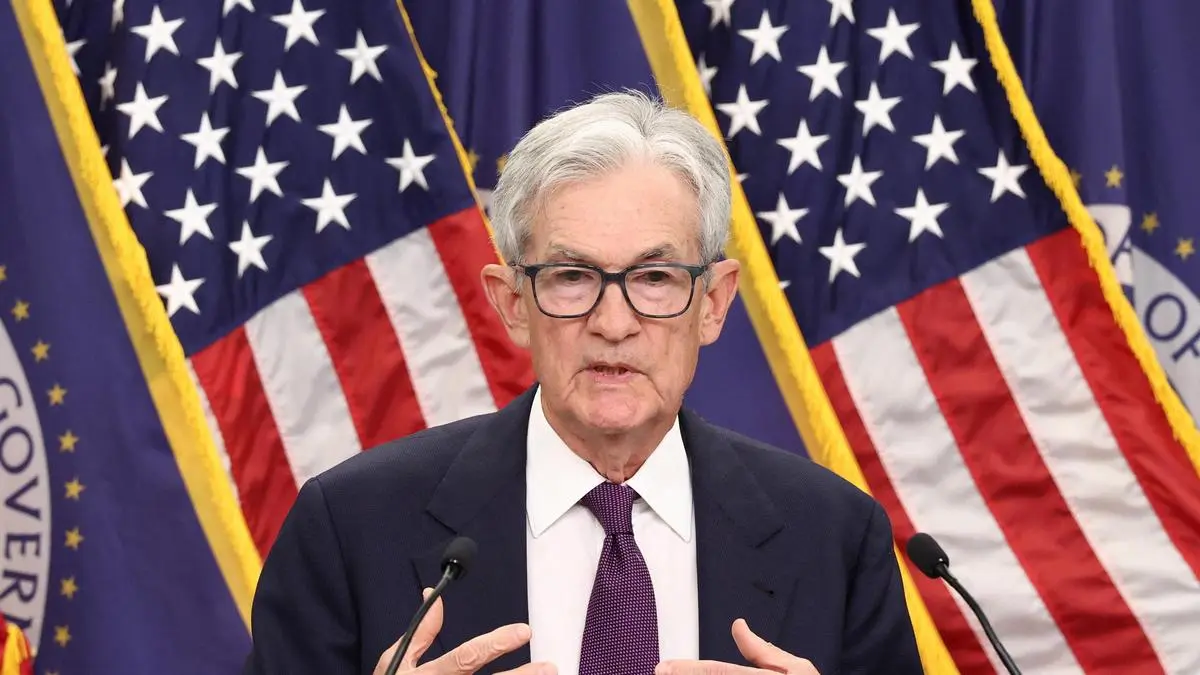
Jerome Powell sits in a room where the air feels heavy with the weight of millions of kitchen table conversations he will never hear. On the surface, the news out of the Federal Reserve today is a flat line—a mathematical shrug. The central bank held interest rates steady. Powell confirmed he isn't going anywhere. To the casual observer, it is a non-event. To the family sitting in a flickering fluorescent kitchen in suburban Ohio, trying to figure out if they can afford a third child or a new used car, it is the invisible hand tightening its grip.
Economics is often treated like a weather report, something that happens to us from a great height. We hear terms like "basis points" and "inflationary targets" and our eyes glaze over. But these aren't just numbers. They are the friction between you and your dreams. For an alternative look, read: this related article.
The Quiet Power of the Pause
When the Fed decides to "hold," they aren't just resting. They are watching a giant, complex machine—the American economy—and deciding whether to throw more sand into the gears or let them spin a little faster. Interest rates are that sand. When rates are high, everything gets harder to turn. Borrowing money for a house becomes a mountain climb. Starting a small business feels like running underwater.
Consider a hypothetical woman named Elena. She owns a small landscaping business. For two years, she has wanted to buy a second truck to expand her crew. But because the Fed has kept rates at these levels, the monthly payment on that truck loan would eat her entire profit margin. She stays small. She doesn't hire the neighbor’s kid who needs a summer job. The ripple effect of a single "hold" decision at a mahogany table in D.C. reaches all the way to a driveway in Des Moines. Further insight on the subject has been provided by MarketWatch.
The Fed is currently in a staring contest with the ghost of the 1970s. They are terrified that if they lower rates too soon, inflation will roar back like a fire that wasn't fully extinguished. So, they wait. They keep the pressure on. They keep the sand in the gears.
The Architect Stays in the House
The second half of today’s news is about the man himself. Jerome Powell isn't just a bureaucrat; he is the pilot of a plane that is currently trying to land on a moving aircraft carrier in a storm. The fact that he is staying on the board provides what the markets call "certainty."
In plain English? It means the people with the most money trust that the person in charge won't panic.
There is a specific kind of tension in being the most powerful person in the global economy. Powell’s words are dissected like holy scripture. If he coughs during a press conference, billion-dollar algorithms sell off stocks in a heartbeat. By committing to stay, Powell is telling the world that the plan remains the plan. There will be no sudden swerves. No radical shifts in philosophy.
But for the person paying 22% interest on a credit card balance, this stability feels a lot like stagnation. The "soft landing" everyone talks about—where inflation drops without a massive recession—is a miracle of engineering if it works. But for those on the ground, a soft landing can still feel like a very hard bump.
The Hidden Tax of Waiting
We talk about inflation as if it’s just the price of eggs. It’s more than that. It is the theft of time. When prices rise faster than wages, you have to work more hours just to stay in the same place. You are trading more of your life for the same gallon of milk.
The Fed’s current strategy is a gamble on patience. They believe that by keeping rates steady, they can eventually starve inflation to death. But the cost of that starvation is felt by the borrower. The gap between the "haves"—those with cash sitting in high-yield savings accounts earning 5% interest—and the "have-nots"—those trying to buy their first home at a 7% mortgage rate—is widening into a canyon.
It is a strange irony. To save the economy, the Fed has to make life a little bit more expensive for everyone, hoping that the collective pain will eventually lead to a collective cure.
The Human Cost of Data Points
Behind every "data-dependent" decision Powell makes, there is a person waiting for a break.
Think of a young couple, let's call them Mark and Sarah. They saved for five years to get a down payment together. In their minds, they are doing everything right. But every time the Fed holds rates steady, the math of their future gets a little bleaker. The house they could have afforded three years ago is now a fantasy. They aren't looking at "basis points." They are looking at a spare bedroom that will remain empty because they can't afford to move.
This is the emotional core of the Federal Reserve. It is the institution that manages our hope. When they keep rates high, they are effectively telling us to wait. Wait to buy. Wait to grow. Wait to live.
Powell’s permanence on the board suggests that this "waiting room" period isn't ending anytime soon. He is a man of deliberate, slow movements. He is not a gambler. He is a technician. He looks at a spreadsheet and sees a path to stability. We look at our bank accounts and see a struggle.
The Weight of the Gavel
The Federal Reserve is often described as a "lender of last resort," but it is also the ultimate arbiter of American ambition. By choosing to hold, they are sending a clear message: the war against rising prices is not over, and they are willing to sacrifice short-term growth for long-term health.
It is a cold, calculated perspective. It has to be. If the Fed operated on emotion, they would have slashed rates months ago to make everyone feel better, only to watch the price of bread double by next Christmas. Their job is to be the adult in the room who says "no" when everyone wants to spend.
But being the adult in the room is a lonely, thankless task. Powell knows that for every headline praising his "steady hand," there is a family wondering why their life feels like it’s stuck in neutral. He is the man holding the brakes on the American dream, waiting for the engine to cool down just enough to safely let it roar again.
The gavel has fallen. The rates remain. The pilot is still in his seat.
And across the country, millions of people look at their bills, take a deep breath, and continue to wait for a signal that the wind has finally changed.