The screens didn’t always glow all night.
There was a time, within living memory, when the world simply went to sleep. You would sit in front of a heavy wooden television set, watch the local news, catch a sitcom, and eventually, the national anthem would play over a grainy image of a waving flag. Then came the "snow"—that frantic, black-and-white static that hummed in the dark, signaling that the day was over and nothing else was happening.
Ted Turner looked at that static and saw a lie. He knew the world never actually stopped. Somewhere, a war was starting. Somewhere else, a market was crashing. He bet his entire life that we wouldn't just want to watch it happen; he bet we needed to.
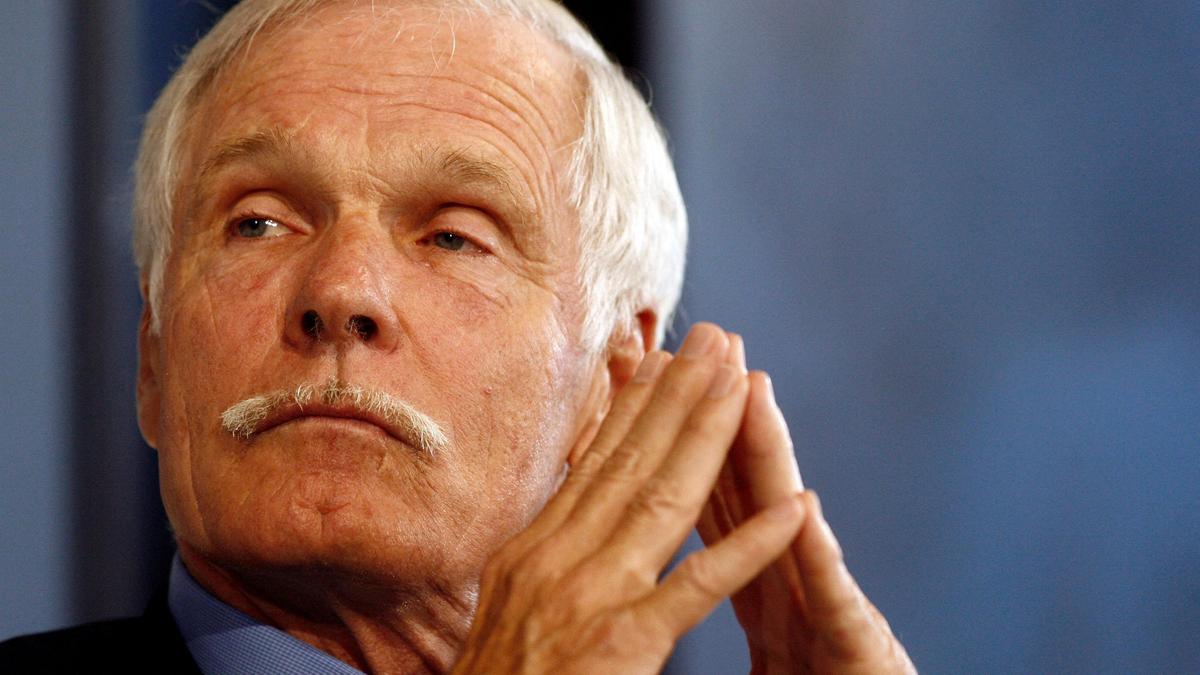
On a quiet Tuesday, the man who forced the world to keep its eyes open finally closed his own. Ted Turner, the "Mouth of the South," the yachtsman, the billionaire, and the architect of our modern obsession with the "now," has died at 87.
The Gamble of the Chicken Noodle Network
To understand the weight of Turner’s passing, you have to look past the billions of dollars and the sprawling ranches in Montana. You have to go back to 1980, to a cramped basement in Atlanta.
The industry giants in New York laughed at him. They called his idea the "Chicken Noodle Network." The logic of the era was ironclad: news was something you did for thirty minutes at dinner time to satisfy a civic duty, and then you moved on to the real money—soap operas and variety shows. Nobody, the experts insisted, wanted to watch news at 3:00 AM.
Turner didn't care about the experts. He was a man defined by a restless, almost manic energy that bordered on the mythological. He had already saved a failing UHF station by airing old movies and wrestling. He had won the America’s Cup. He lived as if the wind were always at his back and he was afraid of what would happen if the air went still.
When CNN launched on June 1, 1980, it was a mess. Satellites failed. Anchors tripped over lines. It lost money at a rate that would have made a sane man jump ship. But Turner wasn't interested in sanity; he was interested in a legacy that would outlast the sun. He famously told his staff that the network wouldn't stop broadcasting until the world ended. He even prepared a video for the occasion: a military band playing "Nearer, My God, to Thee," to be played by the last surviving employee before they turned off the power.
He wasn't joking.
The Night the World Changed
For a decade, CNN was a curiosity. Then came Baghdad.
In 1991, during the First Gulf War, the traditional networks did what they always did: they waited for the film to be processed and the scheduled broadcast to begin. Turner’s team didn't wait. They stayed on the line. As anti-aircraft fire lit up the sky over the Al-Rashid Hotel, the world watched in real-time.
That was the "CNN Effect." It was the moment the umbilical cord between the event and the report was severed. Suddenly, leaders in the White House were learning about world events at the same time as a plumber in Ohio. Information became a flood rather than a filtered stream.
We live in the wreckage of that explosion today. Every time you refresh a social media feed, every time a push notification buzzes on your wrist, you are living in the ecosystem Ted Turner built. He stripped away the luxury of "later." He replaced it with the relentless, crushing weight of "now."
The Complexity of the Maverick
It is easy to paint Turner as a caricature—the loud-mouthed tycoon with the pencil-thin mustache who bought the Atlanta Braves just so he could manage them for a day. But the human being behind the headlines was far more fractured and fascinating.
He was a man haunted by the ghost of his father, Ed Turner, who died by suicide after years of demanding impossible excellence from his son. Ted spent his entire life running away from that shadow, or perhaps trying to catch up to it. He was married and divorced three times, most famously to Jane Fonda, a pairing that felt like two planets colliding. He was open about his struggles with bipolar disorder long before it was socially acceptable for a titan of industry to admit to a "chemical imbalance."
He was also a man who realized, perhaps too late for some, that the planet he was documenting was dying.
Turner became one of the greatest philanthropists in history, not through quiet donations, but through the same brash grandiosity that built CNN. In 1997, he pledged $1 billion to the United Nations. He didn't do it behind closed doors; he announced it at a gala, partially to shame other billionaires into following suit. He spent his later years buying up millions of acres of American land, becoming the largest private landowner in the country for a time, not to build skyscrapers, but to save the bison.
He wanted to preserve the wildness of the world even as his own creation—the 24-hour news cycle—was busy taming it with data and noise.
The High Price of Perpetual Motion
There is a tragedy in the Turner legacy that we are only now beginning to grapple with. By proving that people would watch the news all day, he inadvertently birthed the monster of the "attention economy."
When you have twenty-four hours to fill and nothing is happening, you have to make something happen. You turn policy debates into sports matches. You turn tragedy into a spectacle. You create the "breaking news" banner for a story that isn't actually breaking. Turner gave us the window to the world, but he couldn't control what we saw through it, or how the view would eventually distort our sense of reality.
In his final years, Turner retreated from the noise. He lived a quieter life, diagnosed with Lewy body dementia, a cruel irony for a man whose mind was once the most frantic engine in global media. The man who gave us the "Global Village" found himself in a shrinking one.
He once said that his biggest fear was being "mediocre." He avoided that fate by a wide margin. He was a visionary who was often wrong, a healer who was often abrasive, and a builder who didn't always consider the cost of the foundations.
The Final Broadcast
Think of a newsroom at three in the morning.
The blue light of a hundred monitors reflects off the glass. There is a low hum of electricity, the sound of a world that refuses to sleep. Somewhere, an editor is cutting a clip of a protest; somewhere else, a producer is shouting about a lead.
This is the monument Ted Turner left behind. It isn't made of marble or bronze. It’s made of light and speed. It’s the uncomfortable truth that we can never go back to the waving flag and the static of the midnight sign-off. We are awake now, for better or worse, and we have been for forty-six years.
The band didn't play "Nearer, My God, to Thee" today. The world didn't end. The cameras stayed on. The scroll at the bottom of the screen kept moving, reporting on the death of the man who started the scroll in the first place.
The lights are still on, Ted. We're all still watching.