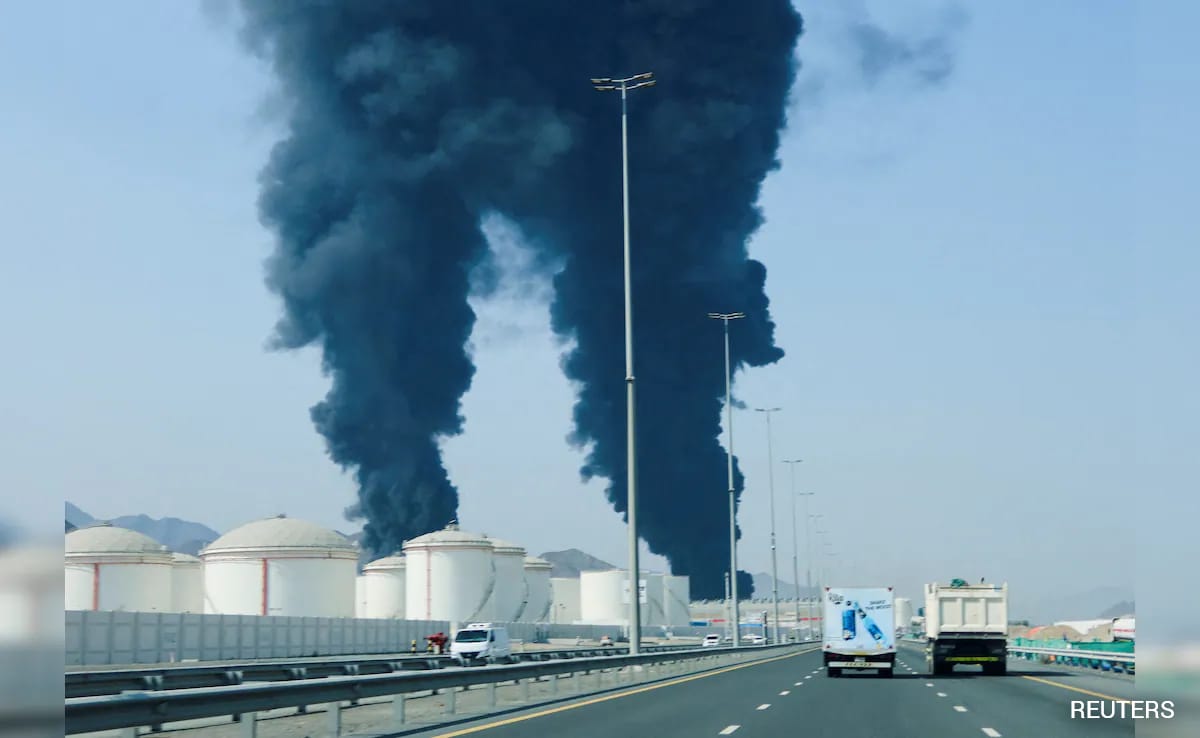
The May 4, 2026, drone strike on the Fujairah Petroleum Industry Zone in the United Arab Emirates is not a random criminal act. It is a precise kinetic signal within a specific operational cycle. To understand why three Indian nationals were injured in a facility designed for hardened industrial resilience, one must move past the incident's emotive surface and examine the geometry of the current escalation between Tehran and Washington.
The attack serves as the opening move in a new phase of the "Project Freedom" confrontation—a direct response to the U.S. Navy’s attempt to escort commercial shipping through the Strait of Hormuz. When the United States signals its intent to override a blockade, regional actors prioritize the destabilization of alternative transit routes to maintain leverage. Fujairah is the single most critical of these alternatives.
The Strategic Value of the Target
Fujairah’s primary utility is its location outside the Strait of Hormuz. For the UAE and global energy markets, this port provides an escape valve from the kinetic risk inherent in the Persian Gulf's narrow chokepoints. By targeting the facility, Tehran is not merely attacking infrastructure; it is signaling the collapse of the "safe zone" concept.
The strike demonstrates two specific military objectives:
- Range Validation: The successful penetration of air defense systems—even if the majority of the projectile payload was intercepted—validates the offensive reach of drone and missile assets against high-value, hardened infrastructure.
- Psychological Denial: By attacking a facility that is geographically removed from the central conflict zone, the aggressor extends the perimeter of the war. It forces the UAE and its partners to distribute defensive assets across a wider, less efficient footprint.
This is a classic denial-of-service attack, not against the network, but against the infrastructure of energy logistics. If the perceived safety of the Fujairah transit option degrades, insurance premiums rise, shipping schedules freeze, and the global market’s ability to bypass the Strait of Hormuz evaporates.
The Mechanism of Expatriate Vulnerability
The injury of three Indian nationals highlights the "human liability" variable in modern regional conflicts. India maintains a significant, non-combatant workforce across the Gulf Cooperation Council (GCC) countries. In a conventional military engagement, this workforce is an unintended, yet statistically inevitable, target.
This creates a rigid diplomatic constraint for New Delhi. India’s national interest relies on two pillars: the continuous flow of energy and the safety of its diaspora. These interests are currently in direct opposition. A hawkish response to Iranian aggression risks alienating Tehran, potentially destabilizing energy supply chains and further endangering the diaspora. Conversely, a passive response incentivizes future risk-taking by combatants who realize that the cost of "collateral damage" is only diplomatic friction, not military retaliation.
The "unacceptable" designation by the Ministry of External Affairs is a signal of diplomatic boundary setting. However, operational reality dictates that boundary setting without enforcement mechanisms—kinetic or economic—has a zero-sum effect on deterrence.
The Project Freedom Escalation Loop
The timing of this strike, immediately following the U.S. initiation of "Project Freedom," establishes the causal chain.
- The Stimulus: Washington moves to forcefully escort vessels, effectively challenging the Iranian blockade of the Strait of Hormuz.
- The Counter-Signal: Tehran strikes the very facility (Fujairah) that allows the region to circumvent the blockade.
- The Strategic Outcome: The escalation loop creates a "security trap." The more Washington protects maritime assets, the more the regional infrastructure—the ports, pipelines, and logistics hubs—becomes a target.
Tehran’s stated claim that the strike lacked a "pre-planned program" and resulted from "U.S. military adventurism" is tactical rhetoric. It is designed to frame the defender as the provocateur. Analytically, the strike is a measured, high-confidence operation intended to remind stakeholders that the Persian Gulf is an integrated, indivisible security environment.
Assessing the Operational Risk
The immediate risk is not total war, but sustained, low-intensity disruption.
- Infrastructure Degradation: The physical destruction of a port facility is secondary to the disruption of operations. Even temporary shutdowns create systemic bottlenecks.
- Asset Pricing: Markets factor in the cost of risk. The "Fujairah premium" on oil and shipping will rise, not because the port is destroyed, but because the perception of its immunity to regional conflict is broken.
- Diplomatic Overreach: The reliance on neutral mediation becomes less effective when the conflict moves from diplomatic negotiation to infrastructure-targeting.
Strategic Recommendation for State Actors
The current situation demands a move beyond diplomatic condemnation. The following actions define the necessary strategic adjustments:
- Hardening Logistics Infrastructure: The UAE and its partners must transition from relying on centralized, fixed-point defenses to distributed, mobile air-defense systems. The concentration of high-value energy assets requires an automated, tiered defense grid that accounts for low-altitude, high-volume drone swarms.
- Diaspora Risk Mitigation: For nations with large expatriate populations in the region, the strategy must pivot from "reactive evacuation" to "continuous contingency planning." This involves establishing secure extraction zones, redundant communication channels, and decentralized medical response capabilities that do not rely on local infrastructure that may become a target.
- Bifurcated Supply Chains: Energy importers must diversify transit routes at the source, prioritizing pipelines that terminate outside the Gulf's immediate risk perimeter. The reliance on Fujairah as a "safe" exit point is a single point of failure that must be addressed through redundancy in Oman, the Red Sea, or increased rail-based transit to the Arabian Sea.
The Fujairah strike is a bellwether for the next six months of regional volatility. The period of "calm" is not a ceasefire; it is a tactical pause. Strategists should expect the kinetic frequency to increase as Tehran attempts to counter the U.S. presence by increasing the operational cost of the region's energy logistics. Predictability is now the rarest commodity in the Persian Gulf. Organizations and states that plan for a volatile, multi-nodal threat environment—rather than a return to the pre-2026 status quo—will retain the highest degree of operational agency.