The coffee in the Bandung station kiosk was still too hot to drink when the Turangga Express pulled away from the platform. It was Friday morning. In West Java, the air usually carries a certain humidity that promises rain by afternoon, but at 6:00 AM, it was just a cool, grey blanket over the tracks. Passengers settled into their seats, some leaning foreheads against the glass, others scrolling through phones, oblivious to the fact that miles away, another train was coming for them.
Distance is a funny thing. We measure it in kilometers, but on a single-track railway, distance is actually measured in seconds and the terrifying absence of a signal.
Near Cicalengka, the landscape is a lush, emerald green, dominated by rice paddies that look like mirrors when the sun hits them right. But that morning, the green was interrupted by the scream of tearing steel. The Turangga Express, a long-distance giant traveling from Surabaya, collided head-on with a local Commuter Line Bandung Raya.
Silence followed. Not a peaceful silence, but the heavy, ringing vacuum that occurs after a physical trauma so great the brain refuses to process the sound.
The Geometry of a Disaster
When two masses of steel weighing hundreds of tons meet at speed, the physics are indifferent to the lives inside. The impact happened at approximately 6:03 AM. The local train, carrying workers and students, was crumpled like a discarded soda can. The express train, heavier and faster, rode up over the local cars in a grisly display of kinetic energy.
Imagine the inside of a watch being crushed by a hammer. That was the state of the driver's cabin.
The official count eventually settled on four dead. All were railway employees—the men who keep the veins of Java pumping. One was a driver, another an assistant driver, a steward, and a security guard. They were the ones standing at the point of impact, the human shield between the physics of the crash and the 478 passengers trailing behind them.
The injury list climbed to 37. But numbers are dry. They don't capture the smell of scorched electrical wires or the way a seat cushion looks when it’s soaked in diesel and mud. They don't describe the sight of a woman’s shoe lying alone in a rice paddy, twenty yards from the nearest window.
The Desperate Hours
Rescue in a rural area like Cicalengka is not a cinematic event with instant floodlights and soaring music. It is a slow, grueling battle against physics.
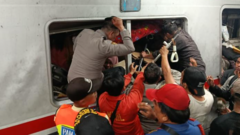
The first responders weren't paramedics in crisp uniforms. They were farmers. They dropped their tools and ran toward the wreckage, their sarongs muddy, their hands bare. They reached through broken glass to pull out terrified commuters who didn't know where they were or why the sky was suddenly where the floor should be.
By the time the heavy equipment arrived, the heat of the day had begun to bake the wreckage. Rescuers faced a grim puzzle. Two carriages from the local train and one from the Turangga had been tossed into the air and then slammed down into the soft earth of the paddies. One carriage was tilted at an almost vertical 90-degree angle.
"We are struggling," one official admitted into a crackling radio. They weren't just fighting the clock; they were fighting the weight of the machines themselves.
Crane operators moved with agonizing precision. A single slip could crush anyone still trapped inside the accordion-folded metal. This wasn't about "leveraging resources." It was about a man with a hydraulic spreader sweating under a tropical sun, trying to find a gap wide enough to reach a hand.
The Invisible Stakes of a Single Track
Java is the most densely populated island on Earth. Its railway system is a colonial-era legacy that has been fighting to modernize for decades. In many stretches, like the one between Cicalengka and Haurpugur, there is only one set of tracks.
It’s a high-stakes dance. A train going east must wait at a station for a train going west to pass before it can proceed. It relies on a delicate orchestration of signals, human communication, and timing. When that dance misses a beat, the result is what happened on that Friday morning.
Statistics tell us that Indonesian rail travel has become significantly safer over the last twenty years. Major accidents have plummeted since the dark days of the early 2000s. But for the families of the four men who didn't come home, the macro-trend is a cruel joke.
We often talk about infrastructure as if it’s something separate from us—roads, bridges, tracks. We forget that infrastructure is a promise. It’s a promise that the person you said goodbye to at 5:30 AM will be back for dinner. When a train crashes, it’s not just a mechanical failure. It’s a broken promise.
The Faces in the Wreckage
Consider the steward on the Turangga. His job was to ensure people were comfortable, to hand out blankets, to sell snacks. He likely spent his final moments thinking about a passenger's request for extra sugar or checking his watch to see how far they were from Bandung.
There is a specific kind of bravery in those who work the "front of the house" on public transit. They are the first to see the danger and the last to be able to do anything about it.
As the sun began to set over the Cicalengka hills, the cranes finally pulled the last of the wreckage apart. The site looked like a battlefield. The rice plants were trampled, the mud was black with oil, and the bright blue and white paint of the trains was scarred and scorched.
Hundreds of people gathered on the surrounding ridges. They didn't shout. They didn't take photos for social media with the usual fervor. They just watched. There is a communal weight to a tragedy like this in Indonesia—a shared understanding of the fragility of the journey.
Beyond the Metal
Investigators from the National Transportation Safety Committee eventually arrived with their notebooks and their measurements. They will talk about signal malfunctions, human error, and technical "glitches." They will produce a report that is fifty pages long and filled with charts.
But the report won't capture the sound of the metal.
Survivors spoke of a "clash like thunder" and then a scream that sounded like it came from the earth itself. That scream was the sound of a system reaching its breaking point.
As the tracks are repaired and the debris is hauled away to a graveyard for iron, the trains will start running again. They have to. Millions depend on them. The commute will resume, the coffee will be sold, and the rice paddies will grow back over the spots where the carriages rested.
The only thing that remains is the memory of that 6:00 AM light, and the knowledge that sometimes, the tracks we trust to take us forward are the very things that bring us to a sudden, violent halt.
The last of the rescue lights flickered out late that night, leaving Cicalengka in a darkness so deep it felt permanent. In the distance, you could hear the faint, haunting whistle of a distant locomotive—a sound that usually signals progress, but that night, sounded more like a prayer for the dead.