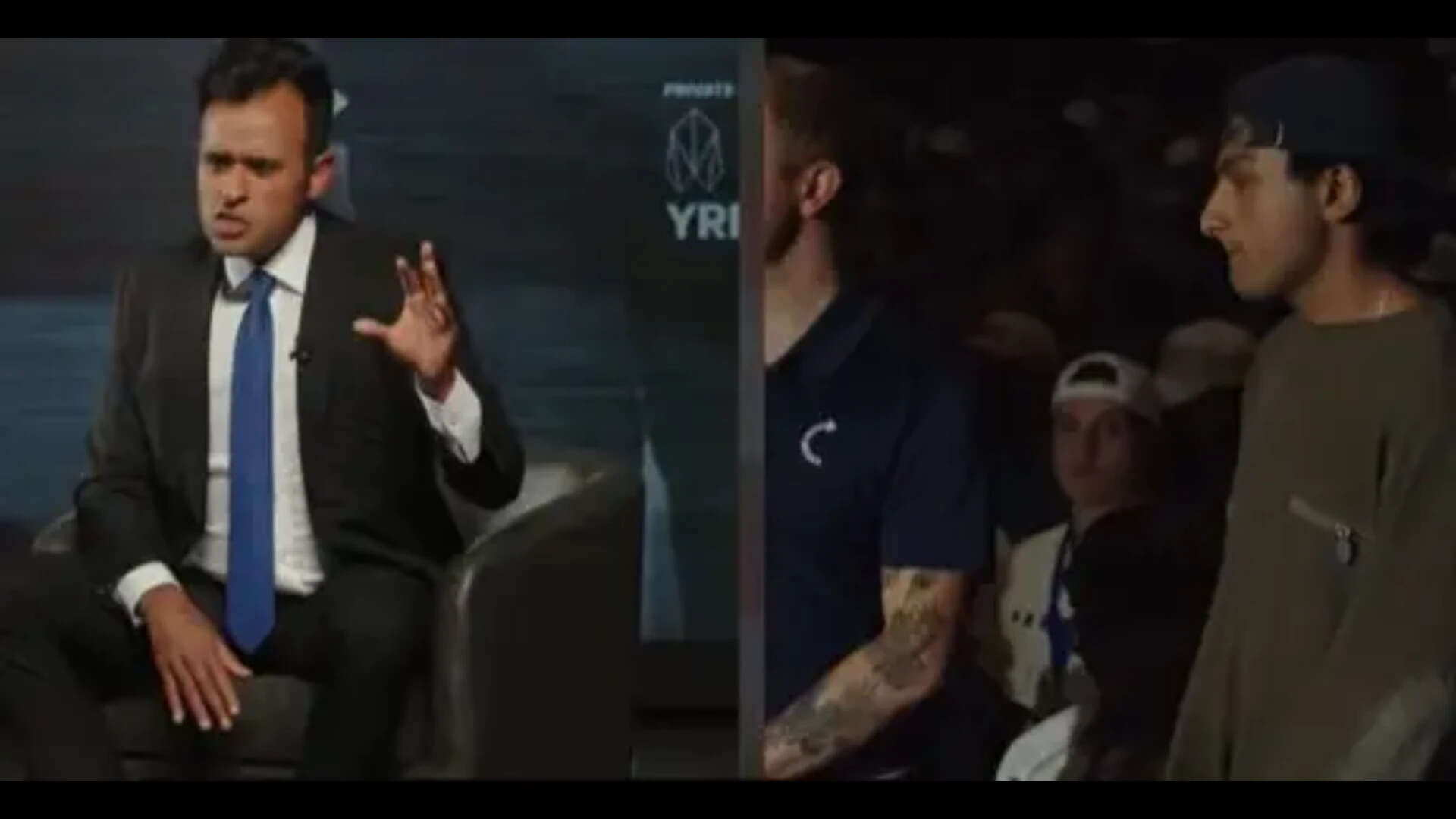
Aaryan Pathak stepped into the lion's den at a Turning Point USA event and walked away a viral sensation. The media narrative is already set in stone: a brave, young Indian-American immigrant "owning" Vivek Ramaswamy and challenging the H-1B vitriol of Charlie Kirk. It’s a heartwarming story of civic engagement. It’s also a total fantasy.
The idea that a single viral exchange or a "civilized debate" can bridge the chasm between MAGA’s nativist core and the high-skilled immigrant class is a delusion. We are witnessing the death rattles of the "Model Minority" strategy. For decades, Indian-Americans have played the game of being the "good" immigrants—the doctors, the engineers, the CEOs of Google and Microsoft—expecting that their economic utility would shield them from the winds of xenophobia. Pathak’s confrontation with Ramaswamy didn't break new ground; it merely exposed the fact that no amount of meritocracy can outrun identity politics.
The H-1B Fallacy: Labor is Never Just Math
The competitor pieces on this topic love to frame the H-1B debate as a technical disagreement about labor markets. They talk about "caps," "lotteries," and "skills gaps." They treat Pathak’s defense of the visa as a logical counterpoint to Kirk’s skepticism. This ignores the reality of how power actually functions.
To the populist right, the H-1B isn't an economic tool; it’s a demographic threat. You can cite all the GDP growth stats you want. You can point out that H-1B holders often create jobs for native-born Americans. It doesn't matter. In the MAGA framework, the economy is secondary to the "culture." When Charlie Kirk rails against the H-1B, he isn't worried about the unemployment rate for entry-level coders in Ohio. He is signaling to a base that feels the country is being sold out to a globalist elite that prefers foreign labor to its own citizens.
Pathak’s mistake—and the mistake of the entire "pro-merit" immigrant lobby—is believing that facts win fights in a post-fact arena. If you are explaining why you deserve to be here based on your tax contributions, you have already lost. You have accepted the premise that your humanity is conditional on your output.
The Vivek Ramaswamy Paradox
Vivek Ramaswamy is the most fascinating figure in this drama because he represents the ultimate end-state of the "seat at the table" philosophy. He is wealthy, articulate, and more MAGA than the MAGA founders. Yet, even he has to dance around the "Hindu hate" that bubbles up in his own movement.
When Pathak questioned Ramaswamy on the rhetoric surrounding Indian-Americans and the H-1B, Ramaswamy’s response was a masterclass in political aikido. He redirected the energy back toward "American excellence" and "merit." It’s a seductive message. It tells immigrants: If you’re the best, we want you. But look at the fine print. The "merit" being sold by the current GOP isn't a neutral yardstick. It’s a filter. It’s a way to justify the exclusion of the many by the inclusion of a hand-picked few who are willing to parrot the party line. Vivek isn't the bridge for the Indian-American community; he is the exception that proves the rule. He is there to provide cover, allowing the movement to claim it isn't racist while it pursues policies that disproportionately target the very community he belongs to.
The Myth of the Civil Debate
The media praised Pathak for his "calm" and "respectful" tone. This is the "respectability politics" trap. We’ve seen this movie before. In the 1990s and 2000s, the Indian-American community leaned heavily into the "quiet achiever" trope. They stayed out of politics, built businesses, and assumed the system would protect them because they were "valuable."
Now, as the political climate sours, that protection is evaporating. Civil debate is a luxury of stable times. When the rhetoric turns toward "remigration" and "ending birthright citizenship"—ideas that are no longer on the fringe—a polite question at a microphone is like bringing a toothpick to a gunfight.
Pathak’s viral moment felt good for 24 hours. It gave liberal pundits a "gotcha" moment against Ramaswamy. But what changed on the ground? Did Charlie Kirk change his stance on the H-1B? Did the MAGA base suddenly decide that Hindu immigrants are the core of their movement? No. If anything, it hardened the lines. It showed the base that there is a "smart, articulate" threat that they need to be even more wary of.
The Inevitability of the Backlash
I have spent years in the tech corridors of San Francisco and the policy circles of D.C. I have seen companies spend millions on "diversity initiatives" while simultaneously lobbying for more H-1Bs to keep labor costs down. The tension is palpable. On one side, you have the corporate machine that views people as interchangeable units of productivity. On the other, you have a populist movement that views those units as "invaders."
The Indian-American community is caught in the middle of this pincer movement. They are the favorite tool of the corporate class and the favorite target of the populist class.
If you think this is just about "Hindu hate," you’re missing the forest for the trees. This is about the fundamental instability of the American identity. For the first time in a century, the definition of what it means to be "American" is being narrowed, not expanded. If you aren't part of the ancestral core, your "American-ness" is now a permanent probation.
Why Logic Fails the H-1B Defense
Let's look at the actual mechanics of the H-1B because this is where the "consensus" gets it wrong. Most defenders of the program claim it is essential for innovation. They are partially right. But they refuse to admit the downside: the H-1B does suppress wages in specific niches, and it does create a class of indentured servants who are tied to their employers.
By refusing to acknowledge these flaws, Pathak and other advocates leave themselves wide open to attacks from Kirk and Ramaswamy.
When you pretend the system is perfect, you look like a shill for Big Tech. A truly contrarian—and effective—stance would be to demand the abolition of the H-1B in favor of immediate Green Cards. If these workers are truly "the best and the brightest," why keep them in a state of precariousness? Why give corporations the power to deport them if they quit?
The reason the GOP won't support immediate Green Cards is that it grants immigrants political power. The reason the Democrats won't fight for it is that their corporate donors want the cheap, compliant labor that the H-1B provides. Everyone is using the immigrant as a pawn.
The False Choice of 2026
The Pathak-Ramaswamy exchange is being framed as a choice: Do you want the "inclusive" meritocracy of the old guard, or the "America First" meritocracy of the new guard?
This is a false choice. Both options end with the Indian-American community being a secondary tier of citizenship. In the "inclusive" model, you are a tool for shareholder value. In the "America First" model, you are a guest who must constantly prove your loyalty and utility to stay in the house.
Stop asking for a seat at the table. The table is being dismantled and used for firewood.
The real "Aaryan Pathak" story isn't about a kid who stood up to a politician. It’s about the realization that the old rules of engagement are dead. You cannot "counter" hate with a better spreadsheet. You cannot "logic" your way out of being a scapegoat when the economy turns or the cultural grievances boil over.
If Indian-Americans want to survive the coming decade of American politics, they need to stop trying to be the "model minority" and start being a political force that doesn't ask for permission to exist. They need to stop looking for a "Vivek" to lead them and stop hoping a "Charlie" will understand them.
The era of the "good immigrant" is over. You’re either a player or you’re the play.
Pick one.