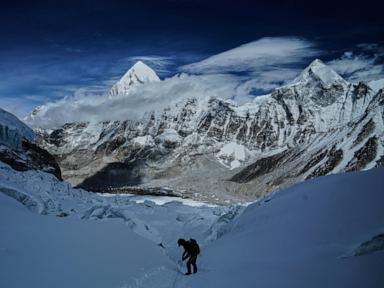
Hundreds of climbers are currently stranded at Everest Base Camp because a skyscraper-sized block of ice is hanging precariously over the Khumbu Icefall. This "serac" is a ticking time bomb, positioned directly above the only viable route to the higher camps. Until it collapses or shifts, the "Icefall Doctors"—the elite Sherpa team responsible for fixing the ropes—refuse to risk their lives in its shadow. This isn't just a weather delay. It is a stark confrontation between the commercial drive of the modern mountaineering industry and the brutal, physics-based reality of a warming Himalayan ecosystem.
The Khumbu Icefall is the most dangerous section of the South Col route. It is a river of ice moving at roughly one to four feet per day, fracturing into deep crevasses and towering pillars. Usually, the danger is statistical. You move fast, you go early in the morning when the ice is frozen solid, and you hope the odds are in your favor. But a hanging serac is different. It is a specific, known threat. Imagine standing at the bottom of a ten-story building made of glass and lead, knowing the foundation is cracked. You don't walk under it. You wait for the demolition.
The Mechanics of the Standoff
The current bottleneck centers on a massive ice feature on the West Shoulder of Everest. For decades, this shoulder has shed ice and snow, often triggering the avalanches that sweep across the Icefall. However, the current formation is uniquely unstable. It has detached from the main slope but hasn't yet fallen.
This creates a logistical nightmare. Expedition leaders are watching their summit windows shrink while paying thousands of dollars in daily overhead. The "Icefall Doctors" are the ultimate arbiters of safety here. They are the ones who must thread the needle, placing ladders across bottomless cracks and bolting lines into shifting walls. When they say the route is too dangerous to open, the mountain is effectively closed.
The physics of a serac collapse are violent. When millions of pounds of ice give way, the resulting air blast alone can be lethal. In 2014, a similar collapse in the Icefall killed 16 Sherpas in one of the deadliest days in the mountain's history. The memory of that disaster looms large over the current decision-making process. No expedition leader wants to be responsible for a repeat of that tragedy, yet the pressure from paying clients—many of whom have spent upwards of $60,000 for this chance—is immense.
The Warming Himalayan Basement
We have to look at why these features are becoming more frequent and less predictable. The Khumbu Glacier is thinning. As the ice thins, it loses the structural integrity that once kept these large blocks "glued" to the rock faces for longer periods.
Recent studies show that the ice on Everest's higher reaches is losing decades of accumulation every year. This thinning doesn't just open more crevasses; it changes the way the glacier flows. When a glacier moves over an uneven rock bed, it bends and breaks. A thinner glacier breaks more easily. The result is a more chaotic, more fractured Icefall that requires more ladders and more time for Sherpas to navigate.
More time in the Icefall means more exposure. The math is simple and grim.
The Human Cost of the Bottleneck
The delay at Base Camp creates a secondary danger: crowds. When the "Icefall Doctors" finally find a way around the serac or after the block finally falls, there will be a frantic rush to make up for lost time.
Imagine five hundred climbers, all trying to move through a narrow, unstable corridor at once. This leads to queues at the ladders. People stand still for forty minutes at a time, their toes freezing, their supplemental oxygen ticking down. In the Icefall, standing still is a death sentence if something moves above you.
The industry refers to this as "objective danger." It’s the stuff you can't control. But the decision to put hundreds of people on the mountain simultaneously is a subjective choice. It’s a business model. We are seeing a collision between a high-volume tourism industry and a mountain that is becoming more temperamental by the season.
Why We Can't Just Fly Over It
A common question from those outside the mountaineering world is why helicopters aren't used to ferry gear to Camp 1 or Camp 2, bypassing the Icefall entirely. This would significantly reduce the number of trips Sherpas have to make through the danger zone.
The Nepalese government has historically been resistant to this. Part of it is environmental protection; the noise and pollution of constant high-altitude flights would transform the upper mountain into a helipad. But there is also a socio-economic factor. The Everest economy is built on the labor of the Icefall. If you remove the need for hundreds of gear hauls through the Khumbu, you change the labor market for the local communities.
However, the safety argument is gaining ground. Some operators are pushing for "long-line" drops of heavy equipment like tents and oxygen bottles. For now, the rules remain strict. The Icefall must be earned on foot, even when it is guarded by a massive, crumbling block of ice.
The Myth of the "Standard" Season
For years, the Everest season followed a predictable rhythm. You arrive in April, acclimatize, and wait for the "May Window"—a period of calm winds before the monsoon arrives. That predictability is evaporating.
We are seeing "unstable" seasons become the new normal. High winds are lasting longer. The ice is moving faster. Features like the current serac are not anomalies; they are the emerging characteristics of a glacier in retreat. The industry analyst in me looks at the data and sees a declining asset. The journalist in me sees a human tragedy waiting for a catalyst.
The Responsibility of Expedition Houses
The big Western guiding companies and the rapidly growing Nepali-owned firms are in a silent arms race. They compete on success rates and luxury. But the real competition should be on safety margins.
When a serac stalls the season, the "reputable" companies wait. They listen to the Sherpas. The "budget" companies might be tempted to push their teams through a different, less-vetted route to gain an advantage. This creates a fragmented safety culture on the mountain. If one team goes, others feel pressured to follow. "If they made it, we can make it." This is how disasters scale.
The Technical Reality of the Route
The current blockage is reportedly near the "Popcorn" section of the Icefall, named for its jumbled, erratic blocks of ice. This area is notoriously difficult to navigate because there is no straight line. You are constantly climbing up, down, and around.
To bypass a major serac, the Icefall Doctors have to scout "Left" or "Right" variations.
- The Left Route: Hugs the base of Nuptse. It is often faster but exposed to massive avalanches from the Nuptse wall.
- The Right Route: Moves closer to the Everest West Shoulder. This is where the current serac sits.
- The Center: The most direct but the most fractured, often requiring dozens of ladders linked together.
If the center and the right are blocked, and the left is an avalanche chute, there is nowhere to go. You sit in your tent at 17,500 feet and you wait. You listen to the mountain groan at night. You watch the sun hit the ice in the morning and hope the heat doesn't trigger the collapse while your friends are scouting the lines.
The Economic Pressure Cooker
Everest is a massive part of Nepal's GDP. The permit fees alone bring in millions of dollars. Beyond that, the trekking industry, the lodges in the Khumbu Valley, and the thousands of porters depend on a successful summit season.
When the mountain stalls, the pressure isn't just coming from the climbers. It’s coming from the entire supply chain. There is a palpable tension at Base Camp right now. It is a city of nylon tents housing thousands of people, all staring up at a single piece of ice that refuses to move.
The psychological toll of this waiting is significant. Climbers lose muscle mass at altitude. They lose focus. The longer they sit at Base Camp, the weaker they become for the actual summit push. By the time the serac falls and the route opens, many will be at their physical limit before they even reach Camp 1.
A Change in Perspective
We have to stop viewing Everest as a static challenge that can be conquered with enough money and gear. It is a living, moving entity. The current delay is a reminder that the mountain does not care about your permits, your sponsors, or your social media followers.
The "Icefall Doctors" are the unsung heroes of this story. They are currently performing a high-stakes assessment that few humans on earth are qualified to do. They are looking at cracks, measuring movement, and listening to the internal echoes of the glacier. Their refusal to move is an act of expertise, not cowardice.
The real story isn't the delay itself, but what the delay tells us about the future of high-altitude mountaineering. We are entering an era where the "standard route" may no longer exist. Every year will be a scramble to find a way through an increasingly broken landscape.
The ice will eventually fall. It is an inevitability of gravity and temperature. When it does, the debris will settle, the dust will clear, and the race will begin. But the question remains: how many times can we play Russian Roulette with a collapsing glacier before the cylinder isn't empty?
The massive block of ice currently hanging over the Khumbu is a physical manifestation of the risks we have normalized. It is a warning written in frozen water. Whether the industry heeds that warning or simply waits for the path to clear so it can continue as usual will define the next decade of Himalayan climbing.
If you are at Base Camp right now, your life depends on the patience of men who know the ice better than you know your own home. Trust them. The mountain isn't going anywhere, but the ice most certainly is.


