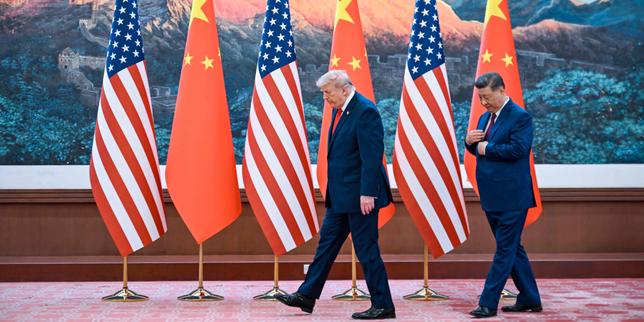
The meeting in Beijing this week between Donald Trump and Xi Jinping was not a summit between a predator and prey. It was a formal acknowledgment of a structural shift that has been decades in the making. While the American political machine remains obsessed with the optics of "winning" trade wars through brute-force tariffs, the reality on the ground suggests that the leverage once held by Washington has largely evaporated.
The primary reason for this shift is not just the volume of trade, but the asymmetry of pain tolerance. Trump’s strategy relies on the belief that a 10% or 60% tariff will eventually break the Chinese manufacturing back. However, Xi has spent the last decade re-engineering the Chinese domestic economy to absorb these shocks, while the U.S. consumer remains precariously exposed to price hikes on everything from semiconductors to basic household goods. If you liked this post, you should look at: this related article.
Beijing is no longer reacting; it is waiting. By controlling the supply of critical minerals and dominating the "green" manufacturing sector, China has created a global dependency that a simple tax at the border cannot solve.
The High Cost of the Tariff Illusion
In February 2026, the U.S. Supreme Court struck down several of the administration’s emergency act tariffs, forcing a pivot to a more standard, albeit still aggressive, 10% across-the-board levy. The administration argues these measures promote domestic manufacturing. The data tells a different story. Corporate bankruptcies in the U.S. reached a 16-year high in early 2026, driven largely by the soaring costs of intermediate goods—the parts American companies need to build their own products. For another look on this development, refer to the latest coverage from MarketWatch.
The "China Plus One" strategy, where companies move production to Vietnam or Mexico, was supposed to be the silver bullet. Instead, it has often resulted in a "China Through One" scenario. Components are still made in Shenzhen, shipped to Hanoi for final assembly, and then sent to the U.S. with a different origin label. The trade deficit with China may appear smaller on paper, but the structural dependence remains untouched.
The Rare Earth Stranglehold
China currently controls over 80% of the world’s rare earth processing. These aren't just for electric vehicles; they are essential for missile guidance systems, F-35 fighter jets, and the very AI chips the U.S. is trying to keep out of Chinese hands.
- Neodymium: Essential for high-strength magnets.
- Gallium and Germanium: Critical for high-speed semiconductors and night-vision tech.
- Lithium and Cobalt: The lifeblood of the energy transition.
When Beijing restricted exports of these materials in 2025, the global price of tech manufacturing spiked instantly. This was a demonstration of escalation dominance. If Washington pushes too hard on trade, Beijing can effectively shut down the American high-tech assembly line without firing a single shot.
The NVIDIA Paradox and the Chip War Failure
The administration’s attempt to "decouple" in the technology sector has hit a wall of economic reality. In early 2026, a policy reversal allowed NVIDIA to sell its H200 AI processors to Chinese firms like ByteDance and Alibaba, provided they underwent third-party testing in the U.S.
This move was born of necessity, not diplomacy. If American chipmakers are barred from the Chinese market—which accounts for roughly one-third of their revenue—they lose the R&D budget required to stay ahead. By trying to starve China of chips, the U.S. risked starving its own innovators of capital.
Meanwhile, China’s domestic semiconductor industry has accelerated. SMIC and Huawei are no longer three generations behind; they are closing the gap. Every restriction imposed by Washington acts as a massive, unintended subsidy for Chinese domestic R&D. The "Chip War" has not stopped China; it has merely forced it to become technologically self-reliant faster than anyone anticipated.
Domestic Fragility vs. Totalitarian Resilience
The "dominant" player is usually the one who can afford to lose the most. Donald Trump faces an electorate that is hyper-sensitive to inflation and a stock market that reacts violently to every "Truth" or tweet. His political capital is tied to immediate, visible economic performance.
Xi Jinping operates on a different timeline. While China faces a real estate crisis and a shrinking population, the CCP’s grip on the financial system allows it to socialize losses and direct capital into strategic sectors like robotics and high-speed rail. China’s $1.1 trillion trade surplus in 2025 occurred despite the most aggressive U.S. tariffs in a century.
The Asymmetric Weapons of 2026
| Weapon | U.S. Strategy | China Counter-Move |
|---|---|---|
| Tariffs | 10% to 60% on all imports | Targeted export bans on critical minerals |
| Tech Bans | Entity list restrictions | Domestic "Safe and Controllable" mandates |
| Finance | Potential Treasury bond sell-off threats | Diversification into gold and non-USD trade |
Washington’s primary weapon—access to the U.S. consumer market—is losing its edge as China builds out the "Belt and Road" and strengthens ties with the Global South. The U.S. is no longer the only game in town.
The Mirage of Reindustrialization
The promise of a manufacturing renaissance in the American Heartland remains a potent political narrative, but the labor market is not cooperating. There is a massive shortage of skilled technicians capable of running the highly automated factories needed to compete with Chinese efficiency.
Throwing money at the problem via the CHIPS Act or green energy subsidies has created "construction jobs," but not a long-term, sustainable manufacturing ecosystem. Without a fundamental overhaul of the U.S. education system and a more flexible immigration policy for high-skilled workers, the factories of the future will remain in Asia, regardless of the tariff rate.
The Beijing summit has shown that the era of American dictate is over. We have entered a period of constructive strategic stability, a polite term for a stalemate where both sides are too intertwined to decouple and too hostile to cooperate.
Xi Jinping is not the underdog. He is the curator of a system that has learned to thrive under pressure. Trump’s "art of the deal" is being met by a Chinese "art of the long game." In this environment, the player who thinks they are winning because they increased a tax rate is the one most likely to be blindsided by the next shift in the global order.
Stop looking at the tariff percentages. Look at the mineral flows and the patent filings. That is where the real war is being won.