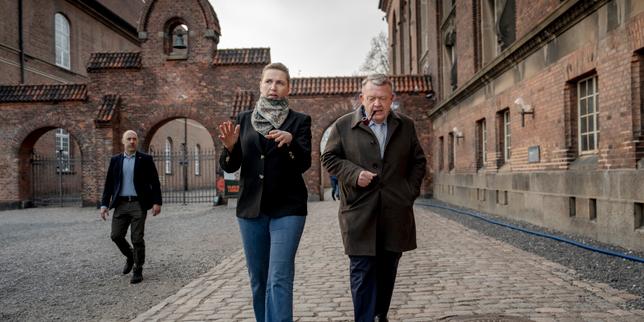
The international press loves a "polarized" narrative. It is the default setting for any journalist landing in Copenhagen with a 48-hour deadline. They look at Mette Frederiksen, see a Prime Minister who has shifted the goalposts on immigration and state power, and immediately reach for the tired trope of a nation torn apart. They see a leader who is "respected abroad but divisive at home."
They are wrong. Meanwhile, you can explore other developments here: The Cold Truth About Russias Crumbling Power Grid.
What they call division is actually the sound of a political consensus being dragged, kicking and screaming, into the 21st century. Frederiksen isn't dividing Denmark; she is the first Western leader to successfully perform a high-stakes transplant of right-wing border reality into a left-wing welfare heart. While the rest of Europe’s center-left parties are vanishing into electoral irrelevance, Frederiksen’s Social Democrats have provided the only viable blueprint for the survival of the European model.
If you think she is a polarizing figure, you aren't paying attention to the math. You are paying attention to the noise. To understand the full picture, we recommend the recent article by NPR.
The Welfare State is a Gated Community
Let’s dismantle the biggest lie in modern European politics: that you can have an open-border policy and a generous, universal welfare state simultaneously. You cannot. It is mathematically impossible.
The "lazy consensus" of the competitor’s view suggests that Frederiksen’s hardline stance on migration—her "zero asylum seekers" goal—is a betrayal of social democratic values. It is the exact opposite. It is the preservation of them.
I have watched policy analysts in Brussels wring their hands over Denmark’s "jewelry law" or the "ghetto legislation" while their own social safety nets crumble under the weight of unintegrated parallel societies. Frederiksen understood early that the Danish model—the folkevalgt—relies entirely on high levels of social trust and a sense of shared contribution. When you dilute that trust by ignoring the pressures of rapid, unmanaged demographic shifts, the taxpayer stops wanting to pay.
By co-opting the migration platform of the far-right Danish People’s Party, Frederiksen didn't "move to the right." She neutralized the far-right. She stole their oxygen and used it to inflate the tires of the welfare state. That isn't a "divided" country; that is a masterclass in political survival.
The Mink Scandal Was a Feature Not a Bug
Critics point to "Minkgate"—the illegal order to cull the country’s entire mink population during the pandemic—as proof of her "autocratic" tendencies. The competitor article frames this as a point of deep domestic resentment.
Let’s look at the reality of executive power. In a crisis, the public doesn't actually want a debate; they want a decision. Frederiksen’s "autocracy" was a display of handlekraft—the power to act. While other European leaders were caught in a loop of committee meetings and legal hair-splitting, she moved.
Was it legally messy? Yes. Did it ignore the constitutional fine print? Absolutely. But the Danish electorate, despite the protests of the mink farmers and the legal purists, saw a leader willing to burn the ships to save the shore. The subsequent election results proved that the Danish public values a functional state over a perfectly polite one. The outrage was a luxury of the media class; the security was the priority of the working class.
The Paradox of the "Iron Lady"
The international media calls her the "Iron Lady of the North." It’s a lazy comparison to Margaret Thatcher that misses the fundamental point. Thatcher wanted to dismantle the state. Frederiksen wants to make the state so strong that it becomes the primary source of identity for the Danish people.
She has replaced the old-school class struggle with a new-school struggle for national cohesion. This is where the "division" comes from. She has alienated the urban, cosmopolitan elite—the people who write the op-eds and work in the NGOs. These people are loud, they are articulate, and they are largely irrelevant to the electoral map of Denmark.
Imagine a scenario where a leader stops trying to please the 10% of voters who live in the capital’s coffee shops and starts focusing exclusively on the 90% who worry about the quality of their local school and the safety of their neighborhood. That is Frederiksen’s "division." It’s not a split down the middle; it’s a surgical removal of an out-of-touch fringe from the center of the political conversation.
The "Denmark First" Progressive Model
We are told that progressivism is synonymous with internationalism. Frederiksen has shattered that. She has pioneered a "Progressive Nationalism" that is deeply uncomfortable for the globalist left.
- Climate: She pushed for a 70% reduction in CO2 emissions by 2030, among the most ambitious in the world.
- Labor: She has defended the "Flexicurity" model against EU interference.
- Social: She has increased spending on the elderly and children.
She is doing everything a traditional leftist should do, but she is doing it behind a wall. The "division" cited by critics is simply the friction caused by a left-wing party finally admitting that a nation-state has borders. If that makes her a villain in the eyes of the Le Monde or The Guardian, she doesn't care. She isn't running for President of the World. She is running for Prime Minister of five million Danes.
The Brutal Truth About Integration
The competitor's piece touches on her "harsh" integration policies as a source of domestic strife. Let’s be brutally honest: the previous "soft" approach failed.
Decades of "multiculturalism" in Scandinavia resulted in the rise of parallel societies where the state’s laws were secondary to local religious or cultural norms. Frederiksen’s government decided that if you live in Denmark, you live by Danish values. Period. Forced language classes, mandatory "Danishness" lessons for children in certain zones, and strict penalties for crime-ridden areas.
Is it "illiberal"? Perhaps by the standards of a 1990s university seminar. But in the real world, it is the only way to prevent the total collapse of social cohesion. You cannot have a high-tax, high-benefit society if people don't feel like they belong to the same team.
The Export of the Danish Model
Watch the rest of Europe. Look at the rise of the AfD in Germany, the RN in France, and the PVV in the Netherlands. These countries are convulsing because their centrist parties refused to touch the third rail of migration and national identity.
Denmark isn't convulsing. Denmark has already integrated these concerns into the mainstream. Mette Frederiksen is the reason the far-right in Denmark is currently in a state of collapse. She did her job so well that she made her opponents' platform redundant.
The "division" the media keeps talking about is the dying gasp of an old political order that thought it could ignore the concerns of the working class indefinitely.
Stop looking for a "split" Denmark. Start looking at a country that has figured out how to survive the populist wave by riding it.
Mette Frederiksen isn't the problem. She is the only solution currently on the table for the Western left. If the rest of Europe doesn't follow her lead, they won't have a welfare state left to argue about.
The lesson is simple: If you want to save the sanctuary, you have to lock the door.