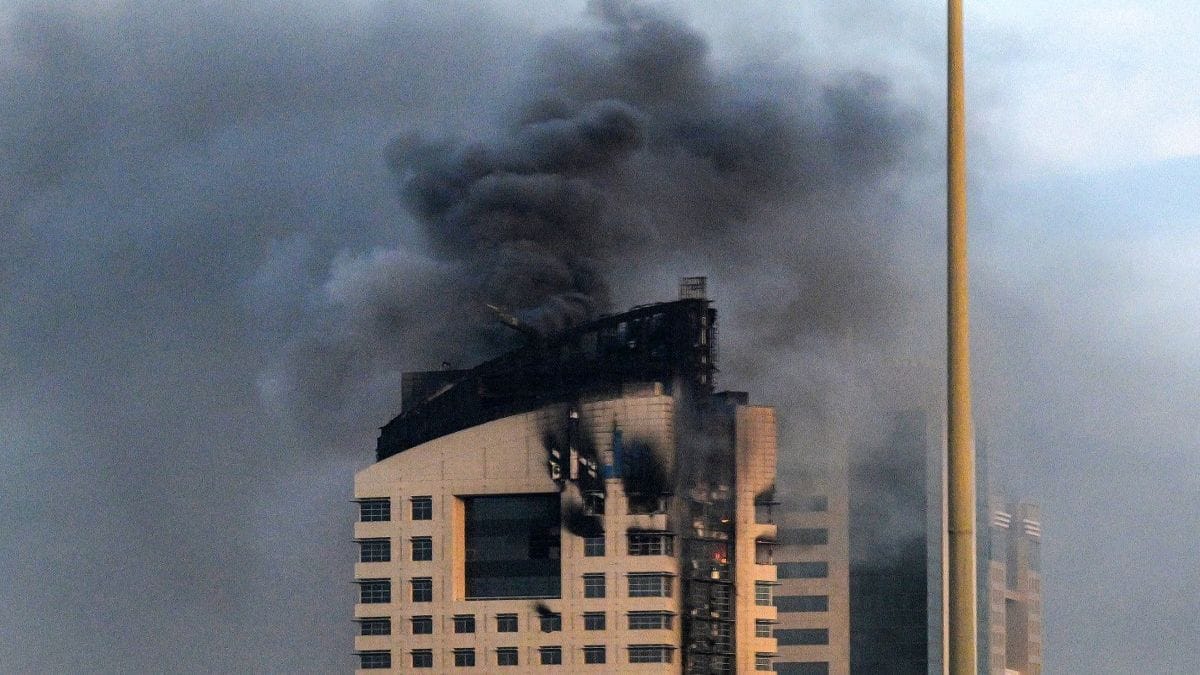
The media is currently hyperventilating over a series of "unprecedented" Iranian strikes on the UAE, Bahrain, and Qatar. They point to the black smoke over Jebel Ali and the drone fragments in Manama as proof that Iran is the ultimate wrecking ball of West Asian prosperity. They call it a "catastrophic" disruption of the regional order.
They are wrong. Not because the missiles didn't land, but because they are misdiagnosing the wound.
I have spent years watching capital flow through the "shadow" corridors of Dubai and Muscat. I’ve seen how the very neighbors now "decrying" Iranian aggression have spent the last decade quietly turning a profit off Iran’s isolation. If you think the current escalation is a simple story of a rogue state hitting its rich neighbors, you are reading a fairy tale written for 1980s Cold Warriors.
The real story isn't about the damage Iran has caused. It’s about the collapse of a symbiotic, high-risk business model that the Gulf Cooperation Council (GCC) has relied on for thirty years.
The Sanction-Busting Subsidy
The "lazy consensus" suggests that Iran is a purely parasitic force in the region. The reality? Iran has been a massive, unacknowledged subsidy for the UAE’s service economy.
For decades, Dubai didn't just "tolerate" Iran; it functioned as Iran’s lungs. When the West tightened the noose with sanctions, the money didn't disappear—it migrated. It flowed into Dubai real estate, into front companies in Ras Al Khaimah, and through dhows crossing the Strait of Hormuz laden with everything from iPhones to industrial machinery.
In 2025, before the current kinetic conflict, Iran was the largest supplier of poultry to the UAE. Think about that. While diplomats talked about "containment," the person eating at a five-star hotel in Abu Dhabi was likely being fed by Iranian agriculture. This isn't a relationship of "damage"—it’s a relationship of deep, messy, and highly profitable interdependence.
The current strikes aren't a "new" threat; they are a messy divorce in a marriage that both sides are now pretending never happened. The "damage" being reported—the $40 billion in lost tourism and the 13% spike in oil—is the cost of a business model finally hitting its expiration date.
The Desalination Delusion
A major talking point in the competitor's piece is the attack on Bahrain’s desalination plants. The narrative is that Iran is "targeting the source of life."
Let’s be brutally honest: the GCC’s absolute reliance on a handful of vulnerable, centralized desalination hubs is a strategic failure of their own making. If your entire civilization’s water supply can be crippled by a few $20,000 drones, the problem isn't just the guy with the drone. The problem is a "prestige-first" infrastructure strategy that prioritized massive, shiny targets over resilient, decentralized systems.
We are seeing a total failure of the "Shield" mentality. The GCC spent hundreds of billions on Patriot batteries and Terminal High Altitude Area Defense (THAAD) systems. Yet, as the UAE Defense Ministry recently admitted, while they intercepted the majority of the 174 ballistic missiles and 689 drones, "collateral damage" still shuttered Dubai International Airport (DXB).
The lesson? Kinetic defense is a losing game of math. An interceptor missile costs millions; a swarm drone costs less than a used Toyota. By continuing to build centralized megaprojects—like the "off-plan" luxury towers currently seeing a 5% fire sale in Abu Dhabi—the Gulf is essentially building bigger targets and asking Iran to keep the price of admission low.
The Hegemony Trap
Here is the counter-intuitive truth that no one in a Riyadh or Manama press office will admit: The Gulf states are terrified of an Iranian collapse.
The competitor article frames Iran’s "weakness" as a win for its neighbors. It isn't. A collapsed Iranian state is a nightmare for the GCC.
- The Refugee Wave: Bandar Abbas is a short boat ride from the UAE. If Iran’s economy truly craters into a failed-state scenario, the resulting migration would overwhelm the demographic balance of the Gulf far more effectively than any missile.
- The Power Vacuum: As analysts like Galip Dalay have noted, the removal of Iran as a regional counterweight doesn't bring "peace." It brings an expansionist Israel and a power vacuum that could trigger internal fragmentation across the Arab world.
- The End of the Middleman: If Iran were to suddenly "normalize" and trade directly with the West, Dubai loses its role as the gatekeeper. The "Sanctions Premium" that built the Burj Khalifa would vanish overnight.
The GCC doesn't want Iran destroyed; they want it contained just enough to remain a profitable, captive market. The "damage" we are seeing now is what happens when that containment fails and the "captive" starts breaking the furniture.
The Real Estate Reckoning
The most "contrarian" take I can offer is this: The Iranian strikes are a secondary threat to the UAE real estate market. The primary threat is the 400,000 new units expected by 2028.
JPMorgan warned of this before the first missile was fired. The market was already running ahead of population growth. The "security" image of the Gulf was the only thing holding up the sky-high valuations. Iran didn't create the bubble; it just provided the pin.
Investors are currently "on hold" not just because they fear a drone hitting their balcony, but because the illusion of the Gulf as a "neutral playground" has been shattered. The GCC tried to play both sides—hosting U.S. bases while courting Iranian capital. You can’t be a safe haven and a front-line airbase at the same time. The "damage" is the realization that neutrality is not a shield; it's a target.
Stop Asking "How Much Damage?"
The wrong question is: "How much damage has Iran caused?"
The right question is: "Why did the Gulf think they could build a 21st-century economy on a 7th-century fault line?"
The status quo of the last twenty years—profitable friction—is over. The GCC has a choice: move toward a genuine regional security architecture that includes Iran (the "rapprochement" path that Clingendael argues for) or continue to watch their "diversified" economies bleed out every time a hardliner in Tehran feels backed into a corner.
If you are an investor, stop looking at the missile debris. Look at the insurance premiums. When the "War Risk" coverage for the Strait of Hormuz disappears, the actual physical damage to a desalination plant in Bahrain becomes a rounding error compared to the systemic collapse of the Gulf's logic of existence.
Move your capital out of the centralized targets and into the decentralized future. Because the next wave won't be missiles—it will be the sound of a thousand "front companies" closing their doors for good.
Would you like me to analyze the specific shifts in the UAE's "shadow banking" sector following the 2026 sanctions escalation?