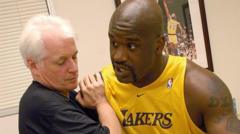
Age in the NBA is usually a death sentence. Most players are eyeing the exit by 32, and by 40, they're relegated to talking-head roles on cable TV. But there's a 74-year-old British coach who hasn't just survived the league’s evolution—he's helping drive it. Gary Boyson doesn't have a highlight reel of monster dunks, and you won't find his face on a cereal box. Yet, his phone keeps ringing.
If you haven't heard of him, it's because the NBA’s best-kept secrets usually stay behind closed doors. While the league obsessed over youth and "potential," savvy front offices realized that wisdom doesn't expire. Boyson, a veteran coach with a resume that spans decades and continents, has become the go-to guy for teams needing to fix the unfixable. It isn't about teaching a 20-year-old how to jump higher; it's about teaching them how to see a game that moves at a hundred miles an hour.
The British Outlier in an American Game
Basketball in the UK has always been the neglected stepchild of the sports world. We're told Brits play football or cricket, not hoops. Boyson ignored that memo. He didn't just participate; he mastered the mechanics of the game. He's a specialist in an era of generalists. Teams like the Toronto Raptors and others have sought his eyes because he sees the "ghost" movements on a court that most scouts miss.
He's currently a consultant and player development guru, a role that sounds corporate but is actually incredibly gritty. It involves hours of film, standing on hardwood until your knees ache, and telling a millionaire athlete that their footwork is trash. That takes guts. At 74, Boyson has the kind of "grandfathered-in" authority that young coaches simply can't replicate. When he speaks, even the stars listen.
Why 74 is the New Peak for Coaching
Modern sports science is great, but it has a massive blind spot. It treats players like data points. We track "load management," heart rates, and shot arcs. What we often forget is the psychological architecture of a winning play. This is where a guy like Boyson earns his keep.
- Experience beats algorithms. An iPad can tell you a player misses 60% of shots from the left corner. Boyson can tell you why—maybe it's a slight hitch in the hip or a mental lapse under pressure.
- The "Old School" filter. He brings a level of discipline that's often lost in the modern, player-empowered NBA.
- Global perspective. Having coached in various international leagues, he understands the "European" style of play that has recently taken over the NBA (think Jokic and Luka).
The league is currently dominated by international talent. The "American way" isn't the only way anymore. Having a British perspective—one rooted in the fundamentals of the global game—is a massive competitive advantage. Teams aren't hiring him out of respect for his age; they’re hiring him because they're terrified their rivals might get him first.
Breaking the Age Barrier in Professional Sports
We've seen this trend elsewhere. Look at Gregg Popovich or even the late-career resurgence of coaches in their 70s across the NFL and MLB. The NBA is a copycat league. If one team finds success by bringing in a "senior advisor" who actually knows his stuff, ten other teams will try to do the same by next Tuesday.
Boyson’s longevity proves that "player development" doesn't have to be a young man’s game. In fact, being older might be a secret weapon. He isn't trying to climb the ladder anymore. He isn't looking for the next head coaching gig or a massive Nike deal. He’s there for the craft. That lack of ego is rare in a league filled with some of the biggest personalities on the planet.
What You Can Learn from the NBA's Elder Statesman
If you think your career has an expiration date, look at Gary Boyson. He’s proof that being a specialist makes you indispensable. Most people try to be okay at ten things. Boyson became world-class at one: seeing the game.
If you're looking to apply this "Boyson Method" to your own life or career, stop trying to keep up with every new trend. Instead, master the timeless fundamentals of your field. While everyone else is chasing the shiny new thing, be the person who understands the foundation. That’s how you stay in demand when you’re 74.
The next time you see a young NBA star suddenly improve his shooting mechanics or defensive positioning, don't just credit the head coach. There’s a good chance a 74-year-old Brit was in his ear two hours before tip-off, quietly fixing the small things that make the biggest difference.
Don't wait for permission to be an expert. Pick a niche, master the physics of it, and make yourself the only person who can solve a specific, painful problem. That's the only way to ensure the phone never stops ringing.