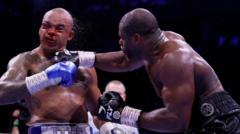
The smell of a high-stakes heavyweight fight isn't just sweat and overpriced beer. It is copper. It is the scent of adrenaline ionizing the air, a metallic tang that hits the back of your throat when two giants decide that their pride is worth more than their neurological health. At the O2 Arena, that scent was thick enough to choke on.
Daniel Dubois walked to the ring looking like a man heading toward a deposition he knew he’d lose. He has always carried that heavy, stoic expression—a mask of granite that critics often mistook for a lack of "heart." Across from him stood Fabio Wardley, a man whose rise had been defined by a visceral, blood-soaked draw against Frazer Clarke that cemented him as the "people’s champion" of the British heavyweights.
The narrative was set before the first bell. Wardley was the warrior. Dubois was the question mark.
Then the hitting started.
The Gravity of the First Fall
In the heavyweights, physics is a cruel master. When a 250-pound man connects a four-ounce leather wrap with the temple of another human being, the lights don't just flicker. They go out.
Early on, it looked like the critics were right. Wardley caught Dubois with a shot that didn't just land; it reverberated. You could see the precise moment Dubois’s internal equilibrium shattered. His legs turned to wet rope. He hit the deck with the heavy, sickening thud of falling timber. The crowd erupted, a predatory roar that signaled the beginning of the end.
This is the moment where boxing stops being a sport and starts being a psychological autopsy. Most men, having felt that level of concussive force, look for a way out. They look at the referee’s count as a countdown to safety. If you stay down, the pain stops. The humiliation is temporary, but the safety is immediate.
Dubois stood up. He looked confused, his eyes searching the rafters for a horizon line that had vanished, but he stood up.
The Invisible Ledger
We often talk about "surviving" a knockdown as if it’s a passive act. It isn't. It is an active, agonizing choice to re-enter a burning building.
Consider a hypothetical fighter—let’s call him Elias. Elias is every prospect who ever hit the big time and realized he didn't have the "dog" in him. When Elias gets hit, he remembers his mortgage. He remembers the way his speech slurs after a hard sparring session. He remembers that he has a life outside the ropes. Elias stays down.
Daniel Dubois was supposed to be Elias.
When he went down a second time, the air left the building. Two knockdowns in a championship-level fight usually signify a mismatch. Wardley was clinical, stalking forward with the confidence of a man who had already written the victory speech. He was throwing with bad intentions, each hook designed to be the final period at the end of the sentence.
But something shifted in the atmosphere.
Dubois wasn't just getting up; he was changing. The vacant look in his eyes replaced by a terrifying, singular focus. The "Triple D" moniker, often mocked as a marketing gimmick, suddenly felt like a warning. He stopped retreating. He began to plant those massive trunk-like legs. He decided that if he was going to go out, he was going to take the entire arena with him.
The Dethroning of the Untouchable
Wardley’s mistake was believing his own press. He thought the knockdowns were the result of his superiority, rather than a momentary lapse in Dubois’s guard. He became reckless. He began to wing shots, smelling the finish, ignoring the fact that a wounded animal is the most dangerous thing in the woods.
Dubois began to find the range with a jab that felt less like a punch and more like a battering ram. It is a stiff, jarring thing—the kind of blow that resets a man’s jaw and makes him reconsider his career choices.
The momentum didn't just swing; it snapped.
Wardley, the man who had never been stopped, the man who thrived in the red zone of a fight, suddenly found himself in a place he didn't recognize. He was being backed up. His nose was a mess of crimson. The "warrior" was being out-warred by the man he thought was a "quitter."
The punches Dubois landed in the mid-rounds were heavy with the weight of years of mockery. Every time a commentator had questioned his chin, every time a fan had called him "No Mas Dubois" on social media, he put that spite into his right hand.
The Sound of the Shift
There is a specific sound when a fighter realizes he can no longer win. It isn't a scream. It’s a sharp, desperate exhale.
Wardley was breathing like a man drowning in shallow water. He had spent his tank trying to find the knockout that wouldn't come, and now he was trapped in a ring with a rejuvenated giant. Dubois was no longer surviving; he was hunting.
The referee’s intervention felt like a mercy killing.
When the fight was waved off, and the crown was officially moved from Wardley’s head to Dubois’s, the O2 went strangely silent for a heartbeat. We were all recalibrating. We had just watched a man be stripped of his greatest asset—his invincibility—by a man who had been told he had no assets at all.
Boxing is a brutal teacher. It teaches us that momentum is a lie and that "heart" isn't something you have, it's something you choose to find when the lights are dimming.
Dubois didn't just win a belt that night. He didn't just "dethrone" a champion. He committed an act of public exorcism. He killed the version of himself that stayed on the floor.
As he stood in the center of the ring, the belt draped over a shoulder that had carried the weight of a thousand doubts, he didn't celebrate with backflips or theatrics. He just breathed. He looked around at the thousands of people who had come to watch him fail, and he didn't say a word.
He didn't have to.
The bruises on Wardley’s face told the story better than any post-match interview ever could. The sport had demanded everything from both men, but Dubois was the only one who had anything left to give when the bill came due.
Sometimes, the most powerful thing a person can do is simply refuse to go away. We spent years looking for the "real" Daniel Dubois. It turns out he was there all along, buried under two knockdowns and a mountain of public doubt, just waiting for a fight hard enough to bring him to the surface.
The ring was cleared. The copper smell began to fade, replaced by the scent of cleaning chemicals as the crew prepared for the next event. But the canvas remained. It was stained with the blood of a man who thought he couldn't be beaten, and the sweat of a man who decided he wouldn't be.
Silence eventually took the arena, but the ghost of that right hand stayed in the air.