Rain slicked the cobblestones of Freedom Square in Tallinn, Estonia. It was a Tuesday, unremarkable in every way, until a notification vibrated against a young woman’s thigh. Her name is Elena. She is twenty-four, works in a digital marketing firm, and likes her coffee with too much oat milk. She is not a general. She is not a diplomat. But as she looked at her screen, the world shifted.
The headline was simple: the United States was considering a withdrawal from NATO. Building on this idea, you can find more in: The Hollow Victory of a Desert War.
To a banker in New York or a car salesman in Ohio, NATO is a collection of letters. It is a line item in a budget that seems bloated. It is a "paper tiger," a relic of a war that ended before they were born. But to Elena, NATO is the invisible wall that allows her to sleep without wondering if the rumble in the distance is thunder or a T-90 tank.
For seventy-five years, the North Atlantic Treaty Organization has operated on a single, sacred sentence: Article 5. An attack on one is an attack on all. It is the most successful insurance policy in human history. Yet, the policy is currently under review by a landlord who thinks the premiums are too high and the neighbors are deadbeats. Experts at USA Today have also weighed in on this trend.
The Math of a Handshake
The criticism isn't entirely baseless, which is what makes it so dangerous. For decades, the United States has shouldered the lion's share of the burden. Washington spends roughly 3.5% of its GDP on defense, while many European allies have struggled to hit the 2% target agreed upon in 2014. From a purely ledger-based perspective, the deal looks lopsided.
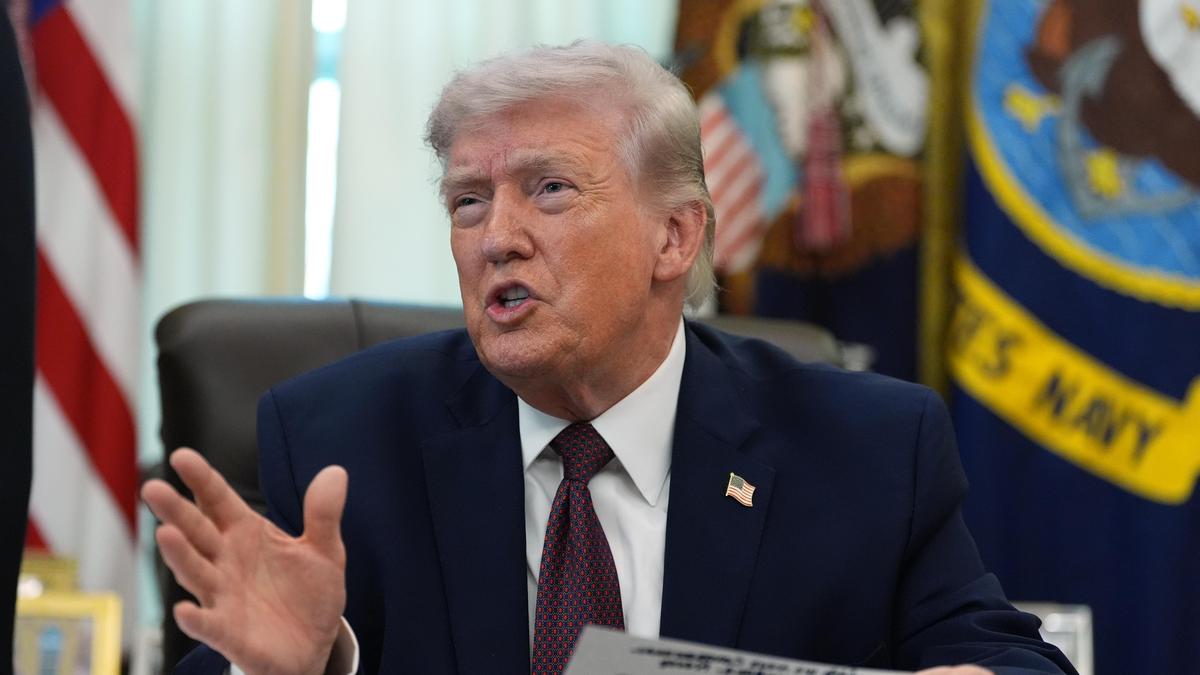
Donald Trump’s rhetoric characterizes the alliance as a club where the members don't pay their dues. He views the international order not as a garden to be tended, but as a series of transactions. If the "customer" isn't paying, the "service" should be cut off. He has signaled that he would not only welcome a withdrawal but might even encourage adversaries to "do whatever the hell they want" to nations that are delinquent.
But treaties are not gym memberships.
When you cancel a gym membership, you lose your access to the treadmill. When you cancel a security guarantee, you change the molecular structure of global peace. The "paper tiger" label is a provocation that ignores the teeth. Since 1949, the mere idea of American intervention has prevented a major European land war. That streak ended in 2022 when Russia invaded Ukraine—a non-NATO member. The contrast is the point.
The Ghost in the Room
Imagine a small classroom in a village near the Suwalki Gap, the sixty-mile strip of land along the Polish-Lithuanian border. If Russia were to seize this corridor, the Baltic states—Estonia, Latvia, and Lithuania—would be physically cut off from the rest of Europe.
The teacher, let’s call him Marek, points to a map. He knows that his town is strategically insignificant to a global superpower, but it is everything to him. For Marek, the U.S. presence in NATO isn't about "projection of power." It’s about the fact that his daughter can play in the yard without him checking the horizon for smoke.
If the U.S. exits, the vacuum left behind wouldn't be filled by a "stronger Europe" overnight. It takes years to build command structures, decades to synchronize communications, and centuries to build the trust that one soldier will die for another's flag.
The critics argue that Europe is wealthy enough to defend itself. They are right. Germany, France, and the UK have the combined economic might to dwarf Russia. However, they lack the singular will. NATO provides the "big stick" that forces cohesion. Without the American anchor, the European house becomes a collection of rooms with no shared foundation. Some might lean toward Moscow for survival. Others might militarize frantically, sparking a new arms race that drains their social safety nets.
The Cost of Going Home
The American voter asks a fair question: "Why is this my problem?"
It is a question rooted in the geography of two oceans. America feels safe behind the Atlantic and the Pacific. But the 21st century is not a century of distance. The global economy is a spiderweb. If the Suwalki Gap is closed, the shockwaves hit the floor of the New York Stock Exchange in minutes. Supply chains for semiconductors, energy, and medicine don't recognize "America First" boundaries. They recognize stability.
A U.S. withdrawal would be the greatest gift to the Kremlin since the fall of the Berlin Wall. It would validate the theory that democracies are fickle, that their promises have an expiration date tied to an election cycle. It would tell every small nation on earth that they are alone.
Consider the psychological shift. For nearly a century, the dollar and the tank have been the twin pillars of American influence. If the tank is pulled back, the dollar's value as a global reserve currency begins to erode. Why tether your economy to a partner who might leave you in the dark when the wind picks up?
A World of Small Shadows
The debate over the "paper tiger" often ignores the human cost of uncertainty. Uncertainty is expensive. It stops investment. It prevents families from buying homes. It creates a low-level, vibrating anxiety that defines a generation.
In the corridors of Brussels, the talk is of "strategic autonomy." It sounds grand. It sounds like a teenager finally moving out of their parents' basement. But in reality, it is a desperate scramble. Europe is currently dependent on American satellite intelligence, heavy-lift transport, and nuclear deterrence. Replacing that "paper tiger" would cost trillions of Euros—money that currently pays for healthcare and pensions.
The American withdrawal isn't just a policy shift; it is an identity crisis.
If the U.S. leaves NATO, it stops being the leader of the free world and becomes just another large, isolated island. It trades its seat at the head of the table for a spot on the sidelines.
Back in Tallinn, Elena closes her laptop. The rain hasn't stopped. She looks out the window at the old town walls, stones that have stood for seven hundred years. They have seen empires rise and fall. They have seen the Danes, the Swedes, the Germans, and the Soviets. She knows that history isn't a straight line. It’s a circle.
The lights in her apartment flicker—a momentary surge in the grid. Usually, she wouldn't think twice about it. But tonight, she wonders if the grid is safe. She wonders if the "paper tiger" was the only thing keeping the wolves at bay.
We often don't realize we are living in a golden age until the bronze age returns. We debate the cost of the umbrella while it's sunny, forgetting that the clouds don't care about our budget meetings. The real danger isn't that the alliance is a paper tiger. The danger is that we might find out exactly what happens when the paper is shredded and there is nothing left to hold back the dark.
The cobblestones are still wet. The square is empty. The silence is loud.