The Mediterranean air in early March usually carries the scent of salt spray and the faint, dusty promise of spring. At RAF Akrotiri, a sprawling British sovereign base on the southern tip of Cyprus, the night is rarely truly silent. There is the low hum of generators, the occasional crunch of boots on gravel, and the distant, rhythmic shush of the sea against the cliffs.
Then comes the buzz. Building on this idea, you can also read: Why the Green Party Victory in Manchester is a Disaster for Keir Starmer.
It isn't the roar of a Typhoon fighter jet or the confident thrum of a transport plane. It is a frantic, lawnmower-like drone. It sounds small, insignificant, and entirely out of place.
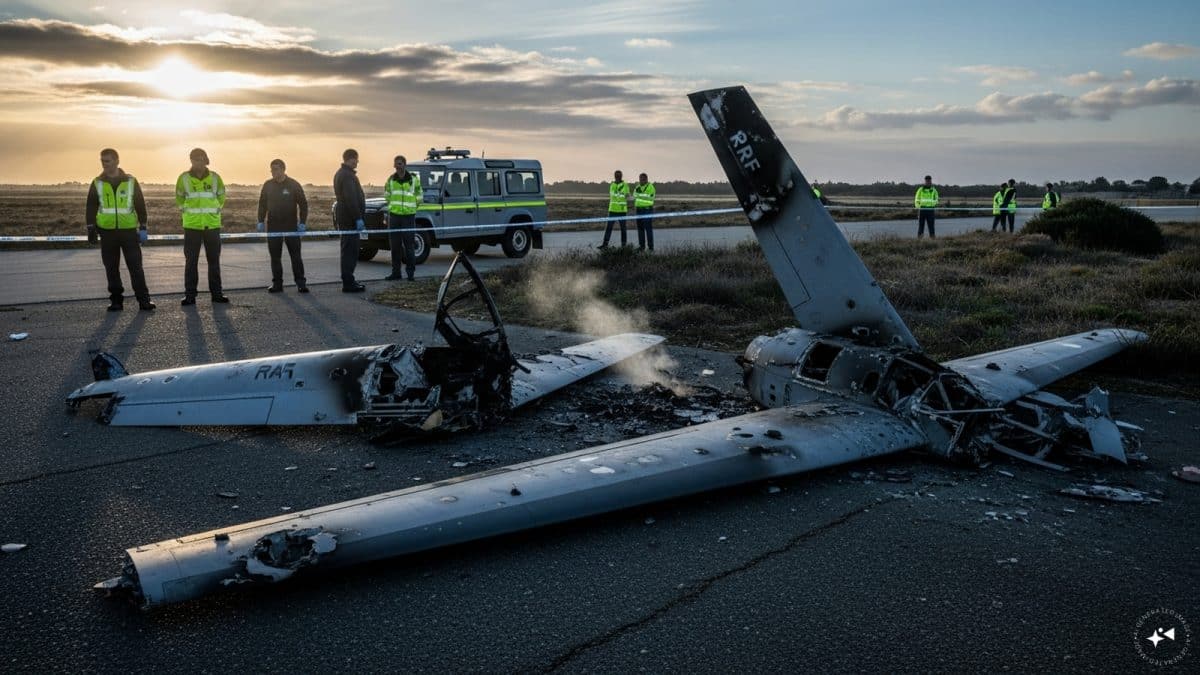
On this particular evening, that sound preceded a flash of kinetic energy that shattered the routine of the base. An Iranian-manufactured one-way attack drone, a jagged silhouette against the stars, plummeted into the perimeter of the military installation. There was an impact. There was debris. Then, for a heartbeat, there was a silence far heavier than the one it replaced. Observers at BBC News have shared their thoughts on this matter.
The Ghost in the Machine
We often talk about modern warfare in the abstract. We use words like "geopolitics" and "strategic depth" as if the world were a giant chessboard and we were merely observers. But for the personnel stationed at Akrotiri, the reality of a drone strike isn't a headline. It is a physical vibration in the chest.
Imagine a young technician, perhaps twenty-four years old, finishing a shift and thinking about nothing more than a cold drink and a call home to Leeds or Bristol. In an instant, the sky—a space they are trained to control—becomes a source of unpredictable lethality.
The drone that crashed wasn't a marvel of high-end engineering. It didn't cost millions of dollars. That is exactly why it is so terrifying. These "suicide drones," or loitering munitions, are the improvised explosive devices of the air. They are cheap. They are mass-produced. They are the democratic distribution of terror.
When a multi-million-pound defense system is challenged by a piece of flying carbon fiber and a lawnmower engine, the math of war changes. We are no longer looking at a battle of might, but a battle of persistence.
The Architecture of an Accident
Early reports suggest the craft suffered a mechanical failure or ran out of fuel before it could reach a "target," if one was even designated. There were no casualties. No buildings were leveled. On paper, it is a non-event—a footnote in a briefing document.
But "no casualties" is a deceptive phrase. It ignores the psychological erosion that occurs when a sovereign base is breached by a foreign power's technology.
Cyprus has long been the "unsinkable aircraft carrier" of the eastern Mediterranean. It is the staging ground for operations across the Middle East, a vital node in the West's ability to project power and monitor the shifting sands of regional conflict. When a drone from an Iranian lineage—whether launched by a proxy or drifting off course from a distant theater—ends up in a crumpled heap on British soil, it sends a message.
The message is: We can touch you.
Consider the path that drone took. It crossed international borders, bypassed radar nets, and defied the supposed sanctity of a high-security military zone. It didn't need to explode to be effective. The crash itself is a proof of concept.
The Invisible Stakes of a Small Failure
Why does a single crash in a remote corner of Cyprus matter to someone sitting in a coffee shop in London or a suburb in Manchester?
The answer lies in the fragility of our perceived safety. We live in an era of "Grey Zone" warfare. This isn't the clear-cut declarations of the twentieth century. It is a murky, constant state of friction where deniability is the primary weapon.
If a missile hits a base, it's an act of war. If a cheap drone "crashes" due to a "malfunction," it’s an incident. It’s an inquiry. It’s a shrug of the shoulders from diplomats while the engineers on the ground scramble to figure out how a low-tech intruder slipped through a high-tech net.
We are witnessing the obsolescence of the front line. In this new reality, the front line is wherever a drone can stay aloft for six hours. The stakes aren't just the lives of the soldiers at Akrotiri; the stakes are the integrity of the international order. If these incursions become routine, they become acceptable. If they become acceptable, the shield we’ve built around our global interests begins to look more like a sieve.
A Symphony of Mismatched Tech
There is a profound irony in the way we defend against these threats.
The UK military utilizes some of the most sophisticated electronic warfare suites on the planet. We have sensors that can pick up the heat signature of a bird and software that can predict the trajectory of a ballistic missile. Yet, the drone is a stubborn protagonist. It flies low. It moves slowly. It often uses commercial GPS signals that are woven into the very fabric of our civilian lives.
Trying to stop a swarm of these drones with traditional air defenses is like trying to swat a cloud of gnats with a sledgehammer. You might hit one, but the effort is exhausting, expensive, and ultimately inefficient.
The crash at Akrotiri is a wake-up call that has been ringing for years, yet we keep hitting the snooze button. From the battlefields of Ukraine to the shipping lanes of the Red Sea, the drone has moved from a novelty to the primary disruptor of the status quo.
The Human Echo
Back on the base, the recovery teams move in. They don't wear dress uniforms; they wear EOD suits and carry scanners. They treat the wreckage like a crime scene, which, in a way, it is. They look for serial numbers, for the specific weave of the fiberglass, for the origin of the circuit boards.
They are looking for a signature.
But beyond the forensics, there is the human reaction. The adrenaline spike that doesn't quite go away. The way the guards look at the horizon just a little bit longer during the dawn watch. The realization that the sea, which once acted as a moat, is now just a highway for anything with a propeller and a grudge.
We want to believe that our technology makes us invincible. We want to believe that "no casualties" means "no harm."
But as the sun rises over the Akrotiri salt lake, illuminating the twisted metal of a machine that shouldn't have been there, the truth is harder to ignore. The world is getting smaller, and the tools of chaos are getting cheaper.
The silence has returned to the base, but it is a different kind of silence now. It is the silence of a breath being held, waiting for the next buzz to emerge from the dark.
Somewhere, on a different coastline, another engine is being cranked to life.


