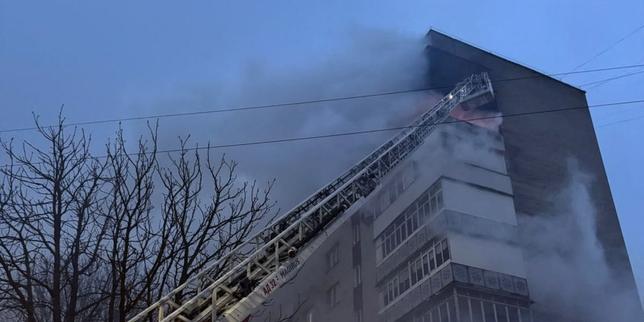
The air in Kyiv carries a specific, metallic tang when the sirens have been screaming for more than four hours. It is the scent of ozone, cold exhaust, and the invisible friction of a city holding its breath. Down in the belly of the metro stations, where the air is thick with the smell of damp wool and cheap tea, the silence isn't actually silent. It is a vibrating hum of thousands of people trying to hear the difference between a distant boom and a close-range shudder.
High above the concrete shelters, the sky over Ukraine has become a cluttered, lethal laboratory. On this particular night, the statistics were staggering: nearly 300 drones. Most people see that number on a screen the next morning and think of it as a data point. They shouldn't. Three hundred drones is not a number; it is a swarm of three hundred lawnmower engines, each carrying a payload designed to turn a living room into a crater, flying low and jagged across the horizon.
The Calculus of Survival
Consider the math of a modern siege. To the people on the ground, the drones—mostly Iranian-designed Shaheds—are known as "mopeds" because of their pathetic, sputtering drone. But there is nothing pathetic about the math they represent. Russia launches them by the hundreds because they are cheap. They are the disposable foot soldiers of the air.
For the defenders, the equation is a nightmare. Do you use a million-dollar missile to swat down a twenty-thousand-dollar piece of flying plastic? If you don't, that plastic hits an electrical substation, and a children’s hospital goes dark. If you do, you eventually run out of the million-dollar missiles. This is the exhaustion of the soul, played out in the theater of air defense.
On this night, the sky was a lattice of tracer fire and searchlights. Imagine a team of mobile drone hunters—usually three or four men in the back of a pickup truck. They aren't high-tech warriors in air-conditioned bunkers. They are guys in parkas, squinting through thermal scopes, trying to track a shadow against a moonless sky while standing in the bed of a bouncing Toyota. They are the human firewall against a digital invasion.
Gravity and the Falling Star
While the drones were being picked out of the air over the capital, something else happened. Far to the south, near the jagged coastline of occupied Crimea, a Russian military aircraft—an Su-27—stopped flying.
It didn't happen with the cinematic flair of a dogfight. Eyewitnesses near Sevastopol saw a sudden bloom of fire, a streak of light, and then a slow, tumbling descent. The pilot managed to eject, a tiny white dot of a parachute drifting toward the Black Sea, but the plane itself became a multi-million-dollar anchor.
The Russian-installed authorities called it a technical failure. The streets of Sevastopol buzzed with a different theory: "friendly fire." In a conflict where everyone is on edge, where the sky is constantly filled with autonomous killers and electronic jamming signals that scramble GPS, the machines eventually start to turn on their masters.
The irony is thick enough to choke on. At the same moment Russia was attempting to overwhelm Ukrainian sensors with hundreds of drones, their own systems may have blinked. In the fog of electronic warfare, the distinction between "us" and "them" becomes a coin toss. A pilot, a father of two, a man who had likely flown hundreds of sorties, was suddenly a victim of the very chaos his own side unleashed.
The Invisible Stakes
We often talk about war in terms of territory, but the true frontline is the electrical grid and the human nervous system. When 300 drones are intercepted, the victory isn't just in the debris piles scattered across the wheat fields. The victory is the light that stays on in a grandmother's kitchen in Podil. It is the fact that the water pumps keep humming, preventing the pipes from freezing and bursting in the bitter spring chill.
The drones are designed to be "loitering munitions." It’s a sanitized term. In reality, it means they are designed to haunt you. They are built to fly in circles until they find a target, or until the people underneath them break. Every night of "nearly 300" is a night where millions of people don't reach REM sleep. It is a slow-motion theft of a nation's collective sanity.
But there is a tipping point.
Ukraine reported that it downed almost every single one of those drones. That isn't just a win for the military; it is a profound failure of the Russian strategy of "cheap saturation." When the swarm fails to sting, it becomes nothing more than expensive scrap metal. The air defense crews, many of whom have been awake for thirty-six hours, don't celebrate with cheers. They celebrate by drinking a cup of scorched coffee and looking at the dawn.
The Cost of the Machine
The Su-27 that plummeted into the sea near Crimea represents a different kind of cost. It is a reminder that gravity is impartial. Whether a plane is downed by a sophisticated Patriot missile or a catastrophic internal error caused by overworked maintenance crews, the result is the same: a hole in the fleet that cannot be easily filled. Russia is burning through its legacy of Soviet steel at a rate that would bankrupt a smaller empire.
The drones are the new way. The Su-27 is the old way. On this night, both ways met the same end—scattered across the earth and the sea.
As the sun began to pull itself over the horizon, the sirens finally fell silent. The people in the metro stations gathered their blankets and their pets. They walked up the escalators, blinking at the pale light. They checked their phones, saw the "300" statistic, and felt a brief, flickering moment of pride before the exhaustion hit them like a physical blow.
The sky is empty now. The smoke from the Su-27 has dissipated into the salt air of the Black Sea. But tonight, the sirens will likely start again. The lawnmower engines will cough to life in distant launch sites, and the men in the back of the pickup trucks will check their thermal scopes.
The war has moved from the trenches to the clouds, but the weight of it still rests on the shoulders of the person trying to find a reason to sleep when the world above them is screaming.
The metal is cold, the stats are dry, but the heartbeat of a city under siege is the only sound that matters.