The air in Uttar Pradesh doesn't just get hot; it turns heavy, a physical weight that settles into your lungs and stays there. On that Thursday evening, the weight felt different. It was stagnant. Sticky. Old men in the village of Kheragarh sat on woven charpoys, fanning themselves with newspapers that would soon carry their own obituaries. They watched the horizon. The sky wasn't blue or grey. It was a bruised, metallic copper.
Nature usually gives you a warning. A shift in the wind. A drop in the birdsong. But this was a blitzkrieg.
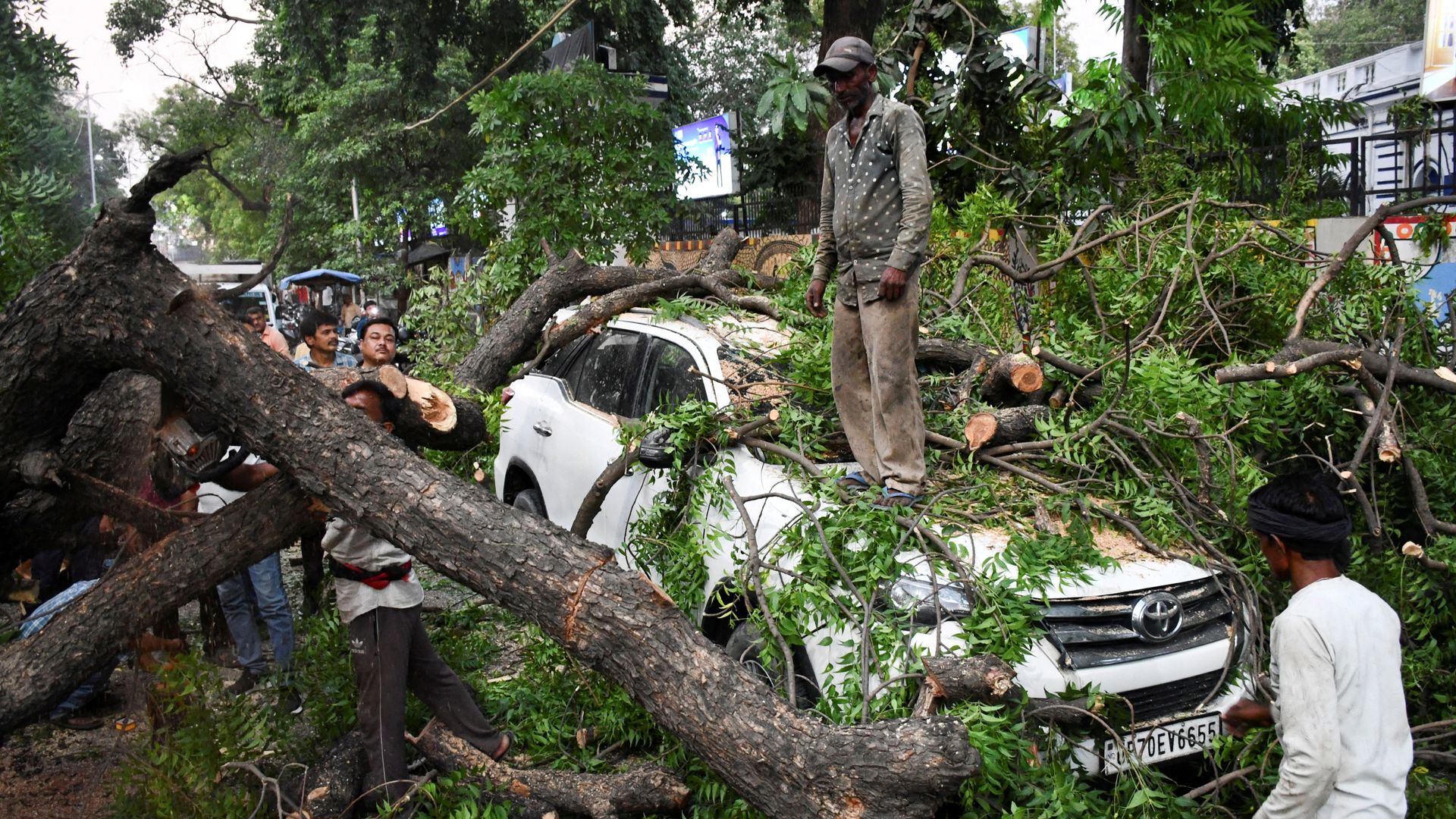
Within minutes, the copper sky went black. The wind didn't just blow; it roared with a mechanical, shrieking intensity that sounded like a freight train derailed in the middle of a primary school. This wasn't a seasonal monsoon shower. This was a high-velocity dust storm, a "kali andhi," packing winds that exceeded 130 kilometers per hour. It turned the very earth into a weapon.
The Anatomy of a Collapse
When we talk about natural disasters, we tend to focus on the sky. We look at satellite imagery and barometric pressure readings. We forget to look at the mud.
In the rural heart of India’s most populous state, the infrastructure of a life is often held together by hope and baked earth. Thousands of families live in "kutcha" houses—dwellings made of unburnt bricks, mud, and thatch. These structures are built to breathe in the heat, but they are not built to withstand a horizontal sledgehammer of wind and grit.
Consider a hypothetical father, let’s call him Rajesh, in a village near Agra. He isn't worried about the "macro-economic impact of climate volatility." He is worried about the tin sheet on his roof. It starts to rattle. The sound is deafening. He moves his children to the strongest corner of the room, a place where the walls are thickest. But the wind finds a gap. It gets under the roof, creating a vacuum that lifts the entire structure.
In a heartbeat, the sanctuary becomes a tomb.
The statistics from that night tell a cold story: 124 dead across the region, with the majority of those fatalities occurring in Agra district. But the numbers don't capture the physics of the tragedy. Most people didn't die from the wind itself. They died from the weight of their own homes. Wall collapses accounted for the vast majority of the casualties. When the mud dries out over a long, punishing summer, it loses its cohesive strength. It becomes brittle. When the storm hits, those walls don't just fall; they disintegrate.
The Invisible Fire in the Clouds
While the dust was choking the plains, the atmosphere was staging a second, more jagged assault. Lightning.
The thermal energy trapped in the lower atmosphere acted as fuel. As the cold front slammed into the wall of heat radiating from the scorched earth, it created massive electrical imbalances. This wasn't the distant, flickering heat lightning of a summer romance. This was a sustained bombardment.
In the Saharanpur and Bijnor districts, the sky stayed white for seconds at a time. Lightning strikes accounted for dozens of the deaths reported by the relief commissioner’s office. It struck farmers who had stayed in the fields a moment too long to cover their grain. It struck people seeking shelter under trees that acted as natural lightning rods.
It is a cruel irony of the geography. The very trees that provide the only shade from a 45-degree sun become the primary killers when the clouds break.
Why the Warning Failed to Travel the Last Mile
There is a gap between a meteorologist’s screen in New Delhi and a tea stall in rural Uttar Pradesh. It is a gap of language, technology, and trust.
The Indian Meteorological Department (IMD) had issued warnings. They knew the pressure was dropping. They saw the convective energy building. But how does a "yellow alert" translate to a family sleeping in a mud house with no radio?
The "last mile" of disaster management is where the tragedy actually happens. Even if a warning reaches a village headman’s smartphone, what is the protocol? There are no storm shelters. There are no sirens. For many, the only option is to stay put and pray that the wall holds.
The storm didn't just kill people; it decimated the local economy in a single hour. Livestock—the living bank accounts of the rural poor—were crushed in their pens. Electricity pylons were snapped like dry twigs, plunging entire districts into a darkness that lasted for days. Without power, the pumps stopped. Without pumps, there was no water.
The tragedy was a cascading failure of ancient infrastructure meeting modern, intensified weather patterns.
The Deceptive Silence of the Aftermath
The morning after a dust storm is eerily beautiful. The dust settles into a fine, golden powder that coats everything, softening the edges of the jagged ruins. The air is suddenly, unnervingly cool.
In the villages of Uttar Pradesh, that silence was broken by the sound of shovels.
Recovery in these regions isn't a matter of insurance adjusters and construction crews. It is a communal labor of grief. Neighbors dig out neighbors. They salvage what they can—a charred pot, a soaked mattress, a photograph. The state government eventually announced compensations of 400,000 rupees (roughly $6,000) for the families of the deceased. It is a sum that acknowledges the value of a life while highlighting the crushing poverty of the landscape.
It is enough to rebuild a mud house. It is not enough to build a house that won't fall down when the sky turns copper again next year.
We often treat these events as "acts of God," a legalistic shrug that absolves us of the need to look closer. But the intensity of these storms is increasing. The heat that fuels them is a product of a changing planet. The fragility of the homes is a product of an unevenly distributed wealth.
The storm didn't just happen to Uttar Pradesh. It revealed it.
It revealed a place where life is lived on the knife-edge of the elements. Where the sky is both a provider and a predator. As the climate shifts, the "once in a century" storm becomes a seasonal visitor. We watch the satellite feeds and we count the bodies, but we rarely feel the grit between our teeth.
The copper sky will return. The winds will howl again. And somewhere in a village near the Taj Mahal, a man will look at his rattling roof and realize that the only thing standing between his family and the fury of the earth is a wall made of sun-dried mud.
He will hold the wall with his bare hands, hoping it is enough. It almost never is.
The wreckage is cleared now. The headlines have moved on to elections and cricket scores. But if you walk through the outskirts of Agra today, you will see the scars. New mud walls rising where the old ones fell. They look identical to the ones that crumbled. They are built with the same hope, the same desperation, and the same terrifying vulnerability to the next time the air goes heavy and the birds go quiet.