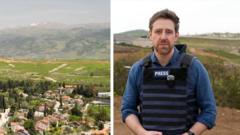
The standard media narrative regarding the northern border of Israel has become a repetitive, sentimental loop. You’ve seen the footage: empty playgrounds in Metula, smoke rising from a ridge in the Galilee, and a somber reporter talking about "life on the frontline." It paints a picture of a brave, static defense against an inevitable tide of rockets.
It’s a lie. Or, at the very least, a massive strategic misunderstanding.
What we are witnessing in the north isn't a "frontline" in any traditional military sense. A frontline implies two opposing forces facing off over a defined piece of dirt. Instead, the Israeli north has been transformed into a voluntary dead zone—a tactical vacuum created by decades of "containment" logic that has finally curdled into a strategic disaster. If you think the story is about the resilience of displaced families, you’re missing the fact that the very concept of the northern border has been redefined by Hezbollah without them ever having to launch a full-scale ground invasion.
The Myth of the Frontline
Mainstream outlets love the word "frontline." It sounds heroic. It suggests a line that is being held. But you cannot hold a line that you have already evacuated. When the Israeli government moved 60,000+ civilians away from the border in 2023, they didn't protect the north; they surrendered its utility.
Hezbollah’s goal was never to fly a yellow flag over the Kiryat Shmona city hall. Their goal was the depopulation of the Galilee. They achieved this through "perpetual friction"—a steady stream of anti-tank missiles and suicide drones that cost them pennies but cost the Israeli state its sovereignty over its own territory.
In military theory, we talk about the Security Buffer. Traditionally, a nation creates a buffer on the enemy's side of the border. By evacuating the north, Israel created a buffer on its own side. This is a reversal of every tenet of Zionist security doctrine since 1948. We are seeing the birth of a "No-Man's Land" within the sovereign borders of a first-world power. That isn't a frontline. It's a retreat disguised as a civilian safety measure.
The Containment Trap
For eighteen years, the "Lazy Consensus" among the defense establishment in Tel Aviv was that Hezbollah could be deterred through economic stakes and the threat of "returning Lebanon to the Stone Age."
I have watched as high-ranking officials patted themselves on the back for years of "quiet." They mistook a buildup for a ceasefire. They looked at UNIFIL (United Nations Interim Force in Lebanon) and saw a peacekeeping body. In reality, UNIFIL functioned as a human shield for Hezbollah’s infrastructure.
Let's dismantle the logic of Resolution 1701. The world talks about it like a holy text that just needs "better enforcement."
- The Premise: Hezbollah stays north of the Litani River.
- The Reality: Hezbollah built a subterranean fortress in the "Nature Reserves" (the wooded hills) directly overlooking Israeli bedroom windows.
- The Failure: The Lebanese Armed Forces (LAF) were never going to disarm Hezbollah. Expecting a junior partner to arrest its own boss was a delusion that the West paid for with billions in aid.
When you play a game of "containment" with a messianic proxy militia, you aren't winning time. You are giving them time to perfect their Kill Chain. Hezbollah isn't a ragtag group of insurgents. They are a semi-state military with better drone integration than most NATO members.
The Economic Ghost Town
Stop looking at the craters and start looking at the balance sheets. The real "war" in the north is being won through the destruction of the northern economy.
The Galilee isn't just a collection of scenic vistas; it is a hub for high-tech agriculture and tourism. By forcing a prolonged evacuation, the state has severed the tie between the people and the land. In the history of modern conflict, once a population is displaced for more than a year, a significant percentage never returns. They find jobs in Tel Aviv. They enroll their kids in schools in Haifa.
Hezbollah’s strategy is Economic Attrition. They don't need to win a battle if they can make the north unlivable and uninsurable. If an insurance company won't cover a factory in Shlomi, that factory dies. If the factory dies, the town dies. This is "Soft Annexation" by fire.
Why "Proportionality" is a Death Sentence
The international community screams for "proportionality" every time an IAF pilot hits a launch site in Tyre. But proportionality is the mechanism by which Israel loses this war.
If Hezbollah fires 50 rockets and Israel responds by hitting 50 launchers, the status quo remains. Hezbollah can lose 50 launchers every day for a year and still have plenty left. Israel, however, cannot lose the north for a year without undergoing a fundamental shift in its national psyche.
The "contrarian" truth here is that disproportionate force is the only way to restore a border. You cannot "manage" a conflict with a group whose entire reason for existence is your erasure. You either win, or you manage your own decline. The current strategy of "exchanging blows" is just a slow-motion surrender of the Galilee.
The "Iron Dome" Delusion
The Iron Dome is perhaps the greatest tactical achievement and the greatest strategic failure in Israeli history.
Wait—how?
Because it provided the illusion of safety. It allowed the political echelon to ignore the growing threat in the north because the "interceptors will handle it." It turned a national security threat into a math problem.
- Cost of a Hezbollah Burkan rocket: A few thousand dollars.
- Cost of a Tamir interceptor: $50,000 to $100,000.
- The Result: A war of exhaustion where the defender goes bankrupt or runs out of magazines before the attacker runs out of cheap iron.
[Image showing the cost-per-intercept comparison between Iron Dome missiles and primitive rockets]
Relying on defense-only tech like Iron Dome or David's Sling is a "Maginot Line" mentality. It creates a false sense of security that prevents the necessary preemptive action required to actually neutralize the threat. We’ve spent two decades building better shields while the enemy was building a bigger sledgehammer.
The False Hope of Diplomacy
The "experts" on cable news will tell you that a diplomatic solution is just around the corner. They point to the maritime gas deal as proof that Hezbollah is pragmatic.
This is a fundamental misunderstanding of the Iran-Hezbollah-Hamas Axis. Hezbollah is the "crown jewel" of the Iranian Revolutionary Guard Corps (IRGC). They are not a Lebanese political party that happens to have a wing of fighters; they are an Iranian expeditionary force that has hijacked a country.
Any "deal" signed today will be used by Hezbollah to:
- Re-arm.
- Dig deeper.
- Map out the next 10/7-style incursion.
If the deal doesn't involve the physical removal of Hezbollah's Radwan Force from the border, it isn't a peace treaty. It’s a countdown.
The Real Cost of Neutrality
We often hear that the Lebanese people are "hostages" of Hezbollah. While true in a technical sense, it's irrelevant to the strategic reality. A nation is responsible for the kinetic actions emerging from its soil.
The "Lazy Consensus" says we must distinguish between the Lebanese state and Hezbollah to avoid a regional conflagration. The contrarian reality? There is no distinction. Hezbollah sits in the cabinet. Hezbollah controls the airport. Hezbollah controls the port of Beirut. By pretending Lebanon is a separate, neutral entity, Israel allows the Lebanese government to act as a diplomatic laundromat for a terrorist organization.
If you want the rockets to stop, the cost of hosting Hezbollah must become higher than the cost of confronting them. Right now, Lebanon (the state) pays zero price for Hezbollah's war. That is a strategic absurdity.
The Path Forward: Tactical Brutality
What does a real solution look like? It doesn't look like "targeted strikes." It looks like an Enforcement Zone.
- Abandon the 1701 obsession: It’s dead. Stop trying to revive a corpse.
- Kinetic Enforcement: Any movement south of the Litani is met with immediate, automated, and overwhelming fire. No warnings. No "Knock on the Roof."
- Internal Displacement as a Weapon: If the Galilee is empty, the South of Lebanon must be empty. This isn't about cruelty; it's about the symmetry of stakes. Until the elites in Beirut feel the same displacement as the families from Kiryat Shmona, there is no incentive for change.
The Hard Truth
I’ve spent years analyzing these cycles of violence. I have seen billions of shekels poured into concrete walls and high-tech sensors. None of it matters if the political will to hold the land has evaporated.
The "town on the frontline" isn't a symbol of strength. It is a warning sign of a shrinking state. If Israel cannot guarantee that a mother can put her child to sleep in Manara without the fear of a Kornet missile coming through the window, then the border has already moved south.
The "frontline" isn't in the north anymore. It’s in the boardrooms of Tel Aviv and the halls of the Knesset, where leaders are deciding whether the Galilee is a part of Israel or just a leased territory they are prepared to let go.
Stop calling it a "border conflict." Call it what it is: the slow-motion dismantling of a sovereign nation’s territorial integrity.
The Galilee is burning because we decided that "containing" the fire was cheaper than putting it out. We were wrong.
The bill has finally come due.
The only question left is whether there is enough left in the bank to pay it, or if we’re just waiting for the next evacuation order to move the "frontline" even further toward the sea.