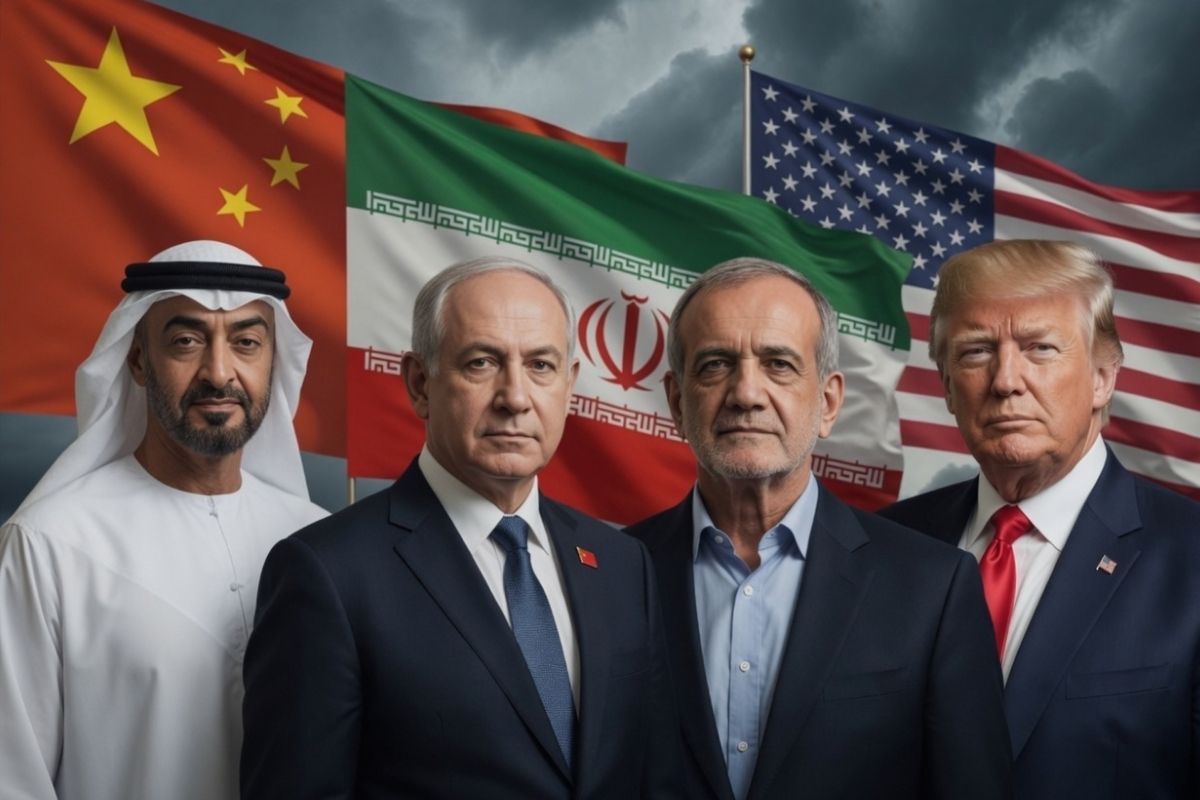
The mainstream media is obsessed with the "crisis" in West Asia. They paint a picture of a crumbling OPEC and a Gulf region on the brink of geopolitical irrelevance because Iran and Israel can't stop trading blows. They see "cracks" and "drifts." They see a UAE that is "lost" or "isolated."
They are looking at the map upside down. Recently making headlines recently: Aviation Sovereignty and Sanction Erosion The Mechanics of the US-Venezuela Air Corridor.
The supposed "split" between the UAE and Saudi Arabia within OPEC isn't a sign of weakness. It is the birth of a more sophisticated, decentralized energy market. The "crisis" isn't a threat to the Khaleeji way of life; it’s the catalyst that finally breaks the region's addiction to the dying cult of production quotas.
The Myth of the United Front
For decades, the "lazy consensus" among analysts has been that a unified OPEC is a strong OPEC. This is a fundamental misunderstanding of how modern power works. In a world of volatile energy transitions, a unified front is actually a rigid, brittle structure. It's a fossilized way of thinking that assumes every member has the same break-even price and the same timeline for diversification. Further information regarding the matter are explored by Investopedia.
They don’t.
The UAE is playing a different game than Saudi Arabia. While Riyadh is burning through cash to fund "Vision 2030" and trying to keep prices high to support a massive sovereign wealth fund, Abu Dhabi has already pivoted. They aren't just looking for high prices; they are looking for market share and technological integration.
When the UAE pushes for higher production baselines, they aren't "betraying" their neighbors. They are acknowledging a reality that the rest of the cartel is too scared to face: the window to monetize underground assets is closing. If you don't pump it now, it stays in the dirt forever as a stranded asset.
Iran is a Distraction, Not a Determinant
Every talking head on cable news wants to tell you how the Iran-Israel conflict is reshaping Gulf diplomacy. They claim the UAE and Saudi Arabia are "forced" into new alliances because of the security vacuum.
Wrong. The security vacuum has been there since the 1970s. The real shift isn't about defensive pacts or Fear of Tehran; it's about the realization that the U.S. security umbrella is now a sunshade with holes in it.
The UAE isn't "drifting" away from Saudi Arabia because of Iran. They are diverging because the UAE has realized that being a "junior partner" in a regional bloc is a losing strategy in a multipolar world. They are building a hub, not a fortress.
- The Saudi Strategy: Centralized, state-heavy, and price-dependent.
- The UAE Strategy: Decentralized, trade-focused, and volume-dependent.
These two models cannot coexist in a rigid cartel. The "crack" in OPEC isn't a failure of diplomacy; it’s an inevitable economic divorce based on irreconcilable visions of the future.
Stop Asking if OPEC is Dying
People ask, "Will OPEC survive this?" That is the wrong question. The right question is: "Why would anyone want it to?"
OPEC was designed for a world where supply was scarce and demand was infinite. Today, supply is everywhere (thanks to U.S. shale and Brazilian offshore), and demand has a visible ceiling. The cartel’s attempts to "balance" the market are just expensive ways of subsidizing American frackers. Every time OPEC cuts production to prop up prices, they hand a gift-wrapped check to companies in Texas and North Dakota.
The UAE knows this. They are tired of paying the bill for a strategy that doesn't work.
By challenging the quotas, Abu Dhabi is forcing a "stress test" on the entire system. If that leads to the end of the cartel as we know it, the UAE wins. They have the lowest lifting costs and the best infrastructure. In a price war, they are the last ones standing. The "danger" everyone talks about is actually the UAE’s greatest competitive advantage.
The Diplomacy of Disinterest
You’ll hear diplomats talk about "de-escalation" and "regional stability." This is code for "we are tired of being dragged into other people's religious and ideological wars."
The UAE’s recent diplomatic maneuvers—normalizing with Israel while simultaneously talking to Tehran—isn't "confused" diplomacy. It is the diplomacy of a merchant state. A merchant doesn't care who wins the war, as long as the trade routes stay open and the ports are functional.
The "tension" with Saudi Arabia stems from this exact point. Saudi Arabia still wants to be the moral and political leader of the Arab world. The UAE just wants to be the world's boardroom. One requires a massive military and ideological purity; the other requires a high-speed internet connection and a functional legal system.
The False Choice of the "Pivot"
The competitor's narrative suggests the UAE is caught between a rock and a hard place. They think the UAE has to "choose" between its neighbors and its global ambitions.
This is a binary trap for small minds.
The UAE is proving that you can be "in" a region without being "of" it. They are decoupling their economic destiny from the chaos of the Levant and the rigidity of the Peninsula. While analysts worry about the "impact" of the Iran war on Gulf shipping, the UAE is busy building logistics hubs in Africa, ports in Central Asia, and AI partnerships in Silicon Valley.
They aren't "reacting" to the crisis. They are using the noise of the crisis to mask their exit from the old regional order.
The Brutal Reality of the Energy Transition
Let’s talk math. If you have 100 billion barrels of oil and the world says it will stop using oil in 40 years, you have to pump 2.5 billion barrels a year just to break even. If your OPEC quota says you can only pump 1 billion, you are losing money every single day.
Saudi Arabia can afford to wait because they want to control the world’s last barrel. The UAE doesn't want the last barrel; they want the capital that comes from the next barrel to build a post-oil empire.
When you see a "rift" in OPEC, you are seeing a conflict between a country that thinks it has time and a country that knows it doesn't.
The Hard Truth for Investors
If you are betting on regional "unity" to keep oil prices stable, you are going to lose your shirt. Stability is a relic. The future of the Gulf is a fierce, internal competition for relevance.
The UAE isn't going back to the fold. They have realized that the "fold" is a cage. They will continue to push the boundaries of production, continue to ignore the dictates of Riyadh, and continue to build a country that functions more like a tech startup than a monarchy.
The "crisis" in West Asia hasn't weakened the Gulf. It has exposed the fact that there is no longer a single "Gulf" to speak of. There is a collection of states with wildly different survival strategies, and the UAE has the most aggressive one on the board.
Stop looking for a resolution to the "spat." The spat is the new status quo. The fracture is the strategy.
The UAE isn't wondering "what to do next." They are waiting for the rest of the world to catch up to what they’ve already done.
OPEC is a ghost. The UAE is the future. Choose which one you want to bank on.