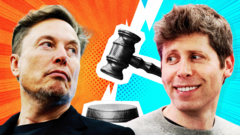
In a federal courtroom in Oakland this week, the utopian veneer of Silicon Valley was stripped away, replaced by the cold machinery of a jury trial. For years, the feud between Elon Musk and Sam Altman played out in cryptic tweets and leaked emails. Now, it has a case number. On April 27, 2026, jury selection began in Musk v. Altman, a legal collision that will determine who owns the narrative of the most transformative technology in human history.
The suit centers on a fundamental betrayal of trust. Musk, who provided the initial $44 million and the gravitational pull to launch OpenAI in 2015, alleges that Altman and President Greg Brockman executed a bait-and-switch. They promised a non-profit "digital intelligence" lab dedicated to benefiting humanity. Instead, Musk claims they built a $852 billion profit engine for themselves and Microsoft.
The Burning Man Defense
While the public focus remains on the "founding agreement," the defense strategy from Altman’s camp has taken an aggressive, personal turn. Court documents reveal a bizarre focus on Musk’s 2017 trip to Burning Man. Altman’s lawyers have gone as far as questioning Musk’s cognitive state during the festival, specifically asking about his use of "rhino ket"—a cocktail of amphetamines and ketamine.
Their goal is surgical: discredit Musk’s memory of the "founding agreement" entirely. If they can prove that Musk was either too distracted or too impaired during the critical months of 2017 when OpenAI’s structure was being debated, his claims of a verbal or implied contract crumble. Judge Yvonne Gonzalez Rogers has already ruled that while the drug use itself is "unduly prejudicial," a lapse in memory caused by it is fair game. This isn't just a business dispute; it is a character assassination designed to paint the world’s richest man as an unreliable witness to his own history.
The Pivot to Public Benefit
While the trial focuses on past promises, OpenAI has been busy moving the goalposts. In October 2025, the company officially restructured into a Public Benefit Corporation (PBC), a move intended to placate regulators and neutralize Musk’s "breach of charitable trust" claims.
Under the new structure:
- The OpenAI Foundation (the original non-profit) retains a 26% stake.
- Microsoft holds roughly 27%.
- External Investors and employees own the remainder.
This restructuring is the bedrock of Altman’s defense. By becoming a PBC, OpenAI argues it can pursue profit while legally maintaining a "commitment to society." But critics, including former employees who filed an amicus brief in 2025, argue this is a distinction without a difference. They describe Altman as a leader of "low integrity" who successfully converted a charity’s assets into a private wealth machine.
The Microsoft Shadow
The elephant in the Oakland courtroom is Microsoft CEO Satya Nadella, who is expected to testify. Musk’s legal team is positioning Microsoft not as a partner, but as a predator that swallowed OpenAI’s mission whole. They point to the "AGI Clause" in Microsoft’s contract—an agreement that expires once OpenAI achieves Artificial General Intelligence.
The definition of AGI has become the ultimate loophole. In May 2025, OpenAI updated its policy: rather than the board deciding when AGI is reached, an "independent expert panel" will now make the call. If that panel delays the declaration, Microsoft retains access to OpenAI’s most valuable intellectual property until at least 2030. Musk alleges this delay is intentional, designed to keep the "profit cap" in place while the technology is milked for every cent of commercial value.
Wealth Machine or Human Safeguard
OpenAI’s counter-offensive is simple: jealousy. Their filings describe Musk’s lawsuit as a "baseless and jealous bid to derail a competitor." They claim Musk only turned on the company after his 2018 attempt to merge OpenAI into Tesla was rejected.
The trial’s first phase will determine liability. If the jury finds Altman and Brockman liable for "unjust enrichment," the financial fallout could be staggering. Musk has recently amended his demands, stating that any damages awarded should be funneled back into OpenAI’s original charitable arm, not his own pocket. He is also seeking the removal of Altman from the board.
The timing is catastrophic for OpenAI. With a massive IPO expected later in 2026, a verdict against the leadership could freeze investor confidence. For Musk, however, the money is secondary to the "fate of civilization." He views a profit-driven AGI as a recipe for a digital dictatorship. Altman views Musk’s interference as an ego-driven attempt to slow down a race he is no longer winning.
This trial isn't about whether OpenAI changed—everyone knows it did. It is about whether that change was a necessary evolution for survival or a calculated heist of a public good.
Jury deliberations are expected to begin by mid-May.