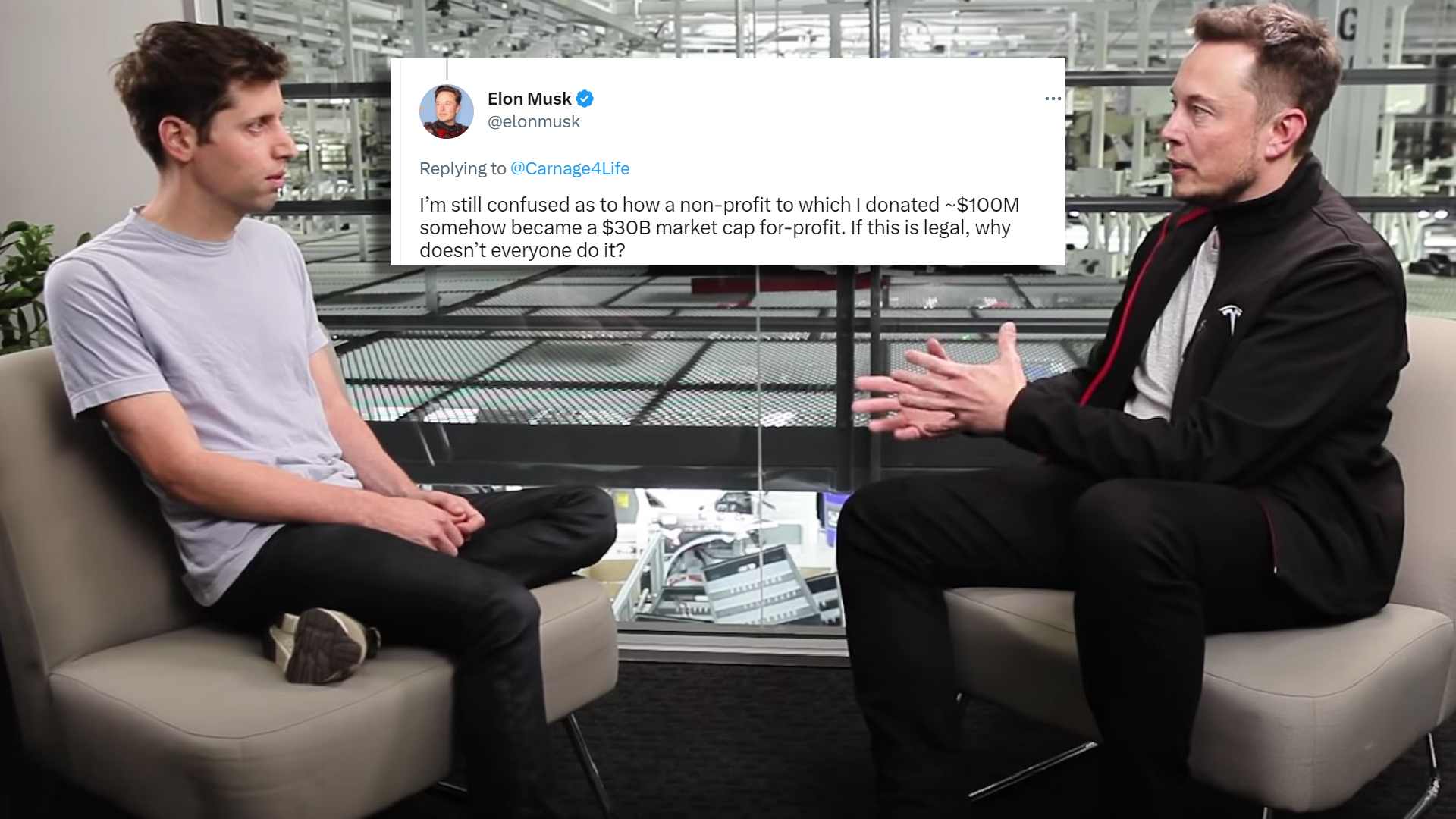
Elon Musk’s legal crusade against OpenAI isn't about saving humanity. It isn't even about a "stolen charity." It’s a multi-million dollar exercise in regret, orchestrated by a man who realized he missed the boat on the most significant architectural shift in computing history.
The media loves the "David vs. Goliath" narrative, except in this version, both sides are Goliaths, and David is just a confused bystander watching two giants fight over who gets to own the sun. When Musk’s lawyers claim Sam Altman "stole" a non-profit, they are counting on the public’s fundamental misunderstanding of how venture-backed research actually functions.
OpenAI didn't pivot to a capped-profit model because they were "greedy." They did it because the hardware requirements for Large Language Models (LLMs) scaled at a rate that would bankrupt any traditional 501(c)(3) in history.
The Myth of the Virgin Non-Profit
The core of the Musk complaint rests on the "founding agreement"—a document that, conveniently, nobody can actually find. Musk’s legal team wants you to believe that OpenAI was meant to be a permanent, open-source kibbutz where researchers would hand out weights and biases for free.
Here is the cold, hard reality: You cannot build a frontier AI model on bake-sale money.
Training GPT-4 cost upwards of $100 million. The next generation will likely cost billions in compute alone. If OpenAI had stayed a pure non-profit, it would have been a footnote in history by 2019. It would have been a high-end research lab producing interesting papers that Google and Meta would have eventually turned into products while OpenAI starved for GPUs.
Musk knows this. He’s currently raising billions for xAI, his own "pro-humanity" AI venture. Notice that xAI isn't a non-profit. It is a Delaware-incorporated, profit-seeking entity. The hypocrisy isn't just a side effect; it’s the strategy. By suing OpenAI, Musk is attempting to use the court system to hobble a competitor he helped create but failed to control.
The Compute Wall and the Death of "Open"
The term "Open" in OpenAI has become a weaponized Rorschach test. To the purists, it means everything must be open-sourced. To the pragmatic, it meant open access to the benefits.
The industry is hitting what I call the Compute Wall. We are moving into an era where $10 billion clusters are the entry price. When you operate at that scale, "open source" isn't just a philosophical choice; it’s a security and financial liability. If you spend $5 billion to train a model and then give the weights away for free, you haven't "saved" the world—you’ve just subsidized the R&D departments of every hostile nation and rival corporation on the planet.
Musk’s argument that OpenAI "betrayed" its mission ignores the fact that a dead non-profit can't fulfill any mission. The capped-profit structure was a legal mutation, yes, but it was a necessary one. It allowed them to attract the capital needed to stay in the race. Without that capital, we’d be living in a world where AI is a closed-door monopoly held exclusively by Google’s DeepMind.
The "Stolen Charity" Rhetoric is Financial Illiteracy
To say a charity was "stolen" implies that the original donors were defrauded. Musk was a donor. He gave roughly $44 million. In the world of high-stakes tech, $44 million is a rounding error. It’s what Meta spends on Mark Zuckerberg’s security detail in a year.
Musk wasn't "defrauded." He was outmaneuvered. He tried to take over OpenAI in 2018, failed, and left in a huff. Now that the entity he abandoned is valued at $80 billion or more, he wants a refund—or at least a way to burn the building down so nobody else can have it.
The legal system isn't designed to adjudicate "founder’s remorse." If every donor to a non-profit could sue because that non-profit evolved to survive a changing market, the entire non-profit sector would collapse under the weight of litigation from disgruntled billionaires.
Why the Trial is a Distraction
While the lawyers argue over emails from 2015, the real story is the centralization of power. But the centralization isn't happening because Sam Altman is a comic-book villain. It’s happening because of the physics of AI.
Modern AI requires:
- Massive Data: Scraped from the entire internet.
- Massive Compute: Thousands of $H100$ or $B200$ GPUs.
- Massive Talent: Researchers who command seven-figure salaries.
A non-profit cannot sustain this. The trial is focusing on the "spirit" of the founding, while the "body" of the technology has moved into a different dimension.
Even if Musk wins—which is a long shot—what happens? Does the court force OpenAI to open-source its models? That would be a gift to every competitor and a potential catastrophe for safety. Does the court revert OpenAI to a non-profit? Microsoft would pull its servers, the engineers would jump ship to xAI or Anthropic, and the company would evaporate in 48 hours.
The Bitter Truth for AI Purists
I've seen boards of directors blow millions trying to maintain "purity" while their competitors eat their lunch. Purity doesn't scale.
If you want to be a contrarian, stop looking at the "betrayal" of OpenAI's mission and start looking at the inevitability of its path. Any group that achieved what OpenAI achieved would have been forced to make the same deal with the devil. If they hadn't, they wouldn't be the ones currently being sued by Elon Musk; they’d be the ones no one remembers.
The trial isn't about ethics. It’s a patent and power dispute dressed in the robes of "charitable intent." It’s an attempt to use a 2015 mindset to regulate a 2026 reality.
Musk isn't the hero of this story. He’s the guy who sold his Bitcoin at $10 and is now suing the exchange because the price hit $60,000. It’s not about the "mission." It’s about the FOMO.
Don't fall for the "charity" narrative. In the tech industry, "non-profit" is often just a placeholder name for "pre-revenue." OpenAI just happened to have the most successful pivot in human history.
Stop asking if OpenAI broke its promise and start asking why anyone was naive enough to think a non-profit could build a god in a box without a credit card.