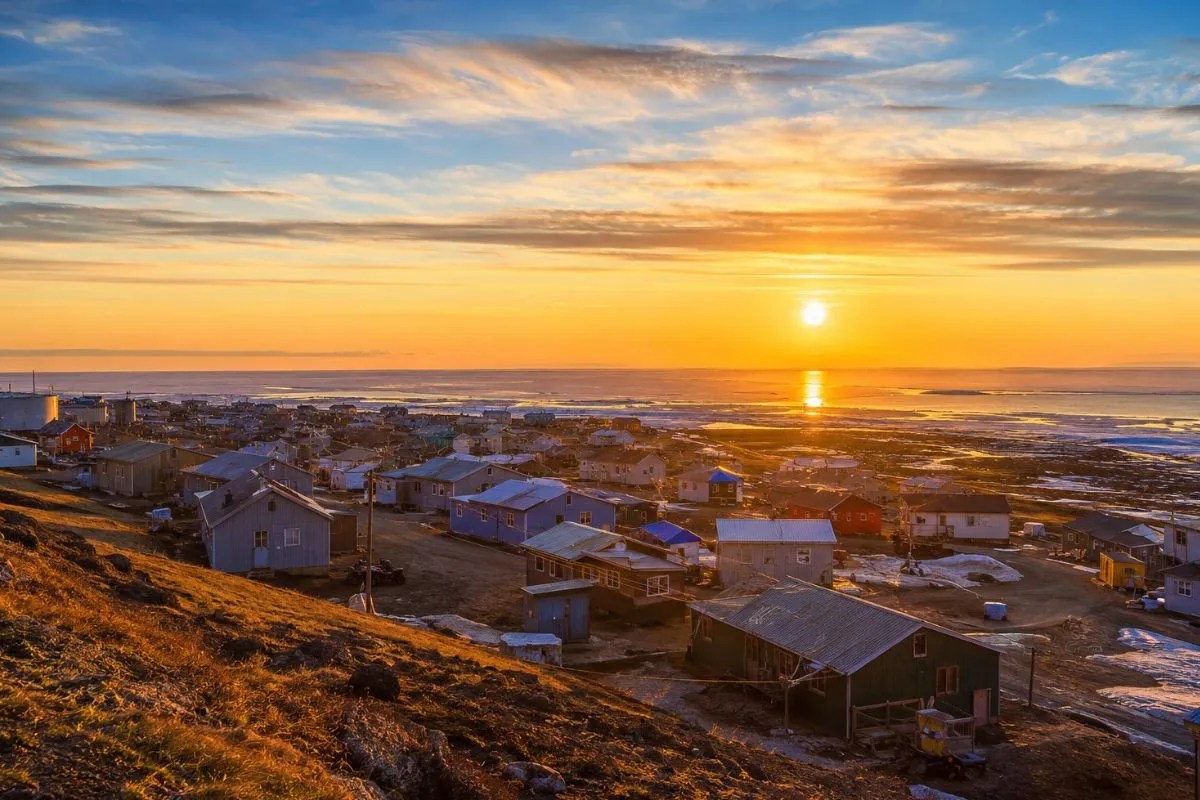
The town of Utqiaġvik, Alaska, operates as a closed-loop socioeconomic experiment defined by extreme axial tilt. From mid-May to early August, the sun stays above the horizon for approximately 2,028 consecutive hours. This is not merely a seasonal curiosity; it is a profound disruption of the circadian rhythms that govern human biological and economic productivity. To understand life in the northernmost point of the United States, one must look past the "midnight sun" aesthetic and analyze the logistical friction, psychological toll, and infrastructure adaptations required to maintain a functioning society in a region where the standard 24-hour day ceases to exist.
The Geometry of Perpetual Irradiance
The phenomenon of the midnight sun is a direct result of the Earth’s 23.5° axial tilt. As the planet orbits the sun, the North Pole tilts toward the star during the summer solstice, placing any latitude above the Arctic Circle ($66^{\circ}33'N$) within a zone of constant solar exposure. Utqiaġvik, situated at $71.3^{\circ}N$, sits well within this boundary.
Unlike lower latitudes where the sun's path is a steep arc, the solar trajectory in the High Arctic during summer is a shallow circle. The sun descends toward the horizon but fails to cross it, reaching its lowest point (solar nadir) in the north rather than setting. This creates a continuous input of solar radiation. While the intensity of this light is lower than at the equator due to the angle of incidence, the cumulative duration triggers significant environmental shifts:
- Thermodynamic Lag: Continuous sunlight prevents the traditional nighttime cooling cycle. However, the proximity to the Arctic Ocean acts as a thermal heat sink, keeping temperatures moderated despite the constant light.
- Atmospheric Refraction: Even as the sun nears the horizon, the atmosphere bends light rays, making the sun appear higher than its geometric position and extending the perceived duration of the "day."
Circadian Dysregulation and the Biology of Sleep
Human physiology is anchored to the suprachiasmatic nucleus (SCN), a tiny region in the hypothalamus that regulates the production of melatonin based on light cues. In a standard environment, the absence of blue light at night signals the SCN to initiate the sleep cycle. In Utqiaġvik, this signal is perpetually suppressed for 84 days.
The result is a phenomenon often referred to as "Arctic Hysteria" or, more clinically, Circadian Rhythm Sleep-Wake Disorder. Without the environmental anchor of darkness, the body’s internal clock tends to drift. This creates a bifurcation in the population’s response:
- Hyper-Productivity Cycles: Many residents report a surge in energy during the initial weeks of the sun’s return. The constant presence of Vitamin D-inducing light creates a manic-like state where the community engages in construction, hunting, and maintenance at all hours.
- Cumulative Cognitive Deficit: The lack of deep, REM-conducive sleep eventually leads to a "brain fog" that persists throughout the summer. The inability to reach total darkness without artificial intervention (blackout curtains, eye masks) results in chronic low-level sleep deprivation.
Economic productivity in these regions does not follow a 9-to-5 arc. Instead, it becomes fluid. It is common to see children playing or residents performing vehicle maintenance at 2:00 AM, as the concept of "late" loses its temporal meaning.
Infrastructure and the Logistics of Isolation
Utqiaġvik is not connected to the North American road system. Every liter of fuel, every gram of medication, and every piece of heavy machinery must be flown in or brought via a brief summer sea-lift. The 84 days of daylight coincide with the most critical logistical window of the year.
The Maritime Window
The disappearance of sea ice is the primary catalyst for the town's survival. When the ice recedes, barges arrive to restock the town’s bulk supplies. This operation is time-sensitive and high-risk. The continuous daylight is a strategic advantage here, allowing for 24-hour unloading operations, which minimizes the time vessels spend in unpredictable Arctic waters.
Permafrost Maintenance
The thermal stability of the ground is the most significant engineering challenge. Most structures are built on pilings to prevent the heat from the building from melting the permafrost below. Constant solar radiation in the summer puts additional stress on these foundations. Engineers must utilize "thermosyphons"—heat pipes that passively remove heat from the ground—to ensure the structural integrity of the town's buildings.
Energy Consumption Trade-offs
While solar energy seems like an obvious solution for a town with 2,000+ hours of sun, the efficiency is hampered by several variables:
- Low Sun Angle: Solar panels must be mounted at near-vertical angles to capture the low-hanging sun.
- Albedo Effect: In the early summer, snow cover reflects light, which can actually increase solar panel output if they are bifacial (capturing light from both sides).
- Grid Limitations: The town relies heavily on natural gas from local fields. Integrating intermittent solar into a micro-grid requires sophisticated battery storage that can withstand extreme temperature fluctuations.
Socioeconomic Frameworks of the North Slope
The economy of Utqiaġvik is a hybrid of modern capitalism and ancient subsistence. The Iñupiat people have inhabited this region for millennia, and their social structures are optimized for these solar extremes.
The Subsistence Multiplier
During the period of endless light, the pursuit of traditional food sources (bowhead whales, seals, caribou) reaches its peak. This is not a hobby; it is a critical economic necessity. The cost of imported groceries in the Arctic is often 300% higher than in the contiguous United States. A gallon of milk or a crate of fresh produce carries a massive logistics premium. Subsistence hunting provides high-protein, nutrient-dense food that buffers the community against supply chain disruptions.
The endless daylight allows hunters to track animals across vast distances without the danger of being caught in the dark. This creates a "seasonal work-load" where the labor performed in these 84 days must provide a caloric surplus sufficient to last through the 67 days of total polar night that occur in winter.
The Psychological Architecture of "The Long Day"
To survive the psychological pressure of 84 days of light, the community employs specific behavioral frameworks. Isolation is the baseline; the sun is the variable.
- Artificial Temporal Anchoring: Successful residents maintain strict schedules regardless of the light outside. They simulate "night" by blacking out windows and adhering to rigid clock-time. This prevents the "free-running" rhythm where a person’s sleep cycle migrates later and later each day.
- Community Cohesion: The summer months are characterized by high-density social interaction. The Nalukataq (spring whaling festival) serves as a vital social release valve, reinforcing tribal bonds and distributing resources before the leaner winter months.
The psychological danger is not the light itself, but the loss of boundaries. In a standard environment, the sunset acts as a natural "stop" sign for labor and social obligation. In the High Arctic, that boundary is removed, leading to a breakdown of the work-life balance that can manifest as burnout or increased domestic tension.
Strategic Realities of Arctic Governance
As the Arctic ice sheet continues to thin, Utqiaġvik’s position becomes more strategically significant. The town sits at the crossroads of emerging trans-polar shipping routes. The 84 days of daylight are becoming a period of increased geopolitical activity, with research vessels, military aircraft, and commercial prospectors utilizing the town as a northern hub.
The primary bottleneck for growth is not the climate, but the cost of infrastructure. Every project—whether a new school or a telecommunications tower—must account for the "Arctic Premium." This includes specialized materials that don't shatter in -40°C and the logistics of transporting them during the brief summer thaw.
Investment in this region must be viewed through a long-term lens. Short-term profit motives are frequently crushed by the sheer volatility of the environment. Instead, success in the High Arctic is defined by "resilience engineering": building systems that are modular, repairable with local tools, and capable of operating autonomously when the rest of the world is cut off by weather.
The Final Operational Shift
Living through 84 days of light requires a fundamental retooling of the human experience. It is a shift from a "diurnal" existence to a "persistent" one. For those managing operations in the Far North, the strategy is clear:
- Engineer for Light Management: Treat darkness as a scarce resource that must be artificially manufactured to preserve human capital.
- Optimize the Logistical Window: Front-load all physical infrastructure work and supply chain intake into the first 45 days of the solar cycle to hedge against early autumn storms.
- Respect the Subsistence Cycle: Acknowledge that traditional hunting practices are the most efficient form of resource management in the region and integrate them into any modern economic planning.
The 84 days of sun are not a vacation from reality; they are a high-intensity period of preparation. The sun is a tool, a stressor, and a deadline all at once. Failure to capitalize on the light leads to a catastrophic winter; over-exerting during the light leads to psychological collapse. The balance is narrow, and the stakes are survival.