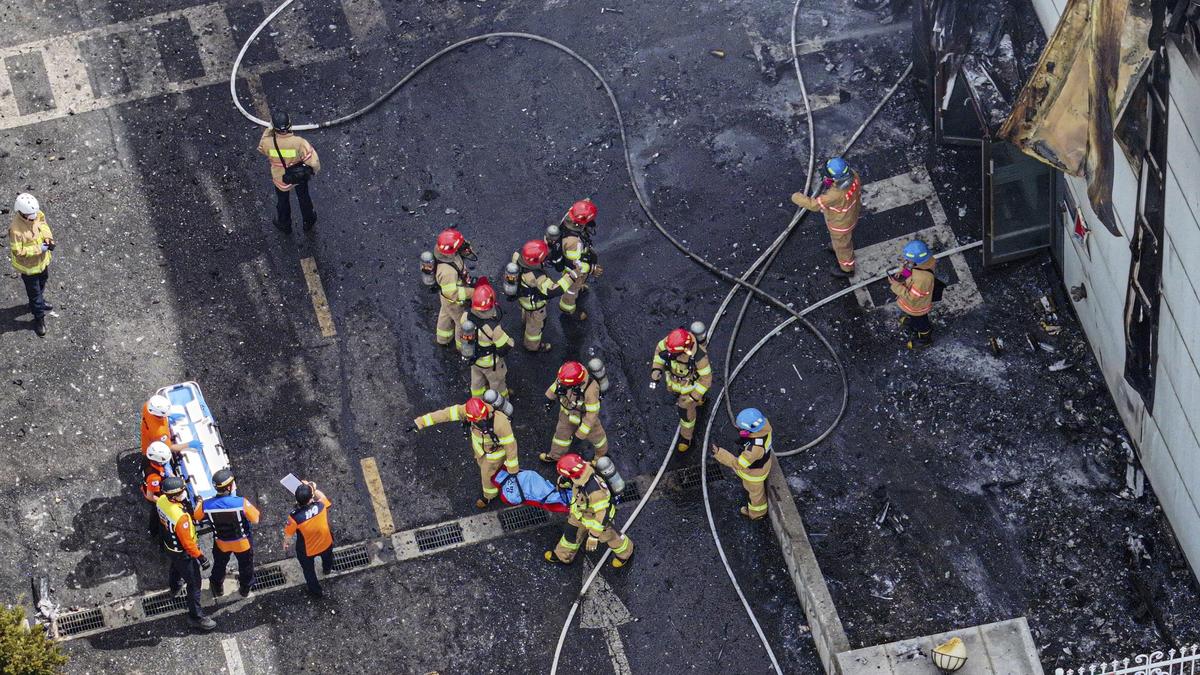
The reduction of the prison sentence for Park Soon-kwan, CEO of Aricell, following a fire that claimed 23 lives, exposes a critical misalignment between South Korean workplace safety legislation and corporate liability structures. When a high-court appeals process reduces a sentence—in this instance, from 15 years to 9 years—it signals a judicial shift from punitive deterrence to a recognition of "reparative actions." However, from a structural risk management perspective, this mitigation fails to address the underlying failure in lithium-ion thermal runaway protocols and the systemic reliance on an untrained, outsourced labor force.
The Aricell disaster was not a statistical anomaly but a predictable outcome of a failure in three specific operational domains: chemical volatility management, egress architecture, and labor compliance.
The Triad of Failure in Lithium Battery Production
The disaster at the Hwaseong plant can be deconstructed through a hierarchy of failures. The primary catalyst was the thermal runaway of lithium batteries, but the scale of the fatality count was dictated by human-centric systems.
1. The Chemistry of Thermal Runaway
Lithium batteries utilize a volatile electrolyte. When a cell short-circuits or overheats, it triggers a self-sustaining exothermic reaction.
$$\text{Heat Generation} > \text{Heat Dissipation}$$
This imbalance leads to a rapid pressure buildup within the cell casing, resulting in the venting of toxic gases and explosive ignition. In the Aricell facility, the storage of finished products in proximity to active production lines created a high fuel-load environment. The lack of fire-rated partitioning meant that a single cell failure escalated into a facility-wide conflagration within seconds.
2. Architecture of Egress and Containment
The high death toll—predominantly involving Chinese migrant workers—is directly attributable to the physical layout of the second floor. Reports indicate that the exit paths were either obstructed or poorly marked, violating basic fire safety codes. In a high-risk chemical environment, the "Time to Exit" must be less than the "Time to Critical Atmospheric Toxicity." Aricell’s failure to maintain clear egress routes meant that employees were trapped in a blind alley as the room filled with hydrofluoric acid fumes and smoke.
3. Labor Stratification and Risk Transfer
Aricell utilized a labor supply agency to provide workers. This creates a "Risk Transfer Gap" where the primary employer avoids the direct cost of safety training by classifying workers as external contractors. These individuals often receive minimal orientation regarding emergency shut-off procedures or specific evacuation routes for the facility they are working in. The judicial system's decision to reduce Park’s sentence partially rested on the company’s efforts to compensate families, yet this financial restitution does not rectify the operational decision to employ a vulnerable, untrained workforce in a high-hazard zone.
The Economic Logic of Judicial Mitigation
The appellate court’s decision to cut Park Soon-kwan’s sentence reflects a specific interpretation of the Serious Accidents Punishment Act (SAPA). SAPA was designed to hold top executives personally liable for workplace fatalities, yet the legal application often hinges on "post-event remediation" rather than "pre-event prevention."
The Reparations Discount
The court cited the fact that Aricell reached settlement agreements with the majority of the victims' families. From a legal strategy standpoint, this creates a "Reparations Discount" where liquid capital is used to offset criminal liability. While this provides immediate financial relief to survivors, it creates a moral hazard:
- Companies may prioritize a "litigation fund" over "safety infrastructure."
- The cost of a settlement becomes a predictable line item in a risk-benefit analysis.
- The deterrent effect of SAPA is diluted if the sentence is negotiable based on the checkbook of the defendant.
The Problem of Managerial Intent
The court likely struggled with proving "willful negligence" versus "systemic incompetence." Under South Korean law, for a maximum sentence to hold, the prosecution must demonstrate that the CEO was aware of specific, immediate risks and chose to ignore them for profit. While the prosecution argued that Aricell rushed production to meet deadlines, the defense successfully argued that the fire was an unprecedented industrial accident. This distinction is the primary lever used to reduce prison terms in the South Korean appellate system.
Quantifying the Safety Gap in Battery Manufacturing
The lithium-ion industry is currently scaling faster than its safety regulations. To understand why Aricell failed, one must look at the Safety Margin Deficit.
In high-precision electronics, the margin for error is measured in parts per million. However, in the physical manufacturing environment, the safety margin is often eroded by:
- Storage Density: Maximizing floor space leads to "over-stacking" of volatile components.
- Detection Latency: Standard smoke detectors are insufficient for lithium fires. Specialized IR-based heat sensors are required to detect a thermal event before visible smoke appears.
- Suppression Inadequacy: Traditional water sprinklers can actually worsen certain types of lithium-based chemical fires or be entirely ineffective against a thermal runaway chain reaction.
Aricell’s reliance on standard industrial fire protocols for a specialized chemical risk was a fundamental engineering oversight.
Structural Implications for the Global Supply Chain
South Korea is a linchpin in the global EV and energy storage system (ESS) supply chain. The Aricell ruling sends a ripple through the industry regarding how "Tier 2" and "Tier 3" suppliers are managed.
The Transparency Bottleneck
Major OEMs (Original Equipment Manufacturers) often audit their Tier 1 suppliers for ESG (Environmental, Social, and Governance) compliance. However, the oversight diminishes as you move down the chain. Aricell, as a smaller player, operated with a level of opacity that allowed for the bypass of rigorous safety standards. If the legal system allows for reduced sentences through financial settlement, there is less pressure on global OEMs to enforce strict safety audits on their sub-contractors.
The Migrant Labor Vulnerability
The heavy reliance on E-9 and H-2 visa holders in South Korea’s manufacturing sector creates a language and cultural barrier that compromises safety. Safety instructions, warning signs, and emergency drills are frequently conducted in Korean, leaving non-native speakers at a disadvantage during a crisis. The Aricell fire highlights that labor safety is not just an ethical concern but a core operational risk that can lead to total facility loss and executive imprisonment.
Strategic Framework for Industrial Risk Mitigation
For executives in the battery and chemical sectors, the Aricell case serves as a blueprint for what to avoid. Relying on judicial leniency is a failing strategy. Instead, firms must adopt a Defensive Operational Architecture.
Redundant Containment Zones
Facilities must be designed with "sacrifice zones." If a thermal event occurs in one sector, fire-rated automated shutters must isolate that zone within 30 seconds to prevent a facility-wide flashover. This limits the "Fuel-Load Connectivity" that destroyed the Aricell plant.
Integration of Real-Time Labor Tracking
In an evacuation, the greatest delay is accounting for personnel. High-risk facilities should utilize RFID-tagged badges for all workers, including temporary contractors. This allows emergency responders to pinpoint the exact location of trapped individuals, bypassing the confusion that occurs when manual roll calls fail.
Direct Executive Accountability Loops
Under SAPA, the CEO cannot delegate safety to a mid-level manager and claim ignorance. A "Safety Dashboard" must be a permanent fixture of board-level reporting, tracking variables such as:
- Temperature variances in storage zones.
- The ratio of trained vs. untrained labor on the floor.
- Results of unannounced egress drills.
The reduction of Park Soon-kwan’s sentence may be seen as a legal victory for the defense, but it is a strategic warning for the industry. The financial cost of the Aricell settlements, combined with the total loss of the facility and the multi-year prison term, represents a "Total Risk Realization" that outweighs any short-term profit gained from cutting corners on safety.
The shift in the global regulatory environment is moving toward "Strict Liability." Companies must assume that any future disaster will be met with even harsher judicial scrutiny, regardless of post-facto reparations. The only viable path forward is the hard-coding of safety into the engineering phase of the factory, rather than treating it as a compliance layer added after the fact.
The immediate strategic move for battery manufacturers is to conduct a "Dark Audit"—a safety review performed by an outside firm with the explicit goal of finding ways to trigger a facility-wide failure. Only by identifying these catastrophic trigger points can a CEO truly insulate themselves from both criminal liability and operational ruin.