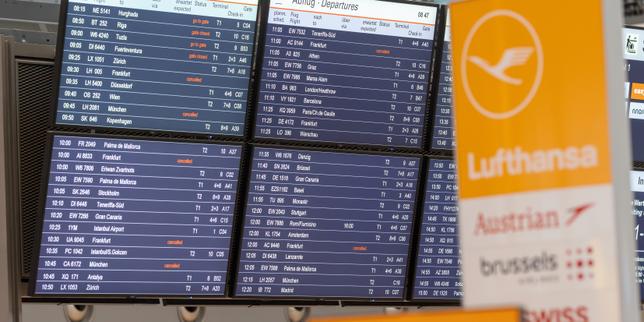
The cancellation of 90% of Lufthansa’s flight schedule across Germany is not merely a labor dispute; it is a systemic failure of high-utilization logistics when confronted with a rigid labor market. This 2024 ground strike by ground staff represents a total breakdown in the service-delivery chain, exposing a critical vulnerability in the hub-and-spoke model. When ground handling services—ranging from maintenance and pushback to baggage loading—cease operations, the airline loses its ability to monetize its most expensive assets: its fleet and its landing slots. The resulting 100,000 affected passengers per day represent more than just lost revenue; they represent a massive accumulation of contingent liabilities for the carrier under EU regulation 261/2004.
The Economic Mechanics of Ground Handling Attrition
The strike by the Verdi union targets the most labor-intensive segment of the aviation value chain. Unlike cockpit or cabin crew, ground staff provide the industrial foundation that allows an aircraft to transition from an idle asset to a revenue-generating vehicle. This specific disruption highlights three distinct economic pressures:
- The Fixed-Cost Trap: Aviation is a business defined by high fixed costs (aircraft leases, debt service, airport fees) and razor-thin margins. While variable costs like fuel are avoided during a strike, the fixed costs remain constant. A 90% cancellation rate means the airline is hemorrhaging cash to maintain an idle infrastructure.
- The Re-Accommodation Cost Curve: Re-booking 100,000 passengers during a peak travel period is an exponential challenge. Because load factors on remaining flights are typically high, there is no "slack" in the system to absorb displaced travelers. This forces the airline to pay for competitors' seats or provide hotel vouchers, turning a missed flight into a direct cash payout to the customer.
- The Yield Management Collapse: Strikes destroy the predictive power of yield management algorithms. The sudden removal of supply creates a vacuum in the market, often driving prices for alternative transport (rail or rival airlines) to extremes, further damaging the brand’s price-value perception.
Structural Vulnerabilities in the Hub-and-Spoke Model
Lufthansa’s reliance on Frankfurt and Munich as central nodes creates a single point of failure. In a point-to-point model, a strike at one station might isolate a specific route. In a hub-and-spoke system, striking at the hub effectively decapitates the entire network.
The disruption propagates through the system via "tail-swapping" and crew duty limitations. When a plane is grounded in Frankfurt, the crew scheduled to fly it to New York also becomes displaced. This creates a "network rot" where the effects of the strike persist for 48 to 72 hours after the labor action officially ends. The time required to reposition aircraft and crews to their correct starting locations—known as the recovery phase—is often as costly as the strike itself.
Inflationary Pressure and Labor Arbitrage
The union’s demand for a 12.5% pay increase over 12 months, alongside a "cost-of-living bonus," reflects a fundamental shift in the German labor landscape. For decades, German industrial relations were defined by "Mitbestimmung" (co-determination) and restraint. However, the post-2022 inflationary environment has broken this social contract.
Ground staff positions, which involve grueling physical labor and unsocial hours, have become increasingly difficult to fill. The "scarcity premium" for these roles has risen. Lufthansa is essentially fighting a two-front war: trying to maintain a competitive cost structure against low-cost carriers like Ryanair, while competing for labor against a domestic German market where logistics and warehousing firms offer similar pay for less regulated work environments.
The bottleneck is not the number of planes, but the number of qualified personnel to service them. This labor shortage grants unions unprecedented leverage. When the cost of a strike day exceeds €30 million, the math for the union is simple: the pain they can inflict in 24 hours is a significant percentage of the annual cost of the wage increase they are seeking.
The Operational Risk of Maintenance and Safety Rescheduling
A strike of this magnitude introduces significant technical risk. Aircraft maintenance schedules are calculated in flight hours and cycles. When 90% of the fleet is grounded, the maintenance "buffer" is consumed.
- Cycle Stacking: When the fleet returns to service simultaneously, a massive volume of aircraft will hit their minor maintenance checks at the same time in the future. This creates a predictable bottleneck in the hangars three to six months down the line.
- Safety Documentation: Every grounded aircraft requires specific "storage" procedures if the grounding lasts beyond a certain window (e.g., covering pitot tubes, cycling engines). If the ground staff responsible for these tasks are the ones on strike, the airline must utilize a skeleton crew of management-level engineers, which is a slow and inefficient process.
Strategic Divergence: Lufthansa vs. Low-Cost Carriers
The strike highlights the different risk profiles between "legacy" carriers and "low-cost" entities. Lufthansa’s complexity is its greatest weakness in labor negotiations.
| Metric | Legacy Carrier (Lufthansa) | Low-Cost Carrier (Ryanair/Wizz) |
|---|---|---|
| Labor Structure | Highly unionized, multi-layered | Fragmented, often outsourced |
| Network Interdependence | High (Hub reliance) | Low (Point-to-point) |
| Customer Compensation | High (Business class/Long-haul) | Low (Short-haul focus) |
| Recovery Speed | Slow (Complex crew rotations) | Fast (Simple fleet commonality) |
Lufthansa’s premium positioning makes these strikes more damaging. A business traveler who pays €3,000 for a long-haul flight has a significantly lower tolerance for disruption than a budget traveler paying €50. Frequent strikes erode the "reliability premium" that allows Lufthansa to charge higher fares than its competitors.
Quantitative Impact on the 2024 Fiscal Year
The immediate financial hit is visible in the quarterly earnings, but the "hidden" costs are more insidious.
- Opportunity Cost of Capital: While planes are idle, the interest on the debt used to purchase them continues to accrue.
- Customer Churn: Corporate travel departments utilize "reliability scores" when selecting preferred carriers. Consecutive strikes in the German market lower Lufthansa’s score, potentially shifting multi-million euro contracts to Air France-KLM or IAG.
- Regulatory Scrutiny: Frequent mass cancellations often lead to increased pressure from the Luftfahrt-Bundesamt (LBA) or European regulators to increase the transparency of passenger rights, which further increases the administrative cost of doing business.
The Logistics of the Recovery Phase
The moment the strike ends at 7:10 AM, the airline enters a state of "controlled chaos." The logic of the restart is dictated by the "first-wave" departures. If the early morning long-haul flights cannot depart because the ground crews are just clocking in and haven't fueled the planes, the entire day's schedule remains shifted.
The primary constraint during recovery is often not the planes, but the "Duty Period" of the crews. If a pilot spends four hours waiting for a plane to be de-iced or loaded because of a strike-related backlog, they may "time out" and become legally unable to fly the actual mission. This creates a secondary wave of cancellations that are often blamed on "operational reasons" but are direct downstream effects of the labor action.
Tactical Response and Long-term Mitigation
To stabilize the network, Lufthansa must move beyond reactive crisis management. The current strategy of "thinning the schedule" to protect a core 10% of flights is a survival tactic, not a solution.
The move toward automation in ground services—automated baggage loading, self-service kiosks, and autonomous pushback vehicles—is the only logical path to reducing the union’s leverage. However, this requires massive capital expenditure and is often met with further labor resistance.
The airline must also consider "wet-leasing" capacity during strike windows. By hiring third-party airlines to operate flights under the Lufthansa brand, they can bypass the domestic labor dispute, although this is often restricted by existing labor contracts.
Ultimately, the goal is to shift from a "fragile" network to an "anti-fragile" one. This involves diversifying hubs (potentially utilizing Swiss or Austrian bases more aggressively during German strikes) and restructuring ground handling contracts to include "service level agreements" that penalize the ground handling subsidiaries for labor-related downtime.
The current 90% cancellation rate is a signal that the cost of labor peace is now lower than the cost of continued disruption. Lufthansa will likely settle for a figure close to the union's demand, but will compensate by accelerating the retirement of older, labor-intensive aircraft and increasing the use of AI-driven customer service to handle the inevitable future disruptions. The era of cheap, reliable German aviation is effectively over; it has been replaced by a period of high-cost volatility where the passenger pays the premium for the airline's internal instability.