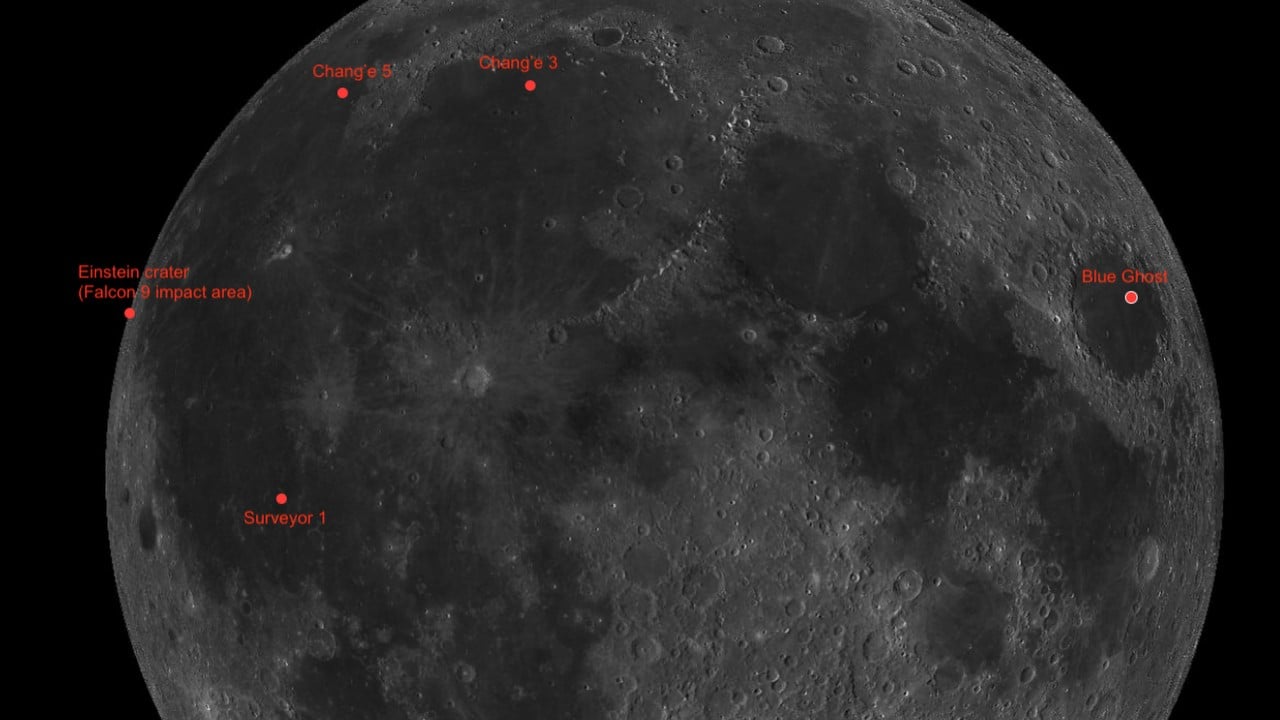
The intersection of uncontrolled orbital decay and lunar exploration assets is not a matter of "if" but a statistical function of "where and when." When a spent rocket stage—specifically a multi-ton upper stage—is projected to impact the lunar surface, the immediate concern is the preservation of high-value hardware like the Chang’e landers. Assessing the actual risk requires moving beyond speculative "expert" quotes and into the physics of ballistic trajectories, the geometry of the lunar surface, and the mechanics of secondary ejecta.
The risk profile of a lunar impact event is governed by three primary variables: the precision of the impact coordinates (The Target Error Ellipse), the velocity and angle of the striking body (The Kinetic Energy Constant), and the distance from existing infrastructure (The Proximity Buffer).
The Geometry of Impact Probability
Lunar impacts are not point-events; they are probability distributions. When a rocket stage enters a chaotic Earth-Moon transfer orbit, its eventual impact site is defined by an error ellipse that can span hundreds of kilometers. This uncertainty stems from solar radiation pressure, outgassing from residual fuel, and the "lumpy" gravity field of the Moon, known as mascons (mass concentrations).
The probability of a direct hit on a specific lander, such as Chang’e 4 or Chang’e 5, is statistically negligible. The Moon’s surface area is approximately 38 million square kilometers. A rocket stage with a cross-section of roughly 10 to 20 square meters striking a lander of similar size involves a geometric probability so low it approaches zero. However, the "unlikely" label used by generalist media ignores the real threat: Secondary Ejecta and Regolith Displacement.
The kinetic energy ($KE$) of a falling rocket stage is calculated by the standard formula:
$$KE = \frac{1}{2}mv^2$$
Given that a spent Falcon 9 or Long March upper stage weighs several metric tons and impacts at velocities exceeding 2.5 kilometers per second, the energy release is equivalent to several tons of TNT. This energy does not vanish; it transforms into a crater and a high-velocity debris curtain.
The Physics of the Debris Curtain
On Earth, atmospheric drag decelerates ejected material. On the Moon, in a vacuum with 1/6th Earth's gravity, there is no such braking mechanism. When the rocket stage strikes the regolith, it creates a "primary" crater. The force of this impact launches shards of rock and fine-grained glass (regolith) into ballistic trajectories that can travel kilometers from the impact site.
The threat to the Chang’e landers is categorized into two risk tiers:
- Line-of-Sight Impingement: High-velocity particles striking delicate solar panels or optical sensors. Even a sub-millimeter grain of lunar dust traveling at several hundred meters per second can "sandblast" a lens or puncture a pressurized vessel.
- Electrostatic Levitation: The impact creates a localized plasma cloud. On the Moon, dust particles are already prone to electrostatic charging due to solar wind. An impact-induced dust plume could settle on the Chang’e assets, compromising thermal management systems by altering the emissivity of the lander’s surfaces.
The Cost Function of Orbital Negligence
The current incident highlights a systemic failure in the "End of Life" (EOL) protocols for deep-space missions. While Low Earth Orbit (LEO) has established guidelines for de-orbiting to prevent debris accumulation, the Cis-lunar environment—the space between Earth and the Moon—remains a "Wild West."
The cost of a collision is not merely the replacement value of the hardware (billions of dollars in the case of the Chang’e program) but the loss of irreplaceable scientific data and the potential contamination of "Cold Traps" in permanently shadowed regions. If a rocket stage containing residual hydrazine or other hypergolic propellants impacts near a lunar pole, it could contaminate the very water ice that future missions intend to sample.
Structural bottlenecks in tracking deep-space debris aggravate this risk. Most Space Situational Awareness (SSA) systems are optimized for LEO and Geostationary (GEO) orbits. Once an object enters a High Earth Orbit (HEO) or a Lunar Transfer Traivity (LTO), tracking becomes intermittent. We are essentially flying blind until the object nears its terminal descent.
Deconstructing the "Experts Say" Fallacy
The narrative that the Chang’e landers are "safe" relies on the assumption that the impact site will be on the far side of the lunar limb or at a significant distance from the Procellarum region. This logic holds only if the trajectory is stable. The second-order effect of N-body gravitational math (the interaction between Earth, Moon, and Sun) means that even minor perturbations can shift an impact point by 500 kilometers over the course of a few weeks.
Analysis of the BepiColombo or DSCOVR-related debris shows that these objects undergo "orbital wandering." A strategy consultant would view this as a high-impact, low-probability risk. In risk management, these are the most dangerous scenarios because they encourage complacency. The lack of a centralized, international "Lunar Traffic Control" means that the Chinese National Space Administration (CNSA) must rely on their own deep-space tracking networks to calculate the "Red Threshold"—the moment when the lander’s systems should be put into a protective "Safe Mode."
Operational Constraints for the Chang’e Program
To mitigate the effects of a nearby impact, the CNSA has limited but specific operational levers:
- Sensor Stowing: Retracting or covering optical apertures to prevent dust impingement.
- Thermal Shuttering: Closing louvers to prevent regolith from entering thermal control loops.
- Orientation Adjustment: Rotating the lander (if mobile, like the Yutu rovers) so that the reinforced structural side faces the predicted impact azimuth.
The primary constraint is that these landers were not designed for "impact survivability" from external ballistic events. They were designed for the vacuum and the cold. The introduction of man-made debris into the lunar environment adds a variable that was not in the original mission requirements.
The Strategic Play for Lunar Sovereignty and Safety
The looming crash serves as a catalyst for a new regulatory framework. The current data-driven reality is that the Moon is no longer a pristine environment. As lunar traffic increases with the Artemis Accords and the International Lunar Research Station (ILRS), the frequency of these "uncontrolled impacts" will scale linearly with the number of launches.
The immediate strategic requirement is the establishment of Cis-lunar Space Situational Awareness. This involves:
- Dedicated Deep-Space Radars: Moving beyond repurposed Earth-centric sensors to monitor the volume of space between 300,000 and 400,000 kilometers.
- Mandatory Disposal Maneuvers: Requiring that all lunar-bound upper stages be equipped with enough propellant for a "targeted" impact in a "Lunar Graveyard Zone"—a designated area far from scientific assets—or a heliocentric escape trajectory.
- Active Debris Removal (ADR) for LTO: While technically challenging, the cost of losing a $2 billion lander justifies the development of "tug" satellites designed to intercept and redirect spent stages before they reach the lunar gravity well.
The risk to the Chang’e landers from this specific event is low, but the risk to the integrity of lunar operations is at an all-time high. The move from "unlikely to hit" to "guaranteed to impact" necessitates a shift from passive observation to active orbital management.
Future mission planners must now include "Impact Proximity Analysis" as a standard part of the mission lifecycle, treating spent rocket stages not as ghosts, but as kinetic threats that require active mitigation through the entire flight envelope. The era of treating the Moon as a celestial backstop for spent hardware must end to ensure the longevity of multi-decade lunar exploration programs.